Vanaheimr: The Homeland of the Vanir
We first catch sight of Vanaheimr through a question about a god who has made his home somewhere else.
In Vafþrúðnismál, Óðinn asks the wise jötunn Vafþrúðnir where Njörðr came from. Njörðr holds an honoured place among the gods, yet he wasn’t originally one of the Æsir. Vafþrúðnir answers that he came from Vanaheimr, where wise powers brought him into being, and that he was later given to the gods as a hostage. At the end of the world, we are told, he will return home to the Vanir.
It is only a brief glimpse, but it tells us something important. Njörðr has a homeland and a people, and neither is erased by the long years he spends among the Æsir. What the poem doesn’t give us is a tour of Vanaheimr itself. We aren’t told what its settlements look like, what grows there or what someone would see upon arriving.
Vanaheimr enters the surviving mythology mainly through those who came from it, especially Njörðr, Freyr and Freyja.
The homeland of the Vanir
The name Vanaheimr simply means the home or world of the Vanir, but defining the Vanir themselves isn’t quite so simple.
Modern summaries often divide the gods into two tidy camps: the Æsir as gods of war and rulership, and the Vanir as gods of fertility, nature and peace. There are real associations behind that distinction, but the surviving stories are more complicated.
Njörðr is strongly connected with the sea, ships, wealth and the livelihoods of those who depend upon seafaring. Freyr is associated with good seasons, rain, sunshine, prosperity and the fruitfulness of the earth. Freyja brings together desire, wealth, seiðr, grief and a share of those slain in battle.
There is certainly a strong thread of abundance and prosperity running through these gods, but they aren’t simply gentle fertility deities placed opposite a warlike Æsir. Their stories contain conflict, sexuality, death, magic, longing, wealth and political settlement as well as harvest and peace.
The Vanir are clearly recognised as a divine grouping in the sources, but as with so much of Norse mythology, the boundaries become less tidy once we begin following the individual gods.
A war remembered in fragments
To understand why Njörðr leaves Vanaheimr, we have to look at the conflict between the Æsir and Vanir.
Unfortunately, the surviving material doesn’t give us one complete version of that war. Instead, we have fragments in poetry and later prose accounts that preserve memories of conflict followed by reconciliation.
Völuspá appears to refer to fighting between the divine groups, while later sources give us more detail about the peace that follows. In Ynglinga saga, the settlement includes an exchange of hostages, with Njörðr and Freyr going to live among the Æsir while others pass in the opposite direction.
That kind of hostage exchange wasn’t simply a matter of moving people around after the fighting stopped. Hostages could act as living guarantees between former enemies, making peace into an ongoing relationship rather than a temporary pause between battles.
Njörðr’s life among the Æsir therefore carries the memory of an older division, even after the two divine communities become deeply intertwined.
Peace becomes Kvasir
Another account gives the settlement between Æsir and Vanir a much stranger form.
In Skáldskaparmál, the two groups gather to make peace and spit into a shared vessel. Rather than allowing that symbol of their agreement to disappear, they create from it a being called Kvasir, who possesses extraordinary wisdom.
Kvasir travels through the world sharing his knowledge until he is murdered by dwarves. His blood is mixed with honey and eventually becomes the Mead of Poetry.
It is an extraordinary chain of events. A gesture of reconciliation becomes wisdom, and that wisdom later becomes poetry.
We shouldn’t turn the story into a neat theological formula and claim that the Vanir somehow “represent peace creating culture,” because the source doesn’t say that. Even so, there is something compelling in the image of former enemies creating something new together after the fighting ends.
Peace here isn’t simply the absence of war. It produces a relationship that didn’t exist before.
Njörðr among the Æsir
Njörðr’s later life shows that leaving Vanaheimr doesn’t erase where he came from.
Among the gods, he has his dwelling at Nóatún, usually understood as something like “ship-enclosure,” and he remains closely associated with ships, seafaring, wealth and prosperity.
What we shouldn’t do is automatically place Nóatún inside Vanaheimr simply because Njörðr is one of the Vanir. By this point in the mythology he is living among the gods, and the sources don’t give us a precise map showing where every divine hall sits in relation to every realm.
This becomes important when we look at the other Vanir gods as well. A god can have a homeland, belong to a particular divine group and still have a dwelling or territory associated with somewhere else.
Norse cosmology is far more mobile than a labelled Nine Realms diagram usually makes it appear.
Freyr and Álfheimr
Freyr demonstrates that especially well.
Although he belongs to the Vanir, Grímnismál tells us that Álfheimr was given to him as a tooth-gift.
That doesn’t make Álfheimr part of Vanaheimr, nor does it stop Freyr from being one of the Vanir. It simply shows that divine identity and geography don’t always line up in the neat way modern charts encourage us to expect.
The same is true of Freyja.
Freyja, Fólkvangr and the battle-slain
Grímnismál tells us that Freyja receives half of those slain in battle in Fólkvangr, while Snorri names her hall Sessrúmnir.
Again, the sources don’t tell us that these places stand inside Vanaheimr. They belong to Freyja’s mythology, but that isn’t the same thing as giving us their exact position on a cosmological map.
Freyja also makes it difficult to reduce the Vanir to a simple category of fertility and peace. She is associated with desire, wealth and seiðr, but she also receives the battle-dead and appears in stories filled with grief, loss and conflict.
The Vanir may share certain themes, but Njörðr, Freyr and Freyja remain very different gods.
So where is Vanaheimr?
The frustrating answer is that we don’t really know.
One possible clue appears in Lokasenna, where Loki insults Njörðr and refers to him having been sent eastward to the gods as a hostage. Taken literally, that might suggest Vanaheimr lay somewhere west of the Æsir’s territory.
The problem is that Lokasenna is a flyting, an exchange of insults rather than a geography lesson. The direction may preserve an older spatial idea, but one line in a taunt isn’t enough to pin Vanaheimr confidently onto a map.
Snorri complicates things further in his euhemerised historical writing, where names such as Vanaland are connected with imagined real-world geography as part of his attempt to present the gods as ancient rulers and peoples.
Those passages belong to a different literary framework from the mythological poetry and shouldn’t simply be used as coordinates for the divine Vanaheimr.
The strongest conclusion is therefore the least exciting but the most accurate: Vanaheimr is preserved as the homeland of the Vanir, especially Njörðr, but its precise location isn’t given to us.
A homeland we never really visit
This makes Vanaheimr quite different from somewhere like Jötunheimr. The stories repeatedly take us into jötunn halls, mountains, rivers and strongholds. We have scenes that give those lands shape and atmosphere. Vanaheimr largely remains offstage.
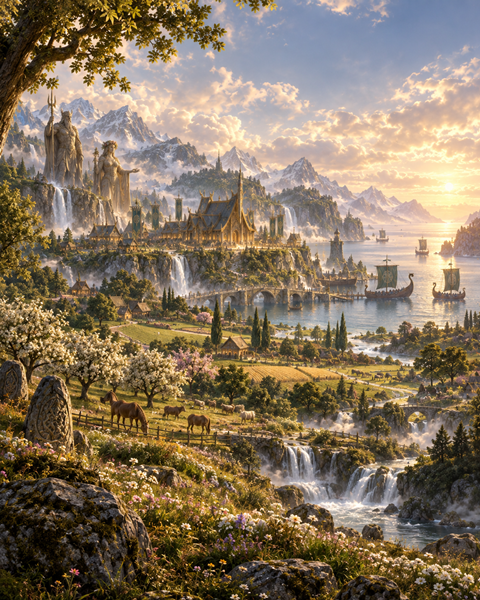
It is easy to imagine fertile fields, sheltered coastlines, orchards, pasture and abundant farmland because those images fit well with Njörðr and Freyr. They may work beautifully in devotional practice, meditation or artwork. But they come from us, not from the surviving sources.
There is no surviving account that walks us through Vanaheimr, names its capital, lists its halls or describes its inhabitants going about their lives. Most of what we know comes through the gods who originated there and the relationships that formed when they entered the world of the Æsir.
In that sense, Vanaheimr feels less like a place we have visited in the stories and more like a remembered homeland in the background of them.
What place-names can tell us
Although archaeology and place-names can’t recover the landscape of Vanaheimr, they can tell us something about the importance of gods associated with the Vanir in pre-Christian Scandinavia.
Theophoric place-names, meaning place-names containing the names of gods, provide evidence for the worship of deities such as Freyr and Njörðr. Freyr-related names are especially prominent in parts of Sweden, fitting with later written traditions that also connect him strongly with prosperity, good seasons and important centres of worship.
This doesn’t mean Vanaheimr was supposed to be Sweden, nor should we turn the geographical spread of a god’s cult into a map of a supernatural realm.
What it does show is that the gods associated with the Vanir weren’t minor inventions of medieval literature. Their worship left traces in the human landscape as well as in mythology.
Nerthus and an older Germanic connection
One of the most interesting comparisons comes from Tacitus, writing many centuries before the Icelandic manuscripts. In Germania, he describes the worship of a goddess called Nerthus, whose sacred image travels in a wagon. During her procession, weapons are put away and peace prevails.
The name Nerthus is linguistically related to Old Norse Njörðr, and that connection has attracted scholarly attention for a very long time.
We shouldn’t push the comparison further than the evidence allows. Tacitus is describing a continental Germanic cult in the first century, not giving us an account of Vanaheimr or a Viking Age Vanir ceremony.
Even so, the connection is valuable because it suggests that traditions associated with a divine name closely related to Njörðr reach much further back into Germanic religious history than the medieval Icelandic texts.
Were the Vanir always a separate group?
This question has become an important part of modern scholarship. Some scholars have questioned whether the Vanir were ever a sharply defined divine tribe throughout pre-Christian Scandinavian religion, or whether later writers, especially Snorri, helped systematise a distinction that may originally have been less rigid. Others argue that the surviving mythology preserves meaningful differences between Æsir and Vanir even if those boundaries were never completely fixed.
The sources certainly distinguish them in important places. A conflict between them is remembered, hostages are exchanged, and Njörðr is explicitly said to come from Vanaheimr before living among the Æsir. At the same time, the two groups become so closely woven together that a simple opposition quickly stops working. Njörðr and Freyr live among the Æsir, Freyr receives Álfheimr, Freyja shares in the battle-slain, and marriage and kinship continue to cross other divine boundaries as well.
Whatever the distinction originally meant, it clearly didn’t require permanent separation.
Vanaheimr and the Nine Worlds
Vanaheimr regularly appears on modern lists of the Nine Worlds, and unlike some later additions found in modern systems, its name is genuinely preserved in the Old Norse poetry. What we shouldn’t expect is for every world to be described in the same way.
Miðgarðr is given to us as the human enclosure. Jötunheimr emerges through distant landscapes, strongholds and journeys. Niflheimr and Muspell appear in descriptions of the world’s beginnings. Vanaheimr is known above all as a homeland. That may simply be the role it plays in the surviving material.
A place doesn’t become less real within mythology because the storytellers didn’t describe its rivers or mountains. Sometimes knowing who belongs somewhere and why that home still matters is all the story gives us.
For Vanaheimr, that connection is clearest through Njörðr. He comes from there, leaves it as part of a peace settlement and, according to Vafþrúðnismál, will eventually return.
Vanaheimr for a modern Norse Pagan
For modern Norse Pagans, Vanaheimr naturally draws attention towards the gods most closely connected with it and the parts of life their stories touch.
Njörðr may bring thoughts of the sea, livelihood, travel and the security that comes from having enough. Freyr is strongly connected with harvest, prosperity, good seasons and peace. Freyja brings a more complicated range of associations involving desire, wealth, seiðr, death, grief and personal power.
Those connections can inspire modern practice around tending land, sharing food, building household security, seeking prosperity or repairing damaged relationships. They should simply be recognised as modern responses to the gods rather than presented as evidence of ancient “Vanaheimr practices.”
The peace between Æsir and Vanir offers another interesting point for reflection. Their conflict doesn’t end because one side destroys the other. Instead, former enemies make terms, exchange hostages and eventually become so closely entwined that their stories can hardly be separated.
That doesn’t mean every conflict should end in reconciliation, nor that peace should be pursued at any cost. The mythology doesn’t give us a universal rule. What it does preserve is one example in which neither side achieves total victory, and the divine world that follows is shaped by the fact that they found a way to live alongside one another.
Perhaps the most fitting way to think about Vanaheimr, though, is through Njörðr himself. He spends much of the mythology among the Æsir. He becomes part of their world, joins their relationships and establishes a life beyond the place where he began. Yet his homeland is never forgotten. At Ragnarök, Vafþrúðnismál tells us, he will return to the Vanir.
We may never know what Vanaheimr was imagined to look like, what lay along its shores or what halls stood there. What survives instead is the sense of a homeland that continues to matter after an age spent elsewhere, and of two divine communities whose future changed because former enemies found a way to make room for one another.
I think this one benefits from not trying to make Vanaheimr more detailed than the sources allow. The lack of scenery actually becomes part of what makes the article interesting rather than something we need to keep apologising for. The strongest thread now is Njörðr: he gives us the opening, explains why Vanaheimr matters, carries us through the Æsir–Vanir settlement, and brings us back home at the end.
Sources and further reading
Primary sources:
- The Poetic Edda, trans. Carolyne Larrington:
- Vafþrúðnismál (Njörðr’s origin in Vanaheimr; hostage; return at world’s end)
- Lokasenna (Njörðr “sent eastward” line in the insult exchange)
- Edda: Prologue and Gylfaginning and related materials, trans./ed. Anthony Faulkes:
- Gylfaginning (Vanir/hostage context; Njörðr, Freyr, Freyja details)
- Skáldskaparmál (Kvasir and the spittle-vat peace story)
- Germania, Tacitus (Nerthus procession tradition as a wider Germanic parallel)
Good scholarly support:
- Stefan Brink on theophoric place-names (Freyr clustering / regional cult signals)
- Rudolf Simek on debates around the Vanir category
- Terry Gunnell on Vanir religion motifs and interpretive frameworks