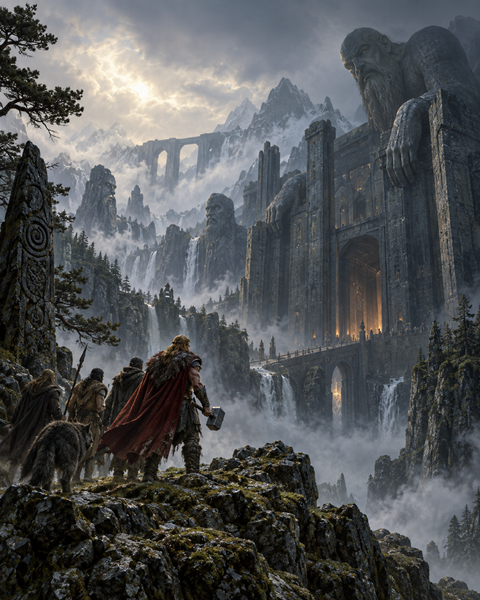
By the time Þórr reaches the stronghold of Útgarða-Loki, his journey has already become decidedly strange. He and his companions have spent the night sheltering in what they thought was a building, only to discover the next morning that it was an enormous glove. Now they stand before a fortress so tall that they have to crane their heads backwards to see the top. The gate refuses to open, so they squeeze between the bars instead.
Inside, their host isn’t particularly impressed by his visitors. If they are going to stay, he tells them, they had better be able to demonstrate some exceptional skill. Loki chooses an eating contest, Þjálfi offers to race, and Þórr attempts to drain a drinking horn, lift a cat and wrestle an elderly woman. On the surface, none of this sounds especially alarming for a group that includes one of the strongest gods in Norse mythology, but every challenge ends badly. Loki loses, Þjálfi is outrun, Þórr can’t empty the horn, barely lifts one of the cat’s paws and is eventually forced onto one knee by the old woman.
Only after they leave does Útgarða-Loki explain what actually happened. Loki had competed against wildfire, which consumed not only the food but the trough holding it. Þjálfi raced against thought itself. Þórr’s drinking horn was connected to the sea, the cat was Jörmungandr, and the elderly woman was old age. Their apparent failures suddenly look rather different: Þórr drank enough to lower the sea, came frighteningly close to lifting the World Serpent from around the earth, and resisted old age longer than anyone should have been able to.
When Þórr reaches for Mjǫllnir, Útgarða-Loki disappears, and so does the stronghold. It is one of the most memorable stories connected with Jötunheimr because it immediately tells us something about the lands beyond the gods’ familiar world. Here, Þórr can’t simply rely upon his strength, and none of them can entirely trust what they see.
Beyond the fence
The name Jötunheimr means the home or world of the jötnar. We also find the plural Jötunheimar, meaning something closer to “giant-lands,” which may actually fit the surviving sources rather well.
Modern Nine Realms diagrams tend to give us one neat Jötunheimr placed somewhere around Yggdrasill, usually with a convenient border separating it from everywhere else. The medieval sources are nowhere near that tidy. They mention nine worlds, but they never provide a complete list with a reliable map showing exactly where each one belongs. Instead, jötunn territory appears through mountains, distant shores, forests, rivers and isolated halls. Sometimes travellers journey north or east; sometimes they simply leave cultivated land behind and continue until the landscape and its inhabitants become increasingly unfamiliar.
Snorri gives this separation a particularly strong image in his creation account. After the sons of Borr make the world from Ymir’s body, the outer shores are given to the families of giants, while Miðgarðr is established farther inland as an enclosure for humanity. We don’t need to imagine Jötunheimr as one country sitting just outside a literal fence, but the relationship between the spaces is clear enough: the protected and familiar world lies within, while the jötnar are strongly associated with lands beyond it.
That doesn’t mean everything beyond the enclosure represents chaos, any more than everything inside represents safety and order. Jötunn territory contains genuine dangers, but it also contains wisdom, wealth, family connections, useful resources and people the gods themselves repeatedly seek out.
Jötnar are not simply “giants”
The English word giant is convenient, but it can also be misleading because it encourages an image of enormous, lumbering creatures whose main purpose is to wait around until Þórr arrives with a hammer. The jötnar of the sources are far more varied than that.
Some are huge, monstrous and violently hostile. Others are beautiful, wealthy, wise, magically skilled or so similar in appearance and behaviour to the gods that the difference between them isn’t obvious at all. They have families, halls, herds, marriages, treasures and rivalries, and they can be concerned with hospitality and honour just as the gods and humans are.
The terminology isn’t especially tidy either. The sources use words such as jötunn, þurs and hrímþurs, often translated as giant, ogre and frost-giant, but these shouldn’t be treated as modern species labels. Medieval poets weren’t constructing a supernatural field guide, and the terms can shift according to context.
Size is just as unreliable. Some jötnar appear on an enormous or even cosmic scale, while others sit at feasts, travel, marry and live in halls much as gods and humans do. Nor do they form a single moral category. Some help the gods, some try to kill them, some marry them, and some possess knowledge that the gods themselves want badly enough to risk their lives seeking.
Gods, jötnar and a tangled family tree
The boundary between gods and jötnar is real, but it isn’t a boundary between two completely unrelated peoples. Óðinn’s mother, Bestla, is the daughter of the jötunn Bölþorn. Loki’s father is Fárbauti, also identified as a jötunn, while Þórr’s mother Jörð belongs within the same tangled world of giant ancestry.
Those connections continue through marriage and desire. Njörðr marries Skaði after the death of her father Þjazi, Freyr falls desperately in love with Gerðr, daughter of Gymir, and other gods have children with women identified as jötnar.
So when gods and jötnar fight, negotiate, marry or insult one another, we aren’t looking at two completely separate species locked in eternal war. We are looking at something much more like a difficult extended supernatural family whose members keep crossing one another’s boundaries whether anyone particularly likes it or not. That makes many of their stories considerably more interesting than a simple “gods versus giants” explanation.
Rivers, forests and distant halls
Although the sources don’t provide a complete map, some boundaries are named. In Vafþrúðnismál, the wise jötunn Vafþrúðnir describes Ífingr as a river separating the lands of the gods from those of the giants. It never freezes, so even winter doesn’t turn it into an easy road, although gods and jötnar clearly cross between their territories often enough that it can’t be an absolute barrier.
Elsewhere we encounter places such as Járnviðr, the Ironwood east of Miðgarðr, where Völuspá places an old woman raising the offspring of Fenrir. Snorri later expands the image with giant women and wolves living within the wood. The sources don’t clearly call Járnviðr part of Jötunheimr, so it is safer to think of it as part of the wider jötunn-associated wilderness rather than confidently dropping it onto a modern realm map.
Again and again, however, journeys into jötunn territory lead to halls. That makes sense in Norse storytelling because a hall is much more than a building; it is a place of status, hospitality and authority. When you enter another person’s hall, you enter their space and, for the moment at least, their rules. Þórr discovers that rather dramatically with Útgarða-Loki, while Óðinn discovers it in a very different way when he visits Vafþrúðnir.
Vafþrúðnir and the wisdom outside Ásgarðr
In Vafþrúðnismál, Óðinn chooses to visit the jötunn Vafþrúðnir despite Frigg warning him about the danger. He doesn’t go there to fight; he goes because Vafþrúðnir knows things.
Disguised under another name, Óðinn enters the jötunn’s hall and becomes involved in a contest of knowledge where losing may cost him his life. Their questions range across the origins of the world, the movements of the heavens, the beginnings of winter and summer, Ragnarök and what comes after it. Vafþrúðnir’s knowledge reaches deep into the oldest parts of the mythic world, and Óðinn eventually wins not because the jötunn runs out of wisdom, but because he asks what he whispered into Baldr’s ear before Baldr was placed upon the funeral pyre. Only Óðinn can know the answer.
It is difficult to maintain the idea of jötnar as mindless monsters when the chief of the gods is willing to risk his life entering one of their halls in search of knowledge. Wisdom, apparently, doesn’t stop at the walls of Ásgarðr.
Þórr, Hymir and a very large cauldron
Not every journey into jötunn territory begins with such lofty aims. Sometimes the gods simply need something.
In Hymiskviða, they need a cauldron large enough to brew ale. Týr knows that Hymir possesses one, so he and Þórr travel to Hymir’s remote home to get it. Naturally, because Þórr is involved, a simple household errand doesn’t remain simple for very long.
The visit includes tense hospitality and displays of strength before Þórr eventually goes fishing with Hymir. For bait he uses the head of Hymir’s finest ox and manages to hook Jörmungandr. The World Serpent rises towards the surface with Þórr gripping the line and preparing Mjǫllnir, bringing the two enemies who will eventually kill one another at Ragnarök dangerously close to an early ending.
The final blow doesn’t fall, and Þórr eventually returns to Hymir’s hall and obtains the cauldron. There is something wonderfully Norse about an enormous mythic confrontation taking place in the middle of a story that began because everyone needed something large enough to brew the ale in. The ordinary and the cosmic have a habit of colliding in these stories.
Þrymr steals the hammer
In Þrymskviða, the problem is more serious from the start. Þórr wakes to discover that Mjǫllnir is gone, and Loki travels into Jötunheimr to find out what happened. Þrymr admits that he has hidden the hammer deep beneath the earth and refuses to return it unless Freyja is brought to him as his bride.
Freyja’s response to this proposal is, unsurprisingly, not enthusiastic. Heimdallr comes up with another plan: dress Þórr as the bride and send Loki along as his maidservant.
The disguise nearly collapses several times. “Freyja” eats an entire ox, eight salmon and plenty of delicacies, then washes it down with an impressive amount of mead. When Þrymr becomes suspicious, Loki explains that the bride has been unable to eat for eight nights because she has been so excited about the wedding. When Þrymr notices Þórr’s blazing eyes, Loki manages to explain those too.
Eventually Mjǫllnir is brought out and placed in the bride’s lap to hallow the marriage. Þórr finally gets his hands on his hammer again, and the comedy ends very badly for Þrymr and his household.
It is a wonderfully entertaining poem, but beneath the humour sits a genuine crisis. Without Mjǫllnir, the gods and humans have lost one of their greatest defences, and Þórr can’t solve the problem through strength until disguise and trickery have placed the hammer back within reach.
When a jötunn comes into Ásgarðr
The gods aren’t always the ones crossing the boundary. In Skáldskaparmál, Óðinn meets Hrungnir in giant territory, and a boast about their horses leads to a race. Hrungnir becomes so determined to catch Óðinn that he follows him all the way through the gates of Ásgarðr.
At first, the gods offer him hospitality. Once Hrungnir becomes drunk, however, he begins boasting that he will destroy Ásgarðr and carry away Freyja and Sif. Þórr eventually challenges him to a formal duel.
Hrungnir arrives with a stone heart and stone head, armed with a whetstone, while the giants create the enormous clay figure Mökkurkálfi to stand beside him. Þórr kills Hrungnir, although he doesn’t leave unharmed; a piece of Hrungnir’s shattered whetstone becomes lodged in his head.
The story mixes hospitality, boasting, formal challenge and violence, but it also makes an important point without needing to spell it out too heavily. The boundary is crossed from both directions. Gods travel into jötunn territory, and jötnar can enter divine spaces too.
Geirröðr and Gríðr
The story of Geirröðr gives us one of the clearest examples of why simply asking whether a character is a jötunn tells us very little about whether they are friend or enemy.
Loki is captured and forced to promise that he will bring Þórr to Geirröðr without Mjǫllnir or his belt of strength. On the journey, Þórr encounters the jötunn woman Gríðr, who warns him that something is wrong and lends him equipment to help him survive.
Her warning is needed. Geirröðr’s household has been prepared as a trap. His daughters try to crush Þórr by forcing his chair towards the roof, and Geirröðr later throws a glowing piece of iron at him. With Gríðr’s help and the equipment she has provided, Þórr survives and kills his attackers.
Geirröðr and Gríðr both belong to the wider world of the jötnar. One tries to murder Þórr, while the other gives him the means to stay alive. Who they are and what they choose to do matters far more than the category we put them in.
Þjazi, Iðunn and what the gods cannot afford to lose
Another story shows the gods’ vulnerability in a very different way. Through a chain of events involving Loki, the jötunn Þjazi manages to lure Iðunn away from Ásgarðr and carry her to his mountain home, Þrymheimr.
Iðunn keeps the apples associated with the gods’ continued youth, and once she is gone, they begin to age. Their power doesn’t make them self-sufficient; their continued wellbeing depends upon one member of their community and what she safeguards.
The gods force Loki to put things right. Borrowing Freyja’s falcon form, he reaches Þrymheimr, transforms Iðunn into a nut and carries her away. Þjazi pursues them in eagle form, but the gods kill him as he approaches Ásgarðr.
That might have ended the matter, except Þjazi has a daughter, and Skaði comes looking for justice.
Skaði crosses the boundary
Skaði arms herself and travels to Ásgarðr to demand compensation for her father’s death. From the gods’ point of view, Þjazi had abducted Iðunn and endangered their entire community. From Skaði’s point of view, the gods killed her father.
Rather than simply attacking her or dismissing her claim, they negotiate. As part of the settlement, Skaði is allowed to choose a husband from among the gods by looking only at their feet. Expecting to choose Baldr, she instead selects Njörðr. The gods also make her laugh and place Þjazi’s eyes in the sky as stars.
The marriage between Skaði and Njörðr doesn’t work particularly well. She can’t tolerate the seabirds at his coastal home, while he can’t stand the wolves at her mountain dwelling. They try dividing their time between the two places, but neither can truly settle in the other’s world.
Skaði remains strongly connected with the mountains, hunting, skiing and Þrymheimr. Crossing into Ásgarðr and marrying one of the gods doesn’t require her to stop being who she is, nor does it erase where she came from.
Gerðr and the uncomfortable side of crossing boundaries
Not every relationship between gods and jötnar should be romanticised. In Skírnismál, Freyr sees Gerðr within the enclosure of her father Gymir and becomes consumed with desire for her. Rather than approaching her himself, he sends his servant Skírnir and gives him his horse and sword.
Skírnir begins by offering Gerðr gifts, but she refuses. The conversation then becomes increasingly threatening. He promises violence, isolation, misery and supernatural harm, eventually using runic magic as part of the coercion. Gerðr finally agrees to meet Freyr after nine nights.
Whatever later traditions make of their relationship, Skírnismál itself isn’t a gentle story of two people falling mutually in love. Gerðr’s resistance and Skírnir’s threats are there in the poem, and smoothing them away to make the story more comfortable would do the source a disservice.
This also gives us another perspective on journeys beyond the enclosure. Sometimes the gods aren’t heroic travellers bravely facing a dangerous outside world. Sometimes they are the ones entering someone else’s space and behaving badly.
What kind of place is Jötunheimr?
By now, Jötunheimr looks rather different from the simple “land of the giants” found on a modern cosmology chart. It contains dangerous strongholds and wealthy halls, ancient knowledge and outright deception. It is where Þórr can be ambushed, where Óðinn finds wisdom, where the gods obtain things they need and where people with their own families, grievances and loyalties live.
Again and again, the stories show the limits of what the gods control. Óðinn goes beyond Ásgarðr for knowledge, Þórr and Týr travel in search of a cauldron, Freyr looks outward and sees Gerðr, Gríðr gives Þórr the help he needs to survive, and Skaði crosses into Ásgarðr demanding that the gods answer for her father’s death.
The important point isn’t that everything outside the enclosure is secretly good. It clearly isn’t. Nor is everything outside hostile. Jötunheimr and the wider jötunn-associated lands are already inhabited by beings with their own homes, interests, relationships and reasons for doing what they do.
Jötunheimr and Ragnarök
At Ragnarök, many of the boundaries that shaped the mythic world begin to fail. Fenrir breaks free, Jörmungandr rises from the sea, Loki leads hostile forces into battle, and Snorri places the frost-giant Hrymr at the helm of Naglfar. Surtr also advances with the forces of Muspell.
It is worth being careful here because these figures shouldn’t simply be bundled together into one enormous “army from Jötunheimr.” Their origins and associations differ, and Surtr and the powers of Muspell belong to their own part of the tradition.
Ragnarök is also more complicated than a story about evil outsiders invading the safe world of the gods. The gods’ own actions play an important role. Promises have been broken, enemies have been bound, violence has answered violence, and attempts to control future dangers have helped shape the relationships that eventually erupt at the end of the mythic age.
By the time Ragnarök arrives, many old consequences have finally come due.
Is Jötunheimr really one place?
Probably the safest answer is that the sources don’t give us enough consistency to treat Jötunheimr as one clearly mapped country. Snorri places giant families along the outer shores beyond Miðgarðr, while other stories send travellers north or east, across rivers, through forests and into distant mountain regions. Some journeys feel almost geographical, while others carry the traveller into places where scale, appearance and ordinary expectations become unreliable.
The plural Jötunheimar is useful because it allows us to think in terms of giant-lands rather than insisting upon one enormous territory with a single border. We can be much more certain about the relationship between these spaces than about their exact geography.
Gods and humans occupy familiar and protected places, while jötunn territory repeatedly appears beyond those places in one form or another. Travelling there means leaving home ground and entering somewhere that belongs to someone else. What happens next depends very much upon whom you meet.
Jötunheimr for a modern Norse Pagan
Modern interpretations sometimes describe Jötunheimr as a realm of wilderness, elemental forces, shadow work or the untamed parts of ourselves. Those ideas can be meaningful within an individual’s practice, but they are modern interpretations rather than definitions given to us by the Eddas. The surviving stories give us particular beings, particular places and particular encounters rather than one universal psychological system.
There is already plenty here to reflect upon without adding that layer. Jötunheimr raises interesting questions about what we do with the unfamiliar and how easily we turn those outside our own circle into a single category. The stories show that someone beyond the boundary may possess knowledge we need, may be dangerous for very good reasons, may offer unexpected help, or may simply have their own concerns that have nothing to do with us.
At the same time, the stories never ask us to romanticise everything outside the enclosure. Óðinn finds wisdom there, but Þórr also finds deception and ambush. Gríðr offers help, while Geirröðr prepares murder. Skaði comes seeking justice, while Gerðr faces coercion from someone who has entered her world on another person’s behalf. The unfamiliar deserves neither automatic fear nor automatic trust.
Perhaps that is why Jötunheimr remains so compelling. The gods can build walls around Ásgarðr, but they can’t build a complete world inside them. Their ancestry, marriages, enemies, needs and search for wisdom continually draw them outward.
Þórr leaves Útgarða-Loki’s vanished stronghold having discovered that his apparent failures were greater achievements than he realised. Óðinn leaves Vafþrúðnir’s hall after encountering knowledge reaching back beyond the gods’ own age, while Skaði crosses into Ásgarðr and makes the gods answer for the death of her father.
Again and again, someone crosses the boundary and comes back changed by what happened there. Sometimes they return with knowledge, sometimes with a cauldron, sometimes with a spouse, and sometimes with a grudge. In Þórr’s case at Útgarða-Loki’s hall, he returns having discovered that the world beyond his own familiar enclosure is far stranger than he expected.
Sources and further reading
Primary sources:
- The Poetic Edda (trans. Carolyne Larrington) — Vafþrúðnismál, Þrymskviða, Hymiskviða, Skírnismál, plus Völuspá for Ironwood imagery.
- Edda / The Prose Edda (trans. Anthony Faulkes) — Gylfaginning and Skáldskaparmál for narrative versions of Útgarða-Loki, Skaði, Þjazi and Iðunn, Hrungnir, and Geirröðr.
- The sagas in Jackson Crawford’s translations where relevant to worldview and cultural framing.