
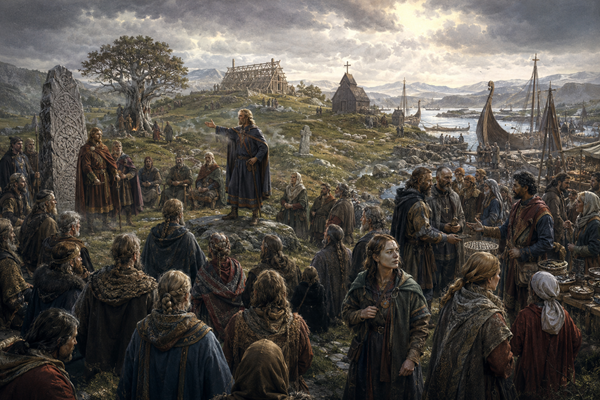
Part Five: Christianisation Was Not One Event
When we compress several centuries into a few paragraphs, the conversion of Scandinavia can sound remarkably simple. Missionaries arrive, kings convert, Paganism is prohibited and suddenly the Viking world is Christian. History rarely behaves that neatly.
Christianisation happened at different times and moved at different speeds across Denmark, Norway, Sweden, Iceland, the North Atlantic and the Scandinavian settlements overseas. Kings and missionaries played important roles, but so did traders, travellers, enslaved people, marriages, migrants and ordinary households.
For generations, people lived in a world where religious boundaries were still shifting.
Christianity arrived before official conversion
Scandinavians encountered Christianity long before rulers could proclaim their kingdoms Christian.
Merchants travelled through Christian lands. Scandinavian warriors entered the service of Christian rulers. Norse settlements in Britain and Ireland existed among Christian populations, and captives brought back from raids carried their religions with them. Marriage and migration moved beliefs in both directions.
Some people certainly converted from conviction. Political alliance, trade and social advantage could also make Christianity attractive. Others appear to have moved gradually between religious worlds rather than making one dramatic decision.
Old Norse sources even preserve the idea of primsigning, or prime-signing, a preliminary Christian rite involving the sign of the cross. Saga accounts describe people receiving it without immediately proceeding to full baptism, allowing closer participation in Christian society while their religious status remained less settled.
The conversion period was full of such awkward spaces between categories.
Denmark and Harald Bluetooth
Around 965, Harald Bluetooth raised the great Jelling Stone. Its famous inscription declares that Harald won Denmark and Norway and “made the Danes Christian.”
That is one of our most important pieces of evidence for royal Christianisation in Denmark. It’s also a royal monument. Harald is telling us about Harald’s achievements. Christianity was present in Denmark before the stone was raised. Earlier missions are recorded, Christian objects circulated and Harald Klak had been baptised on the continent more than a century earlier.
The Jelling declaration therefore marks a major change in royal identity and public religion rather than the date upon which every Dane simultaneously stopped honouring the older gods.
A king could support churches, clergy and Christian law. Royal patronage could move the centres of public power very quickly. Private belief didn’t necessarily move at the same speed.
Norway: kings, persuasion and force
The conversion of Norway is particularly associated with rulers such as Hákon the Good, Óláfr Tryggvason and Óláfr Haraldsson.
Later saga literature gives us vivid stories of preaching, destroyed sacred places, forced conversions, threats and violence. Those accounts require care because many were written generations after the events by Christian authors with their own literary and political concerns.
Even so, the broader connection between conversion and royal authority is difficult to miss.
Christian kingship tied Scandinavian rulers more closely to the political and ecclesiastical world of Christian Europe. Bishops and clergy brought literacy and administrative networks. Christianity could reinforce centralising royal authority, particularly where older cult practice had been connected with local elites.
Political usefulness doesn’t explain every conversion. Faith, family, ambition, diplomacy, pressure and fear can exist in the same historical process.
People rarely change entire religious cultures for one reason.
Iceland chooses one public law
Iceland offers one of the most unusual conversion stories.
Around the year 999 or 1000, conflict between Christian and Pagan Icelanders had become serious enough to threaten the legal unity of the country. Our earliest surviving account comes from Ari Þorgilsson’s Íslendingabók, written more than a century later but considerably closer to the events than the great thirteenth-century sagas.
According to Ari, the lawspeaker Þorgeirr was asked to find a settlement. His argument centred upon the danger of dividing the country under separate laws. Iceland would officially adopt Christianity and the unbaptised were to receive baptism.
The compromise didn’t instantly erase older practices.
Ari says that the old law initially remained concerning infant exposure and the eating of horsemeat. People could also continue Pagan sacrifice in secret, although witnessed sacrifice was punishable. These concessions disappeared after a few years.
The settlement is remarkable because Ari presents conversion primarily as a problem of law and social peace rather than a miraculous triumph in which an entire population suddenly experiences the same change of heart.
Officially, Iceland became Christian. What every person privately believed the following morning is another question altogether.
Sweden and the longer transition
Christianisation in Sweden took even longer and varied greatly between regions.
Christian kings, churches and communities appeared while older religious practices continued elsewhere. Archaeology and later written evidence both suggest a transition extending well beyond the neat conversion dates sometimes given in timelines.
Some parts of eastern Scandinavia maintained older customs after Christianity had become established elsewhere. Even burial practices could continue along different paths within comparatively small geographical areas.
The wider North Atlantic had its own histories as well. The Faroe Islands, Greenland and other Norse communities encountered Christianity through migration, rulers, family relationships and continued contact with Europe.
Norse identity didn’t disappear when someone entered a church. Language, kinship, law, artistic traditions and cultural memory continued even as religion changed.
More than two organised religions facing each other
It’s also misleading to imagine one unified “Norse Pagan Church” facing one equally uniform Christian organisation.
Pre-Christian Norse religion had no single central scripture, universal doctrine or authority dictating identical practice across Scandinavia. Different regions and families could favour different gods, sacred sites and ritual traditions.
Christianity brought more formal institutions, but Christian rulers, missionaries, bishops and local clergy still had different priorities and methods.
That helps explain why the conversion period looks so inconsistent. There was violence, persuasion, political bargains, marriages and economic incentives. There were sincere conversions and reluctant ones. There were households in which older customs remained meaningful after public religion had changed.
Trying to reduce all of that either to peaceful blending or to one perfectly organised campaign of religious destruction loses the human messiness of what actually happened.
A world changing at different speeds
Christianisation eventually transformed law, burial, sacred space, kingship and public ritual across the Norse world. Those transformations didn’t arrive together.
A king could be Christian while people in parts of his kingdom maintained older rites. A community could build a church while still remembering stories attached to the surrounding landscape. Objects carrying Christian and older Norse symbols could circulate in the same society, although an object by itself can’t tell us exactly what its owner believed. Conversion unfolded through generations.
Some people embraced Christianity enthusiastically. Others resisted. Many lived through periods when the line between “Pagan” and “Christian” was still being drawn around them.
The Norse world didn’t simply wake one morning and discover that the old religion had vanished. It changed through rulers and assemblies, marriages and households, laws and burials, public rituals and private choices.
And once those laws began to change, religion became something authorities could increasingly regulate.
Source notes
The Jelling Stone, raised by Harald Bluetooth around 965, provides the famous royal claim that Harald “made the Danes Christian,” while archaeological and historical evidence shows Christian presence in Denmark before that proclamation. Norway’s conversion history relies upon a combination of contemporary or near-contemporary evidence and much later saga narratives, so dramatic episodes involving individual kings require appropriate caution. Iceland’s settlement is described in Ari Þorgilsson’s Íslendingabók, chapter 7, which records baptism, the temporary survival of the old laws concerning horsemeat and infant exposure, and restricted private sacrifice. Sweden’s transition was particularly prolonged and regionally varied.
Next in the series
Part Six: Law, Burial, Food and Sacred Practice
Conversion becomes much easier to see when we stop asking what people privately believed and look at what they were allowed to do. In the final part we’ll follow Christianisation into the law codes, graveyards, ritual feast and sacred landscape — the places where religious change left physical and legal traces.