Part Three: What Christian Writers Did With Norse Myth
Most of the surviving literary narratives through which we know Norse mythology were written down after the conversion of Scandinavia.
That doesn’t place a giant question mark over the existence of the older religion. Skaldic poetry, runic inscriptions, images, archaeology and place-names all provide evidence that gods, rituals and mythic traditions existed before Christianisation. The difficulty comes when we want the stories in detail, because our fullest written accounts belong to a later world.
The interesting question is therefore less about deciding whether a medieval author can be “trusted” and more about understanding what that author inherited, what he preserved and how his own education and beliefs may have shaped the version that reached us.
Old poems in Christian manuscripts
The Poetic Edda is central to almost every modern discussion of Norse mythology. Its principal manuscript, the Codex Regius, dates to around 1270 — centuries after Iceland officially adopted Christianity.
The poems themselves are another matter. They weren’t all composed at the same time, and dating individual Eddic poems can be extremely difficult. Some preserve language, themes and poetic material that may be much older than the manuscript in which we find them. Between an early oral poem and a thirteenth-century parchment, however, lie generations of remembering, performing, transmitting and copying.
That history doesn’t make the poetry worthless. It’s part of the poetry’s history.
Snorri Sturluson’s Prose Edda, composed in thirteenth-century Iceland, presents a different problem. Snorri was a Christian intellectual writing about a religion that was no longer the official religion of Iceland. One of his purposes was to preserve the mythological knowledge required to understand traditional skaldic poetry. Kennings referring to Óðinn, Þórr, Freyja, giants and legendary events become impossible to understand once the stories behind them are forgotten.
We owe Snorri an enormous amount for that reason. We also need to remember that he was organising and explaining old material from within his own medieval Christian intellectual world.
Those two facts can sit comfortably beside one another.
Making gods into ancient people
One of the clearest examples of Christian reinterpretation is euhemerisation: the explanation of gods as remarkable human beings who were later mistakenly worshipped as divine.
In the Prologue to the Prose Edda, Snorri connects the Æsir with Asia and Troy. Óðinn becomes part of a learned historical scheme in which impressive ancestral figures travel north and later generations come to regard them as gods.
This was a useful solution for a Christian writer. Stories about the old gods could be preserved without recognising those beings as genuine rival divinities.
Saxo Grammaticus does something comparable in the Gesta Danorum, although his versions can look very different from Snorri’s. Baldr becomes Balderus, a formidable warrior competing with Hotherus for Nanna. Hotherus deliberately fights him and eventually brings about his death. Loki, mistletoe and the blind Höðr of Snorri’s version are absent from the central action.
That variation reminds us of something important even before Christianity enters the discussion: Norse myths were never necessarily one fixed set of authorised stories.
Different communities and storytellers could preserve different traditions.
Did Christian ideas enter the myths?
Almost certainly somewhere, but identifying exactly where is far more difficult.
Völuspá, for example, describes Ragnarök, the sinking and return of the earth and a renewed world in which Baldr and Höðr return. Some of its imagery has long encouraged comparison with Christian ideas of apocalypse, resurrection and renewal.
Comparison doesn’t tell us which direction influence travelled or whether influence is required at all. Pre-Christian religions were perfectly capable of imagining cosmic destruction, returning figures and renewed worlds. A surviving version might preserve an older Pagan tradition, reflect later Christian influence, or combine material from both environments.
That uncertainty has produced a great deal of scholarly debate, and it’s a useful warning against easy answers.
Snorri’s treatment of elves creates similar questions. His Gylfaginning distinguishes between luminous beings associated with heaven and darker beings associated with the earth. Scholars have sometimes wondered whether this neat classification owes something to Christian or learned medieval ways of organising supernatural beings. Other Norse evidence doesn’t give us the same tidy system, which makes Snorri’s presentation intriguing but impossible to diagnose with certainty.
The safest approach is to recognise possible influence without turning possibility into proof.
The gods were never simply Christian characters in disguise
Modern discussions sometimes go much further and try to build a substitution chart in which Baldr becomes Christ, Loki becomes Satan, Þórr becomes Michael and the jötnar become demons.
The surviving evidence is far too complicated for that.
Loki certainly acquires strongly destructive characteristics in the Ragnarök tradition, and Christian readers could easily see something devil-like in him. Yet Loki’s surviving stories, relationships and functions can’t be reduced to Satan with a Norse name.
The jötnar are even harder to force into a Christian category of demons. They can oppose the gods, marry them, host them, parent them, provide wisdom, become their lovers or become the ancestors of divine figures themselves.
Þórr fighting Jörmungandr can visually remind a Christian audience of a saint or archangel fighting a dragon, but resemblance is different from documented replacement. We have no surviving missionary handbook telling Christians across Scandinavia to substitute Michael for Þórr.
The cultural exchange of the conversion period was far more complicated than a one-for-one renaming exercise.
Reading through layers
What survives is layered.
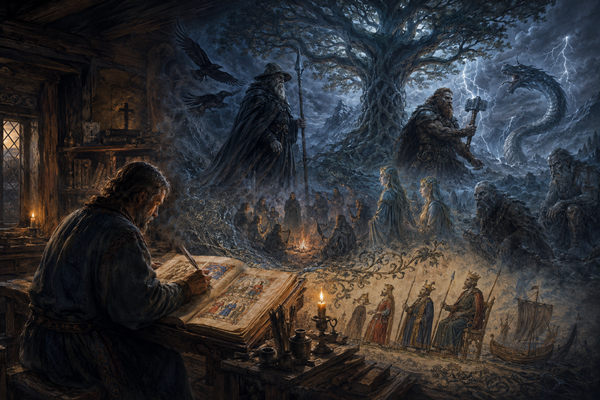
At the bottom may lie stories, poems, rituals and regional traditions from pre-Christian communities. Over time they were remembered, performed and altered. Conversion changed the culture in which those stories were told. Christian scholars later collected, copied and explained them, and still later scribes transmitted the manuscripts we now use.
Archaeology sometimes agrees with the literary material. Sometimes it complicates it. Early skaldic poetry can support traditions that Snorri records centuries later. Place-names can show that a deity was honoured in regions where surviving myths barely mention that god at all.
This is why studying Norse religion requires several kinds of evidence rather than dependence upon one medieval author.
Snorri is neither an enemy who ruined Norse mythology nor a transparent window through which we can watch the Viking Age exactly as it happened. He belongs to the history of how Norse mythology survived.
The same is true of other Christian scribes and writers.
They inherited fragments of an older world, understood those fragments through the world they inhabited and preserved enough that we are still arguing about them nearly a thousand years later.
Source notes
The Codex Regius of the Poetic Edda is generally dated to around 1270, while the dates of individual poems remain debated. Snorri Sturluson’s Prose Edda was composed in thirteenth-century Iceland and should be read alongside the Eddic and skaldic poetry it quotes. Snorri’s Prologue provides the clearest example of euhemerisation and the learned connection of the Æsir with Troy and Asia. Saxo Grammaticus’s Gesta Danorum preserves important alternative versions of several traditions. Possible Christian influence upon Völuspá, Ragnarök and later mythological systematisation remains a subject of scholarly debate rather than a settled explanation for the myths.
Next in the series
Part Four: Ask and Embla — What Makes a Human?
We have already met the first human pair twice. This time we’re leaving the question of population behind and looking much more closely at the strange gifts in Völuspá. Breath, mind, vitality, activity and appearance all seem to play a part — but the Old Norse words refuse to fit neatly into English.