From Creation to Christianisation: The Norse World Through Changing Eyes
Part Four: Ask and Embla — What Makes a Human?
We have already met Ask and Embla in the earlier parts of this series, first as the human pair placed within Miðgarðr and then as the ancestors whose missing generations the Norse sources never bother to explain.
There is another reason to return to them. Their story contains one of the most fascinating descriptions of human personhood in Norse myth, hidden inside a handful of difficult Old Norse words. Instead of asking where the first humans’ children came from, we can ask a much more interesting question.
What did Ask and Embla need before the gods could call them fully human?
The beings found on the land
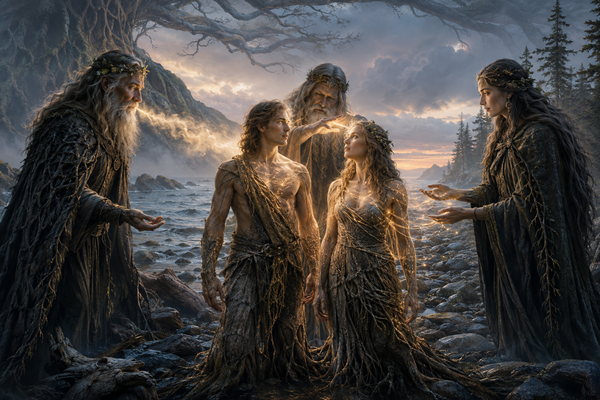
In stanzas 17–18 of Völuspá, three Æsir come upon Ask and Embla. They are Óðinn, Hœnir and Lóðurr.
The pair are described as lítt megandi — possessing little strength or capability — and örlöglausa. That final word is often translated as “without fate” or “without destiny,” although, as usual, the Old Norse idea behind örlög carries more weight than a simple English equivalent can capture.
Then comes the list of what they lack:
önd
óðr
lá
læti
and litr góður.
Translations make this passage look much simpler than it really is.
One English version may give us soul, sense, heat, movement and good colour. Another may prefer breath, mind, blood, activity and healthy appearance. Those differences aren’t translators being careless. Several of the words genuinely allow more than one interpretation.
That uncertainty is part of what makes the passage so interesting.
Önd — breath and life
Önd is commonly translated as breath, spirit or the life-breath.
The connection between breathing and being alive hardly needs explaining. Breath is one of the clearest boundaries between a living body and a dead one, and many cultures have used the same word or related ideas for breath, spirit and life.
In the poem, Óðinn gives önd.
It would be easy to translate this simply as “soul,” but that imports a great deal of later religious baggage. “Breath” or “life-breath” leaves more room for the Old Norse term to remain itself.
The gift begins the transformation, but it doesn’t complete it.
Óðr — mind, awareness and inspiration
Hœnir gives óðr.
This is an especially rich word. Depending upon context and interpretation, it can be connected with mind, thought, sense, inspiration, excitement or an intensified state of awareness. It’s also linguistically related to the name Óðinn, which makes the vocabulary even more intriguing.
Calling óðr simply “intelligence” feels too narrow.
Ask and Embla require an inward capacity to perceive, think and respond. Breath may make life possible, while óðr gives that life awareness and inner movement.
Even then, the pair still require more.
Lá — the difficult gift
Then we reach lá, one of the most troublesome words in the stanza.
Translations have offered blood, warmth, vital fluid and other possibilities. Scholars continue to debate exactly what was meant, and there is no reason for us to pretend the problem has been solved.
Lóðurr gives lá and good litr.
Whatever lá meant to the poet or audience, it appears to belong among the bodily or vital qualities missing from Ask and Embla. It contributes something that makes the body alive, animated or properly human.
Sometimes uncertainty is more useful than choosing the neatest translation. In this case, the uncertainty reminds us how easily an English word can create an interpretation that the Old Norse itself doesn’t demand.
Læti and litr — activity and living appearance
Læti is also difficult. It can carry ideas connected with movement, behaviour, manner, sound or activity depending upon context. Then there is litr góður — literally something much closer to good colour or good appearance than to a grand spiritual quality.
That might sound superficial until we think about the visible difference between a living human body and a corpse. Colour, animation, movement, expression and response are all signs that someone is present.
The poem therefore seems to be looking at humanity from several directions at once. There is breath. There is consciousness or inspired awareness. There are bodily qualities. There is activity. There is the visible appearance of life. No single English word captures the whole transformation.
Snorri tells it differently
Snorri’s Gylfaginning gives us the more familiar story of gods walking beside the shore and finding two pieces of wood.
His divine trio is Óðinn, Vili and Vé rather than Óðinn, Hœnir and Lóðurr. They fashion human beings from the wood and give them qualities including life and breath, consciousness, movement, appearance, speech, hearing and sight. They also give them clothing and names.
The man becomes Ask and the woman Embla, and Miðgarðr becomes their home.
Snorri’s version makes the physical shaping of the pair much more explicit than Völuspá does. Modern retellings frequently blend the poem and Snorri together, producing one seamless story in which three gods find an ash and an elm, carve them into human shape and distribute a fixed list of spiritual gifts.
The sources themselves are less tidy.
Even the trees deserve caution. Ask has a strong linguistic association with ash. Embla is often called an elm, but the meaning of her name remains debated. “Ask and Embla are associated with wood or trees” is far safer than treating ash-and-elm as a certainty supplied by every source.
A human made through several gifts
This is where the story becomes much richer than a simple tale of two wooden people coming alive. Ask and Embla need more than breath. They need awareness. They need bodily vitality and activity. They need the ability to perceive and participate in the world around them. Snorri adds speech, hearing and sight, emphasising communication and sensory experience.
Taken together, these stories present human existence as something made from interdependent qualities. A body without awareness is incomplete. Thought without senses is incomplete. Breath, movement, appearance and communication belong to the picture too.
We should be careful here. Völuspá doesn’t hand us a systematic Norse philosophy of the soul, and we can’t use two stanzas to announce exactly what every pre-Christian Scandinavian believed a human being was.
What the poem does give us is a remarkable image. Humanity comes into being through relationship. Several powers contribute. Several qualities are required. Ask and Embla receive the ability to breathe, perceive, move and appear as living people within a world that already existed before them.
Humans enter an older world
That final point can easily be missed. Ask and Embla arrive late.
Ymir has already lived and died. The world has been shaped from his body. Gods and jötnar already exist. Relationships, conflicts and generations have already begun. Miðgarðr is prepared within an established cosmos.
Human beings don’t stand at the centre of the Norse creation sequence with everything else appearing for their sake. They enter a world already inhabited by gods, jötnar and other beings, and later Norse traditions will add ancestors, landvættir, elves, dwarves and many more presences to that inhabited landscape.
Ask and Embla are important because they mark humanity’s arrival within it. Perhaps that is the most compelling part of their story. The poem spends very little time telling us where their descendants came from, yet it pauses to tell us that being human requires far more than simply having a human-shaped body.
Breath alone isn’t enough. Neither is thought. Human life is lived through body, mind, movement, perception, appearance, communication and relationship with the world around us.
The exact meanings of the old words may continue to be argued over. The question they leave behind is still worth asking.
What is it that makes us fully human?
Source notes
The principal source is Völuspá 17–18, where Ask and Embla lack önd, óðr, lá, læti and good litr. Translation of several of these terms remains debated, particularly lá, so no single English rendering should be treated as definitive. Snorri’s alternative version appears in Gylfaginning chapter 9 and uses Óðinn, Vili and Vé as the divine trio. The common identification of Embla specifically with the elm tree is traditional but uncertain.
Next in the series
Part Five: Christianisation Was Not One Event
The myths survived into Christian manuscripts, but the conversion itself had been unfolding for generations. Next we’ll leave cosmology behind and move into history: traders carrying unfamiliar beliefs, kings using Christianity as part of political change, Iceland negotiating a legal settlement and communities living between old and new traditions.