Álfheimr: A Gift to Freyr, a Glimpse of the Elves
A child’s first tooth might seem an unlikely place to begin a story about one of the Norse realms, yet that small milestone gives us one of our clearest glimpses of Álfheimr.
In Grímnismál, we are told that the gods gave Álfheimr to Freyr as a tooth-gift. Gifts marking a child’s first tooth were part of ordinary family life, which makes the image rather wonderful: a familiar childhood milestone carried into the world of the gods, except Freyr’s present happens to be an entire realm.
The poem doesn’t tell us who presented the gift or what Álfheimr looked like when Freyr received it. What it leaves us with is the connection itself, and that connection has shaped much of the way Álfheimr has been imagined ever since.
Freyr is associated with fruitful seasons, prosperity, fertility, peace and the conditions that allow life to flourish. It is easy, then, to picture his realm as green and abundant, filled with fertile fields, bright groves and thriving life. It is a beautiful image, and one that can work perfectly well in modern devotional practice, but it comes from Freyr’s associations rather than from an ancient description of Álfheimr itself.
A realm we glimpse rather than explore
Some places in Norse mythology are revealed through journeys. We travel into jötunn territory with Þórr, hear descriptions of divine halls, and follow the road towards Hel. Álfheimr is different. We are told it exists, given a few tantalising details, and then the stories move elsewhere.
Snorri gives us one of those glimpses in Gylfaginning, where he places the ljósálfar, the Light Elves, in Álfheimr and describes them as more beautiful in appearance than the sun. It is an extraordinary description, but a very short one. He doesn’t tell us how the Light Elves live, what their relationship with Freyr is, or what sort of landscape surrounds them.
That scarcity of detail doesn’t make Álfheimr unimportant. It simply means we need to resist the temptation to furnish it ourselves and then accidentally turn our imagined version into ancient lore.
Who were the álfar?
The word “elf” arrives in the modern imagination carrying a remarkable amount of baggage. Depending on the person, it may conjure tiny winged beings, harmless nature spirits or elegant fantasy figures with pointed ears. The Old Norse álfar are much harder to fit into one picture.
In the poetry, gods and elves are repeatedly mentioned alongside one another, which suggests beings of considerable significance rather than insignificant spirits hovering around the edges of the mythological world. Yet the texts rarely pause to explain exactly what an álfr was. The people hearing these poems may simply have understood the category without needing it defined for them.
Across the wider traditions, elves become associated with supernatural power, beauty, prosperity and ritual, with some material also raising possible connections with the dead. None of those associations gives us one neat definition, and that may be part of the problem when we try to translate them into modern categories.
One thing we can safely discard is the assumption that beauty meant harmlessness.
Völundr and the less gentle side of elves
Völundarkviða gives us one of the strongest warnings against turning every elf into a pleasant woodland spirit. Völundr is associated with elves through the titles used for him, but his story is brutal.
He is an exceptional smith who is captured by King Níðuðr, maimed and held against his will. His eventual revenge is calculated and horrific, involving murder and sexual violence before he escapes.
Völundr’s story isn’t set in Álfheimr, and we shouldn’t make him a standard example of Snorri’s Light Elves. What he does show is that the wider category of elves could carry something far more formidable than the soft, harmless imagery that later folklore and modern fantasy sometimes encourage.
Other-than-human beings in the Norse world didn’t need to be safe in order to be worthy of respect.
Freyr and the flourishing world
Freyr’s connection with Álfheimr naturally draws our attention towards flourishing and abundance. As one of the Vanir, he is strongly associated with prosperity, fruitful seasons, peace, rain and sunshine, all of which mattered greatly to households whose survival depended upon land, livestock and harvest.
Fertility in that context means much more than reproduction. It includes crops actually growing, animals thriving, families remaining healthy, favourable weather arriving when it is needed and enough peace existing for people to sow, tend and eventually harvest what they planted.
That gives modern Norse Pagans plenty to work with when contemplating Freyr and Álfheimr. What we should avoid is turning those associations into a detailed ancient description and claiming that the sources tell us Álfheimr consisted of fertile fields, sacred groves or shining farmland tended by Light Elves.
They don’t. What they give us is Freyr and Álfheimr together, and sometimes a connection is all that survives.
Behind a closed door
One of our most fascinating glimpses of elves in religious practice doesn’t take us to Álfheimr at all. Instead, it leaves us standing outside somebody’s house.
The Christian poet Sigvatr Þórðarson describes travelling through Sweden in his Austrfararvísur. At one household he is refused entry because an álfablót, a sacrifice to the elves, is taking place inside.
And unfortunately for us, the door stays firmly shut.
We don’t see what was offered or hear what was said, nor are we told exactly which álfar were being honoured. What the incident does preserve is evidence that elves could receive ritual attention and that this particular observance was private enough for an outsider to be turned away.
There is something wonderfully human about the scene. Rather than a grand mythological encounter, we have a traveller arriving at a household only to be told, essentially, “Not tonight, we’re doing something private.”
That small moment gives the elves a place within lived religion rather than mythology alone.
Elves, prosperity and the dead
The household setting of the álfablót becomes even more interesting when placed beside traditions that have led scholars to explore possible relationships between elves, prosperity and the dead.
One frequently discussed figure is Óláfr Geirstaðaálfr, a deceased ruler whose name and later traditions have contributed to debates about whether certain honoured dead could, under some circumstances, become associated with elves. Burial mounds, ancestral presence and the continued influence of the dead upon the living form part of the wider background to those discussions.
It would be very easy to jump from that evidence to “elves were ancestors,” but that takes us further than the sources allow. Nor should álfar, ancestors and landvættir simply be treated as different names for the same beings.
The religious world behind these traditions may have allowed categories to overlap without requiring them to be identical. Land, fertility, family continuity, prosperity and the honoured dead can all belong within the same web of relationships without every being involved becoming the same thing.
Sometimes our difficulty comes from wanting sharper labels than the original traditions may ever have needed.
Light Elves, Dark Elves and Snorri’s tidy divisions
Snorri complicates the picture by distinguishing between Light Elves and Dark Elves. His ljósálfar dwell in Álfheimr and are described through brightness and extraordinary beauty, while the dökkálfar, Dark Elves, are associated with what lies beneath the earth.
At first glance this seems wonderfully straightforward: bright elves above and dark elves below. Modern systems can then take the idea further, turning them into two balanced halves of a spiritual system, perhaps with Light Elves governing growth and fertility while Dark or Black Elves rule minerals, craft and transformation underground.
The problem is that the medieval material doesn’t actually give us that system.
Snorri also uses terminology involving svartálfar, Black Elves, in contexts that become tangled with dwarfs. Scholars have therefore long questioned how clearly these categories were distinguished in earlier tradition and how much Snorri may have been organising varied material into a system that made sense within his own intellectual world.
His contrast between beings of light and darkness may also owe something to the Christian environment in which he was writing. That doesn’t mean we should simply throw Snorri’s account away, but it does mean we should be cautious about treating his categories as a perfectly preserved map of older pre-Christian belief.
Álfheimr belongs securely with the Light Elves in Snorri’s account. Beyond that, things become considerably murkier.
How close were the elves?
Modern Nine Realms diagrams encourage us to imagine Álfheimr as a completely separate world with a nice clear border around it. The sources don’t tell us how someone would travel there from Miðgarðr, how far away it was, or whether every storyteller imagined its relationship with the human world in exactly the same way.
What is interesting is how often elves appear close to human concerns. An álfablót takes place inside a human household. Discussions around elves can touch upon prosperity, family continuity and the dead. Later legendary traditions contain people whose ancestry or qualities blur the line between ordinary humanity and the supernatural.
None of that proves that Álfheimr was imagined as a hidden layer sitting directly beside our own world, and we don’t need to invent a “parallel dimension” to explain it. It does suggest that the álfar themselves weren’t necessarily thought of as completely detached from human life.
The realm may remain distant and poorly described while the beings associated with it appear surprisingly close.
Álfheimr and the edges of human experience
Later sagas and legendary traditions make these boundaries even less comfortable. Extraordinary ancestry, relationships between humans and supernatural figures, unusual beauty and remarkable abilities can all place characters somewhere near the edge between the ordinary and the otherworldly.
These later stories can’t be used as straightforward maps of Álfheimr, nor do they establish that humans and Light Elves routinely married one another. They do, however, preserve a world in which the supernatural wasn’t always locked behind an impenetrable wall.
That fits surprisingly well with everything else we encounter around elves. They appear beside gods in poetry, within household religion, around traditions involving prosperity and the dead, and within stories where categories become difficult to keep neatly separated.
Perhaps the problem isn’t that the elves are badly defined. Perhaps we are simply expecting them to fit into a kind of classification system the surviving mythology never intended to provide.
What can we actually say about Álfheimr?
When the later imagery is cleared away, what remains isn’t a huge amount, but it is still significant.
Álfheimr is genuinely named in the Old Norse sources. Grímnismál tells us that it was given to Freyr as a tooth-gift, while Snorri places the extraordinarily beautiful Light Elves there.
Beyond that, the picture becomes less certain.
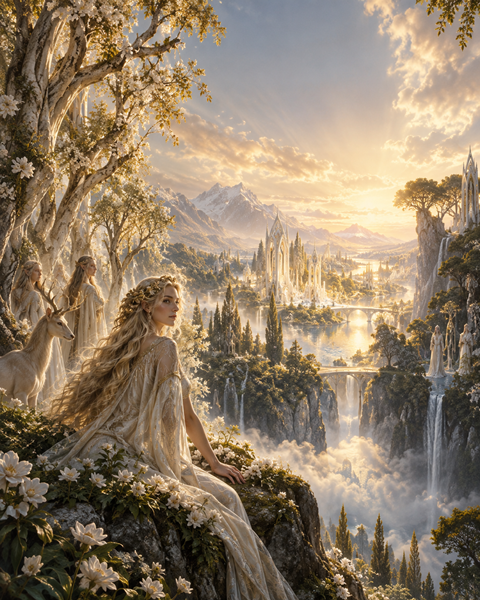
We don’t have an ancient description of shining elven cities, eternal summer, endless flower-filled meadows or elaborate courts ruled by beautiful supernatural beings. Those images can be perfectly meaningful in artwork, meditation or personal practice, but they should be recognised as imagination rather than surviving description.
There is no need to see that as disappointing. Sometimes mythology leaves us with a doorway rather than a complete room, and Álfheimr is one of those places.
Álfheimr for a modern Norse Pagan
For modern Norse Pagans, Álfheimr offers plenty to contemplate without requiring us to fill every gap.
Freyr’s connection naturally brings thoughts of growth, good seasons, peace, prosperity and the conditions that allow life to thrive. That can turn our attention towards very practical things: tending the land we live upon, caring for what feeds us, supporting the wellbeing of our household and recognising that abundance usually requires work as well as good fortune.
The álfablót gives us something different. It reminds us that pre-Christian religion wasn’t lived only through great public ceremonies or stories about famous gods. Some relationships were maintained quietly within households, behind doors outsiders weren’t permitted to enter.
The possible connections surrounding elves, prosperity, land and the honoured dead can also encourage us to think about our own relationships with place and those who came before us, while remembering that álfar, ancestors and landvættir aren’t automatically interchangeable.
There is also something valuable in simply accepting the uncertainty.
Our knowledge of Álfheimr begins with a wonderfully domestic image: a young god gets his first tooth and receives a gift. From there we glimpse beings described as more beautiful than the sun, hear gods and elves named together, and find evidence that people once held sacrifices for álfar behind closed doors.
Then the trail grows faint.
Perhaps that is part of Álfheimr’s charm. We know enough to recognise that it belonged within the Norse mythological world and mattered enough to be remembered, but not enough to draw every tree, road and hall upon a map.
For once, we can leave the door partly closed.
Sources and further reading
Primary sources:
- Prose Edda, trans. Anthony Faulkes — Álfheimr given to Freyr as a tooth-gift; Light/Dark Elf distinctions.
- Poetic Edda, trans. Carolyne Larrington — contextual references to elves, fertility, and cosmology.
- Þiðreks saga, trans. Jackson Crawford — saga motifs involving elves and human lineage.
- Hrólfs saga, trans. Jackson Crawford — legendary material hinting at elf–human interactions.
Scholarly context:
- Discussions of álfablót and household cult.
- Studies on elves as ancestral or land spirits in Norse belief.
- Comparative Germanic folklore on elves and fertility spirits.