The trouble begins with Sif’s hair.
Loki cuts it off, and Þórr’s reaction makes it very clear that this particular joke needs fixing quickly. Loki promises to replace what he has taken, but ordinary hair won’t do. He must find craftsmen capable of making hair from gold that will grow upon Sif’s head as naturally as the original.
To repair the damage, Loki has to seek out skills the gods themselves do not possess.
The sons of Ívaldi make the golden hair, but they don’t stop there. They also create Gungnir, Óðinn’s spear, and Skíðblaðnir, Freyr’s remarkable ship, large enough to carry the gods and their equipment yet able to be folded away when it isn’t needed.
Three extraordinary treasures might have been quite enough, but Loki being Loki, he turns the whole thing into a wager. He bets his own head that Brokkr’s brother can’t produce three objects equal to those already made.
What follows gives the gods some of their most famous possessions and gives us one of our best glimpses of the beings behind them: the dvergar, the dwarves.
Finding the makers is much easier than finding their realm.
Svartálfaheimr, Niðavellir and a problem with names
Modern Nine Realms charts often treat Svartálfaheimr and Niðavellir as two names for the same dwarven world. It is a convenient solution, but the surviving sources aren’t quite that tidy.
In Gylfaginning, Snorri sends Skírnir to Svartálfaheimr, the world or home of the Black Elves, to obtain the binding that will eventually hold Fenrir. The beings who make it are dwarves. Elsewhere in Skáldskaparmál, Loki encounters the dwarf Andvari after being sent into the land of the Black Elves. Snorri therefore creates a strong overlap between svartálfar, “Black Elves,” and dwarves.
Niðavellir appears differently. In Völuspá, we hear of a golden hall there belonging to Sindri’s kin, which clearly connects the place with dwarves. The poem doesn’t, however, tell us that Niðavellir and Svartálfaheimr are the same place, nor does it say that every dwarf lives there.
So it makes sense to discuss them together, because both names belong within traditions surrounding dwarven places, but we should resist turning them into one perfectly mapped underground kingdom simply because a modern realm-list wants a single answer.
The dwarves themselves are much more securely attested than the borders of wherever they live.
Dwarves at the beginning of the world
The dwarves aren’t late additions who appear only when a god needs something forged. They belong very close to the beginnings of the mythological world.
Völuspá places their formation among the events surrounding the ordering of the cosmos and connects them with the mysterious imagery of Brimir’s blood and Bláinn’s limbs. The poem then launches into the long Dvergatal, the catalogue of dwarf names familiar to anyone who has ever tried to keep track of just how many of them there are.
The details of their origin aren’t completely straightforward, particularly once Snorri’s prose account is placed beside the poetry. As happens often in Norse mythology, the surviving traditions don’t line up perfectly.
What does come through clearly is that dwarves aren’t insignificant background creatures. They belong to the oldest layers of the mythic world, and what they know how to make repeatedly changes the stories of gods, monsters and humans.
The treasures of the gods
The story that begins with Sif’s missing hair shows just how important dwarven craft becomes.
The sons of Ívaldi create Sif’s golden hair, Gungnir and Skíðblaðnir. Then Loki makes his wager, and Brokkr and his brother accept the challenge.
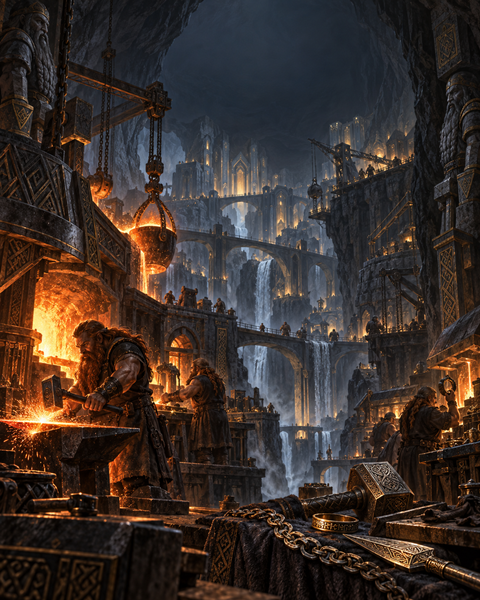
As the smith works, Brokkr keeps the bellows going. A fly repeatedly attacks him, trying to interrupt the work, but he endures the first assaults. From the forge come Gullinbursti, the golden-bristled boar whose light shines through darkness, and Draupnir, the ring from which eight rings of equal weight drop every ninth night.
During the final task, the fly bites Brokkr between the eyes. Blood runs down his face, forcing him to lift his hand from the bellows for a moment.
The final treasure is Mjǫllnir.
Its handle is shorter than intended because of that interruption, yet the gods still judge Þórr’s hammer the greatest of the treasures because of the protection it offers against their enemies.
There is something I particularly like about that detail. One of the most famous objects in Norse mythology isn’t presented as flawless. The circumstances of its making leave a mark upon it, but that imperfection doesn’t prevent it from becoming one of the gods’ most important possessions.
And then, of course, there is Loki’s wager.
He loses.
The makers expect to be paid
It is easy to tell stories about dwarves as if they simply exist somewhere underground waiting for gods to turn up with commissions. The actual myths give them far more agency than that.
Brokkr expects Loki to honour his wager and hand over his head. Loki tries to escape the consequences by arguing that Brokkr may take his head but can’t damage his neck, since the neck wasn’t included in the bargain.
Brokkr can’t collect the payment exactly as promised, so he settles for sewing Loki’s lips together.
It is funny, but it also tells us quite a lot about how these encounters work. Dwarves bargain, compete, demand payment and object when someone attempts to cheat them. Their skills may serve the gods, but that doesn’t make them servants of the gods.
The treasures leave the forge and enter divine mythology. Their makers remain people with their own interests, pride and grievances.
Gleipnir: solving an impossible problem
One of the strangest dwarven creations isn’t a weapon or piece of jewellery at all.
As Fenrir grows, the gods become increasingly afraid of him. They try to restrain him with great chains, but he breaks them. Greater weight and more ordinary strength aren’t enough, so once again the gods turn to dwarven skill. The result is Gleipnir, a binding that looks smooth and soft like a ribbon yet proves stronger than the heavy fetters that came before it.
Snorri gives its ingredients as a wonderfully impossible collection: the sound of a cat’s footsteps, a woman’s beard, the roots of a mountain, a bear’s sinews, a fish’s breath and a bird’s spittle. Gleipnir works precisely because it’s not ordinary material behaving in an ordinary way.
Fenrir, however, is suspicious. He agrees to be bound only if one of the gods places a hand inside his mouth as a pledge of good faith. Týr does so, knowing what may happen. When Gleipnir holds and the gods refuse to free the wolf, Fenrir bites off Týr’s hand.
The dwarves have done exactly what they were asked to do. They solved the problem the gods brought them. What happens because of that solution belongs to a much larger story.
That distinction becomes important throughout the dwarven myths. Craft can make something possible, but it doesn’t decide how that creation will be used.
Alvíss and knowledge beyond the forge
Dwarven ability isn’t limited to making objects.
In Alvíssmál, the dwarf Alvíss arrives claiming that Þórr’s daughter has been promised to him. Þórr isn’t pleased to discover that such an arrangement was made in his absence, so rather than simply accepting the marriage, he begins questioning Alvíss.
Throughout the night, Alvíss gives the different names used for earth, sky, sun, moon, sea and other parts of the cosmos among gods, jötnar, elves, dwarves and other beings. The same world, we discover, can be known through many different words depending upon who is speaking.
Alvíss displays an impressive command of language and poetic knowledge. The poem doesn’t require us to turn those names into a secret magical system through which reality can be controlled. His knowledge is remarkable enough without adding something that the source doesn’t say.
Þórr, meanwhile, has been doing something rather less scholarly. He keeps Alvíss talking until dawn. The usual interpretation is that daylight turns the dwarf to stone, although the poem itself ends with Þórr announcing that day has overtaken him rather than giving us a lengthy description of the transformation.
Alvíss knows an extraordinary amount about the world, but he fails to realise what Þórr is doing until it is too late. It is a nice reminder that knowing many things and reading the situation in front of you aren’t always the same skill.
Dvalinn and the runes
Hávamál gives us another short glimpse of dwarven knowledge. In the passage concerning the runes, Dvalinn is named in connection with runes among the dwarves. The reference is brief, but that brevity is part of what makes it interesting. It places runic knowledge beyond Óðinn alone and associates it with different groups of beings within the mythological world.
What it doesn’t tell us is that Dvalinn taught Óðinn the runes, nor does it establish dwarves as universal guardians of every hidden magical secret. Those ideas go beyond the poem. Sometimes a small piece of information is more valuable when we allow it to remain small.
Andvari and the gold that carries an old wrong
The story of Andvari takes us away from smithies and into a very different hidden place. Andvari is a dwarf associated with water who can take the form of a fish. Loki catches him and demands his treasure as the price of his life. The circumstances are already ugly. Loki has killed Otr, one of Hreiðmarr’s sons, and gold is needed to pay compensation. To obtain enough, Loki threatens Andvari and strips him of his wealth.
Andvari gives up the treasure but tries to keep one ring. Loki takes that too. Only then does Andvari place a curse upon the hoard, declaring that it will bring destruction to those who possess it. The gold passes to Hreiðmarr, but his son Fáfnir murders him to take it. Fáfnir eventually becomes a serpent or dragon and guards the treasure until Sigurðr kills him, and the hoard continues onward into further betrayals and deaths.
It is tempting to turn this into a simple story about cursed gold and greed, but the trouble begins before the curse is spoken. A killing has already taken place, compensation is being demanded, and another being is threatened and robbed to satisfy that debt.
The curse doesn’t introduce wrongdoing into an otherwise innocent story. It enters a story where violence, greed and coercion are already present. Once the gold begins passing from one owner to another, those earlier wrongs travel with it.
What happens after something is made
Many dwarven stories share an interest in objects that continue gathering meaning long after they leave the hands that made them.
Mjǫllnir protects gods and humans, but it is also a weapon capable of devastating violence. Gleipnir is an extraordinary solution to an impossible problem, yet its use costs Týr his hand and becomes part of the growing hostility surrounding Fenrir. Andvari’s treasure pays compensation for one death before moving through murder, transformation and betrayal.
These objects aren’t morally equivalent, nor are the craftsmen automatically responsible for everything that later happens because of their work. What the stories show is that making something is rarely the end of its story. Someone commissions it. Someone bargains for it. Someone pays honestly, cheats, steals, inherits or decides how it will be used.
That makes the dwarven stories much richer than simple tales of magical craftsmanship. They are also stories about ownership, exchange and consequences.
Dwarves at Ragnarök
Dwarves don’t dominate the Ragnarök stories in the way Fenrir, Jörmungandr, Surtr or the gods do, but they aren’t entirely absent. Völuspá briefly shows dwarves groaning before their stone doors as the world moves towards catastrophe. We aren’t given a detailed account of their fate, but their work remains present in the events unfolding around them.
Fenrir eventually breaks free despite the binding created to hold him. Þórr carries Mjǫllnir into his final battle with Jörmungandr, and the hammer survives beyond its first owner. Vafþrúðnismál tells us that Þórr’s sons Móði and Magni will possess Mjǫllnir after the great conflict.
A dwarven-made object therefore crosses from the old world into the renewed one. The maker may be nowhere near the final battlefield, but the work remains.
What about the Light Elves?
This is where modern cosmological diagrams can create another problem.
Álfheimr and Svartálfaheimr are often placed opposite one another, which makes it tempting to build a beautifully balanced system: Light Elves above ground associated with fertility and growth, while Dark or Black Elves and dwarves rule minerals, forging and transformation beneath the earth. It is an attractive piece of symbolism, but it’s not a system given to us by the medieval sources.
Snorri distinguishes between Light Elves and Dark or Black Elves, but his terminology becomes tangled with dwarves. The texts don’t tell us that the two groups act as complementary halves of one cosmic structure, nor do they divide responsibility so neatly between everything growing above ground and everything hidden below it.
Those ideas can certainly be used within modern spiritual practice if someone finds them meaningful, but they should be recognised as modern interpretation rather than recovered Norse cosmology.
The dwarves already have enough interesting stories without needing to become the shadow-side of the elves.
So where are Svartálfaheimr and Niðavellir?
This is another case where the honest answer is less tidy than the modern map. Snorri uses Svartálfaheimr in stories involving dwarves. Völuspá places a golden hall belonging to Sindri’s kin at Niðavellir. Beyond those associations, we aren’t given enough information to merge them confidently into one realm with known boundaries.
Dwarves themselves appear in stone, mountains, underground places and even water. Their stories care far more about individual beings, treasures, bargains and encounters than about drawing the borders of a dwarven kingdom.
So rather than declaring that every dwarf lives in one subterranean realm, it is safer to accept that the surviving tradition preserves several kinds of dwarven places. In this case, the makers are much easier to find than their homeland.
Svartálfaheimr and Niðavellir for a modern Norse Pagan
For modern Norse Pagans, these stories naturally raise questions about skill, making and responsibility, but they also offer something more practical than turning Svartálfaheimr into a symbolic “realm of creativity.”
The dwarves are skilled because they know their craft. They understand materials, techniques and possibilities that other beings don’t. The gods repeatedly depend upon that knowledge, yet ability alone doesn’t make the dwarves morally perfect. They compete fiercely, bargain hard, take offence, place curses and insist upon being paid.
That feels much more interesting than making them simple symbols of craftsmanship.
Their stories ask us to think about what it means to know how to make something well, who benefits from that knowledge and what obligations surround the things we bring into the world. Those questions can apply to far more than metalwork. They can belong to a tool, a piece of writing, a ritual object, a teaching passed to someone else or something created for a household or community.
The mythology doesn’t tell us that Svartálfaheimr represents technology, obsession, the subconscious or creative transformation. Those are modern frameworks. What the old stories give us are remarkable makers whose work becomes inseparable from the lives of everyone who later uses it.
Þórr carries a dwarven-made hammer into battle. Óðinn carries Gungnir. Freyr possesses Skíðblaðnir and Gullinbursti. Fenrir is held by Gleipnir, and an old wrong follows Andvari’s ring through generations of violence.
The makers themselves may remain behind stone doors, beneath mountains, beside hidden waters or somewhere our surviving maps can’t confidently place. Their work doesn’t remain hidden with them.
Once it enters the world, it becomes part of someone else’s story.
Sources and further reading
Primary sources:
- Poetic Edda, trans. Carolyne Larrington
- Völuspá (creation of dwarves)
- Alvíssmál (cosmic knowledge of dwarves)
- Hávamál (runic wisdom and Dvalinn)
- Prose Edda, trans. Anthony Faulkes
- Skáldskaparmál (the forging of the gods’ treasures)
- Völsunga saga, trans. Jackson Crawford
- Andvari’s hoard, Fáfnir, and the cursed gold