Helheimr: Beyond the Bridge, Among the Dead
For nine nights, Hermóðr rides through valleys so dark and deep that he can’t see his way. He travels on Sleipnir with a task given to him by grieving gods: find Baldr and discover whether there’s any way to bring him home.
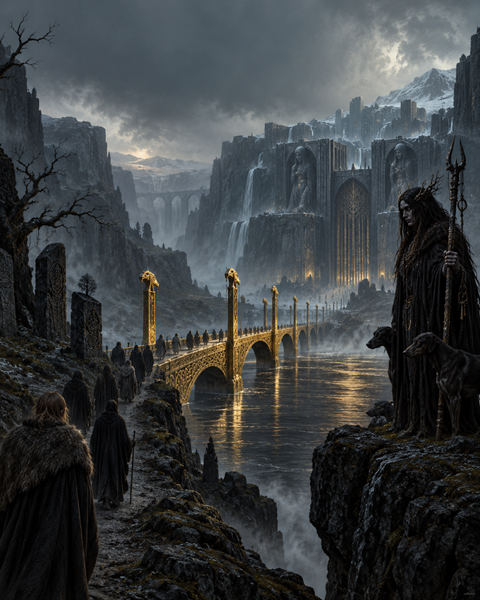
Eventually he reaches the river Gjöll, where a bridge covered in shining gold spans the water. Its guardian, Móðguðr, stops him and immediately notices something strange. Companies of dead people crossed the bridge the previous day, yet it makes as much noise beneath this single rider as it did beneath all of them. Hermóðr also lacks the colour of the dead.
Why, she wants to know, is a living man travelling the road to Hel? Hermóðr explains that he’s searching for Baldr. Móðguðr has seen him pass and directs Hermóðr onwards, along a road leading downwards and northwards.
This journey in Snorri’s Gylfaginning gives us one of the fullest glimpses of the place commonly called Helheimr today. In the medieval sources, Hel can mean both the realm of the dead and the being who rules there. Using “Helheimr” can be helpful when we want to distinguish the place from its ruler, but the older language doesn’t always separate them so precisely.
What Hermóðr encounters is also very different from the fiery place of eternal punishment that the English word “Hell” may bring to mind. Hel’s realm is dark, distant and difficult to reach. Rivers, bridges, gates and guarded boundaries separate it from the living world, but there’s no universal furnace waiting to torment everyone who arrives.
Beyond the gates
When Hermóðr reaches Hel’s gates, he tightens Sleipnir’s girth and urges him forward. The horse leaps cleanly over the barrier, carrying the living traveller into the realm of the dead. Inside, Hermóðr finds Baldr seated in a place of honour.
That detail alone changes the atmosphere considerably. Baldr isn’t being tortured, judged as wicked or stripped of who he was. He remains recognisable, able to speak, remember and care about those he left behind. Nanna is there with him, and when Hermóðr eventually prepares to leave, Baldr sends Óðinn the ring Draupnir while Nanna sends gifts back to Frigg and Fulla. Death has separated them from the living, but it hasn’t erased affection or memory.
Hermóðr stays the night and then asks Hel whether Baldr may return with him. The answer shows just how firmly the boundary between the living and the dead is held.
Hel’s authority
Hel agrees that Baldr may return if everything in the world, living and lifeless, weeps for him. If even one being refuses, he must remain. The gods send messengers throughout the world, and everything mourns until they encounter Þökk, who refuses to weep. Baldr therefore stays with Hel.
From the perspective of those grieving for him, Hel’s decision can feel harsh. Yet the story doesn’t show her causing Baldr’s death or punishing him after it. She has authority over the dead in her keeping, and even the gods can’t simply ride into her realm and take someone back because they miss him.
Snorri establishes that authority earlier in Gylfaginning when describing the children of Loki and Angrboða. Jörmungandr is thrown into the sea, Fenrir remains among the Æsir for a time, and Hel is cast into Niflheimr. There, Óðinn gives her authority over those sent to her, particularly people who die from sickness or old age. Hel doesn’t conquer this realm or seize it from another ruler. She’s placed there and given responsibility for those who come into her keeping. That makes her role much closer to ruler and keeper of the dead than to an executioner waiting to punish them.
Who goes to Hel?
Snorri’s description has helped create the familiar shorthand that warriors go to Valhǫll while everyone who dies from sickness or old age goes to Hel. The surviving traditions aren’t quite that simple, however.
Baldr’s the most obvious difficulty because his death is violent, yet he still goes to Hel. Other traditions connect the dead with burial mounds, the sea and different divine hosts. Óðinn receives some of the battle-slain in Valhǫll, while Freyja receives some in Fólkvangr. Not every surviving story fits into a single system where the manner of death automatically determines one fixed destination.
It’s probably safer to think in terms of several overlapping traditions about the dead rather than one universal Norse afterlife chart.
Hel is nevertheless strongly associated with deaths outside the famous warrior ideal, and that’s notable. Most people in Norse society didn’t die in a blaze of glory on a battlefield. They raised children, tended livestock, grew food, traded, crafted, kept households running and eventually died through illness, age, accident or countless other ordinary causes.
Nothing in the surviving material makes those lives failures simply because they didn’t end with a weapon in hand.
Hel and Niflheimr
The connection between Hel and Niflheimr is another place where modern Nine Worlds diagrams can make things look much more orderly than the sources do.
Snorri explicitly tells us that Hel is cast into Niflheimr and given authority there. That doesn’t mean Hel and Niflheimr are identical in every sense. Niflheimr already exists in Snorri’s creation story as the ancient region of mist, cold and Hvergelmir, while Hel has her own halls, household and authority over the dead.
What it does mean is that insisting upon Helheimr and Niflheimr as two completely separate worlds creates problems the medieval material itself doesn’t seem especially worried about. As with so much of Norse cosmology, the relationship between places is often clearer than the map. Hel’s realm belongs within the wider lower-world traditions connected with Niflheimr, but the sources don’t provide the kind of precise borders modern diagrams tend to demand.
Inside Hel’s hall
Snorri’s description of Hel herself and her household is undeniably bleak. He describes her as partly blue-black and partly flesh-coloured, with a stern appearance. The familiar modern image of Hel as literally divided into a living woman on one side and a corpse on the other develops from that description, although Snorri’s wording itself is less anatomically specific.
Her hall is called Éljúðnir, and many of the names associated with her household evoke hunger, sickness, weakness and bodily decline. Her dish and knife are linked with Hunger and Famine, her threshold with stumbling, and her bed with sickness.
These are grim images, but grimness isn’t the same thing as torture. Hunger, frailty, illness and physical decline were familiar parts of human life and death. Snorri brings those experiences into Hel’s household and gives them names among its furnishings. The stories don’t show Hel deliberately inflicting them upon the dead as punishment.
Nor do we need to turn the realm into a cosy refuge in order to move away from the Christian Hell comparison. Hel is distant, dark and difficult to reach. It belongs to death, separation and things the living naturally fear. It can be bleak without being a place of universal damnation.
A hall prepared for Baldr
Baldrs draumar adds another image that makes Hel’s realm harder to reduce to one simple mood. Before Baldr dies, Óðinn rides down to question a dead seeress. He asks why benches have been decorated, and gold spread so beautifully within the hall. The answer is that mead has been prepared for Baldr.
Placed beside Hermóðr’s journey, this gives us a much richer picture. There are dark roads and guarded boundaries, but there are also halls, prepared benches, mead, conversation and gifts. Baldr remains himself after death, and Nanna’s concern for those she left behind continues.
Hel is neither a cheerful paradise nor simply a place of horror. It’s somewhere the dead exist apart from the living, and the stories allow that separation to contain both sorrow and continuing relationship.
Náströnd and the dishonourable dead
There is, however, explicitly unpleasant afterlife imagery within the Norse sources. In Völuspá, we encounter Náströnd, the “Corpse Shore,” where a terrible hall is associated with serpents and dripping venom. Oathbreakers and murderers suffer there, while nearby in the poem Níðhöggr feeds upon the dead.
This is much closer to what we would call punitive imagery. What we should avoid is simply taking Náströnd and using it as a description of Hel as a whole. The broader traditions surrounding Hel include Baldr seated in honour, prepared mead, halls and ordinary dead, while Náströnd concerns a particularly grim fate associated with serious wrongdoing.
At the same time, the sources don’t give us a labelled map explaining exactly how Náströnd relates geographically to every other lower-world location.
What we can say is that Norse traditions did include the idea that some forms of dishonourable behaviour could lead to a dreadful fate after death. That still doesn’t make Hel herself the torturer of everyone who enters her realm.
Christian influence and older ideas of death
Our surviving accounts were written down in Christian societies, often long after Scandinavia had officially converted. That naturally raises questions about how Christian ideas of Hell, judgement and punishment may have influenced the way older traditions were recorded.
Unfortunately, there’s no simple filter that lets us remove every Christian element and uncover a perfectly preserved pagan original beneath it.
It would be just as misleading to decide that every frightening detail must be Christian and reconstruct an entirely peaceful pre-Christian Hel. Death was frightening long before Christianity arrived in Scandinavia. Illness, hunger, winter, burial, bodily decline and separation from loved ones needed no outside theology to make them unsettling.
The surviving material is better allowed to remain complicated. Hel’s realm can be dark without being evil. It can be sorrowful without being a place of damnation, and somewhere the living wouldn’t necessarily be eager to reach while still belonging naturally within a pre-Christian understanding of death.
When the boundary breaks
Hel’s realm appears again when Ragnarök begins to break apart the old order. Snorri describes people or forces from Hel accompanying Loki into the final conflict. This is sometimes turned into an image of every ordinary dead person suddenly rising as part of an army against the gods, but the text doesn’t tell us enough to make that claim.
What we see more broadly at Ragnarök is the collapse of boundaries that had held the mythic world together. Fenrir breaks free, Jörmungandr rises from the sea, Loki is released, and Surtr advances from Muspell. The separation between living and dead becomes caught within that wider breakdown.
Then, beyond Ragnarök, Baldr and Höðr return in the renewed world. There’s something particularly striking about Baldr’s return. Hermóðr couldn’t negotiate him back from Hel, no matter how deeply the gods grieved. Death couldn’t simply be reversed because they wanted it undone.
Yet Baldr does return eventually, not because Hel’s authority has been overruled in the old world, but because a new age has begun.
Helheimr and ordinary death
Perhaps one of the most important things Hel’s realm gives us is mythological space for ordinary death.
Most lives aren’t heroic epics, and most deaths aren’t glorious last stands. Human lives are largely made from raising children, tending homes, caring for animals, making things, loving people, keeping promises, enduring difficult years and belonging to families and communities.
The surviving Norse traditions don’t require those lives to become less meaningful because they end quietly.
Nor does the afterlife need to become a competition in which reaching Valhǫll is the prize and everyone else has somehow lost. Valhǫll itself has a particular purpose connected with Óðinn and Ragnarök; it was never simply a Norse version of heaven for all the best people.
Modern Norse Pagans naturally understand Hel in different ways. Some approach her devotionally as a compassionate keeper of the dead, while others emphasise her firmness and her guardianship of the boundary between those who live and those who have gone before. Those can both be meaningful modern relationships with her, provided we distinguish them from what the medieval sources explicitly say.
For me, one of the most affecting images remains Hermóðr riding home. He can’t bring Baldr and Nanna back with him. The grief of the gods isn’t enough to undo death, and the boundary remains in place. But Hermóðr doesn’t return empty-handed. He carries Draupnir from Baldr and gifts from Nanna back to the people who love them. Something crosses the boundary even when the dead themselves can’t.
That feels far closer to the Hel we meet in these stories than either a blazing Hell or a perfectly peaceful paradise. Death creates absence, and that absence is real, but the importance of those who have died doesn’t disappear with them.
The road between living and dead may be long, dark and guarded, but relationship and remembrance still find ways to cross it.
Sources and further reading
Poetic Edda (trans. Carolyne Larrington):
- Völuspá (Hel’s dead and Ragnarök)
- Baldrs draumar (Hel’s realm and prophecy)
Prose Edda (trans. Anthony Faulkes):
- Gylfaginning (Hel, Éljúðnir, and the structure of Helheimr)
Sagas (trans. Jackson Crawford):
- References to Hel and death imagery across saga material