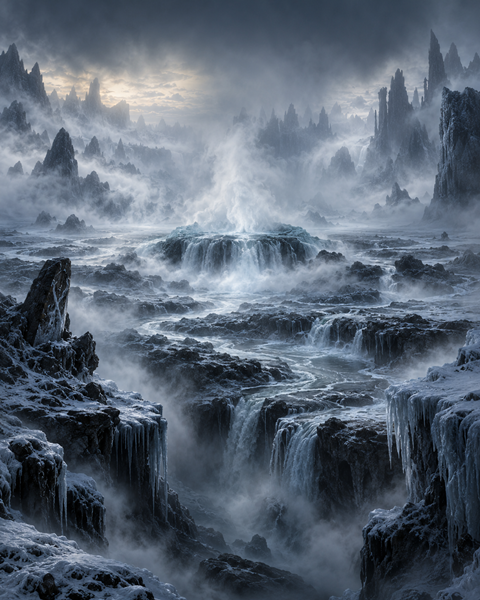
Before there is a winter landscape, there is cold. Not snow-covered fields, frozen forests or households waiting for spring, but something much older, more primordial. In Snorri’s account, Niflheimr exists before the earth has been shaped. At its centre lies Hvergelmir, a great spring from which rivers flow outward into the darkness.
Those waters don’t remain still. As they move farther from their source, the substance within them hardens. Ice forms, rime gathers over it, and frost spreads across the northern reaches of Ginnungagap, the yawning gap.
The name Niflheimr is usually understood as something like “Mist World,” which naturally brings to mind obscured distances, frost and deep cold. Yet Snorri’s description gives us something much more active than a frozen wasteland. Rivers move, moisture gathers, ice thickens, and rime spreads layer upon layer.
Long before there is anyone to see it, something is already happening.
Cold before creation
Across Ginnungagap lies the heat associated with Muspell. Warmth and sparks reach towards the frost, and where heat meets the rime, it begins to melt and drip. From those drops comes Ymir, the primaeval being from whom the frost-giants descend.
Auðhumla appears as well. Her milk sustains Ymir, while she feeds by licking the salty ice. On the first day her licking reveals hair, on the second a head, and by the third day Búri, ancestor of the gods, stands fully uncovered.
It is one of the strangest and most vivid images in Norse creation. Life appears in two different ways at once: Ymir emerges where warmth changes frost, while Búri is gradually revealed from within the ice itself.
Later, Óðinn and his brothers kill Ymir and shape the world from his body. Earth, sea, mountains and sky all come afterwards, meaning the ordered world carries a history that reaches back through Ymir to those first conditions around Ginnungagap.
It can be tempting to turn this into an orderly system in which cold represents form or resistance while heat represents energy and change. That may work as a modern reflection, but the mythology itself is more physical than philosophical. We’re given rivers, frost, melting, bodies and divine action rather than a hidden scientific theory.
And really, the imagery is strong enough without needing one.
The rivers of Hvergelmir
Hvergelmir belongs to Niflheimr from the beginning of Snorri’s account. From it flow the ancient rivers known collectively as the Élivágar, along with other named streams. As the waters move away from their source, frost forms and the rime spreads outward into Ginnungagap.
This gives Niflheimr a very different character from the motionless realm it sometimes becomes in modern descriptions. The cold doesn’t simply sit there. It accumulates around movement.
Older poetic material preserves part of this imagery too. In Vafþrúðnismál, the ancient giant Aurgelmir, whom Snorri identifies with Ymir, grows from venomous drops associated with the Élivágar.
The poem doesn’t tell the whole creation story in the same way as Snorri, but the rivers and the emergence of the earliest giant clearly belong to an older layer of tradition.
So even before we get to the later worlds of gods and humans, Niflheimr is already a place of flowing water, spreading frost and beginnings.
Beneath Yggdrasill
Once the world has been formed, Niflheimr doesn’t just disappear. In Snorri’s cosmology, one of Yggdrasill’s great roots reaches over it, with Hvergelmir lying beneath. Around that root are serpents, including Níðhöggr, who gnaws continually at the World-Tree.
That gives Hvergelmir an interesting place in the mythology. The same spring associated with the oldest rivers also lies beneath the tree whose branches spread across the worlds.
Grímnismál gives us a similarly troubled image of Yggdrasill. A hart feeds upon it from above, decay troubles its sides, and Níðhöggr gnaws from below. The tree isn’t preserved in some perfect, untouched state; it is continually under pressure.
We should be careful not to romanticise that damage by turning it into a lesson that Níðhöggr somehow strengthens the tree by harming it. The poem doesn’t say that. The tree is being injured.
Elsewhere, Snorri tells us that the Norns tend Yggdrasill with water and mud from Urðr’s well. Harm and care both belong to the life of the tree, but they aren’t the same thing.
A cosmology that refuses to sit still
Yggdrasill’s roots are also a good example of why modern diagrams can be more confident than the sources themselves. In Grímnismál, one root is associated with Hel, another with the frost-giants and another with humankind. Snorri gives a different arrangement, describing roots extending towards the Æsir, the frost-giants and Niflheimr.
The broad imagery is recognisably connected, but the details don’t form one perfectly consistent map. It’s worth taking note of that whenever we’re tempted to treat the Nine Worlds like fixed locations on a fantasy atlas. The medieval sources tend to give us relationships between places more clearly than exact coordinates.
For Niflheimr, the strongest points are simple enough. It is ancient, cold, closely connected with Hvergelmir, and placed within the lower structure of Snorri’s cosmos. Once we try to force every root, realm and neighbouring region into one precise diagram, things get much less certain.
Niflheimr and Hel
The relationship between Niflheimr and Hel is one of the places where modern realm lists create the most confusion. Snorri tells us that Óðinn casts Loki’s daughter Hel into Niflheimr and gives her authority over those who are sent to her, particularly those who die from sickness or old age. That means Hel’s realm exists within Snorri’s description of Niflheimr.
This doesn’t make Hel and Niflheimr identical in every sense. Niflheimr is the primordial region of mist, frost and Hvergelmir, while Hel has her own authority, halls and household among the dead. But it does make it difficult to insist that the two must always have been imagined as completely separate worlds.
Modern charts often need them to occupy different boxes because both names have been placed into a fixed Nine Worlds system. The sources are much less concerned with keeping those categories separate. Hel can be a ruler, a place and a region associated with Niflheimr without every term fitting perfectly into a modern map.
And then there is Niflhel
As if that weren’t enough, we also encounter Niflhel. In Vafþrúðnismál, Vafþrúðnir speaks of having travelled to Niflhel below, and Snorri uses the name as well.
The similarity between Niflheimr and Niflhel naturally invites comparison, but similar names don’t automatically make them interchangeable. Nor do the sources give us enough detail to stack one beneath the other as another level in a cosmic underworld.
What we seem to have is a cluster of ideas involving cold, depth, Hel and the dead rather than one surviving universally agreed map. Sometimes the most accurate answer really is that the exact relationship has been lost.
The road to Hel
Hermóðr’s journey after Baldr’s death gives us one of the most memorable descriptions of travel towards the lower world. He rides for nine nights through dark and deep valleys before reaching the river Gjöll and a gold-covered bridge guarded by Móðguðr. Beyond that lie the road to Hel, her gates and eventually the hall where Baldr sits.
The journey is full of darkness, distance, rivers and guarded boundaries. It feels very different from the bright halls and open roads of the gods’ world. What it doesn’t do is give us a sign saying, “You are now travelling through Niflheimr.”
Because Hel is placed within Niflheimr in Snorri’s cosmology, it is understandable that later readers connect the two. But Hermóðr’s journey is better treated as a road to the dead rather than a detailed tour through the primordial mist-world. The story gives us atmosphere and movement, not a cartographer’s guide.
Cold without stillness
Niflheimr is often described in modern writing as a realm of stillness, waiting or suspension. That can be a meaningful personal association, but the oldest imagery is actually full of movement. Hvergelmir sends out rivers. Water flows, frost spreads, and rime thickens. Beneath Yggdrasill, the spring remains active while serpents move around the root and Níðhöggr gnaws upon it.
Cold can slow things, harden them and obscure what lies ahead, but it doesn’t always mean nothing is happening. Anyone who’s watched winter closely knows that much. Ice shifts, cracks and reforms. Frost builds and melts. Water keeps moving beneath frozen surfaces.
Those physical observations can help us respond to the mythology, but they should remain our observations rather than teachings we claim the Eddas secretly contain. The sources give us moving water and gathering frost. We can let the images speak from there.
Niflheimr and Ragnarök
Because Niflheimr and Muspell stand on opposite sides of Ginnungagap in Snorri’s creation account, it is tempting to give them matching roles at Ragnarök.
Muspell sends forth Surtr and fire, so perhaps Niflheimr should release an answering wave of frost and mist. While that would be beautifully symmetrical, the surviving mythology doesn’t give us that scene. Niflheimr doesn’t suddenly unleash primordial cold across the worlds to balance Surtr’s fire. Nor is Ragnarök described as the final release of two perfectly opposed cosmic forces.
That doesn’t make Niflheimr irrelevant. It simply means its role at the world’s ending isn’t the mirror image of Muspell’s role at creation. Norse cosmology has a habit of refusing the symmetry modern systems would really like it to have.
Níðhöggr after the renewal
Níðhöggr does appear again near the end of Völuspá, but not in the way we might expect. After the poem has described the renewed earth, the dragon comes flying from Niðafjöll, carrying corpses in its wings. Importantly, the poem names Niðafjöll here, not Niflheimr.
The image is unsettling because it comes after descriptions of green earth, returning gods and renewed life. Just when everything appears to be moving towards a clean and hopeful ending, Níðhöggr returns carrying the dead.
Scholars have debated what to make of the poem’s ending, and the uncertainty is probably best left intact. Renewal doesn’t necessarily mean that every dangerous or troubling thing has vanished. Norse mythology rarely gives us an ending where everything is wrapped up quite that neatly.
Mist and what can’t yet be seen
The nifl element in Niflheimr naturally brings us back to mist. Mist changes the way a landscape feels. Distances become uncertain, familiar shapes lose their edges, and something can be present long before we can see it clearly. There is something of that feeling in the creation story itself.
Before there are human beings, before there are settlements and before anyone exists to remember what happened, rivers are already flowing and frost is already gathering. The world has a history before there is anyone within it to witness that history.
That doesn’t make Niflheimr a formal realm of hidden knowledge, memory or the unconscious. Those are modern interpretations. What the older imagery gives us is something simpler and, I think, stranger: vast processes already underway beyond ordinary human sight.
Niflheimr and the Nine Worlds
Niflheimr is routinely included in modern lists of the Nine Worlds, and Snorri certainly gives it an important place within his cosmology. The difficulty comes when those lists require every name to occupy a separate box.
If Niflheimr and Hel must be completely separate realms, what do we do with Snorri placing Hel within Niflheimr? If Yggdrasill’s roots must connect exactly three fixed worlds, which version do we choose when Grímnismál and Snorri arrange them differently? And where exactly should we put Niflhel?
The sources were never written to satisfy the requirements of a modern infographic.
It’s more useful to follow the relationships they actually preserve. Niflheimr belongs to the oldest conditions of the cosmos. Hvergelmir lies within it in Snorri’s account. One of Yggdrasill’s roots is connected with it, and traditions surrounding Hel, Niflhel and the lower world overlap with it in ways that aren’t always easy to separate.
Those connections are much firmer than any precise position we might assign it on a chart.
Niflheimr for a modern Norse Pagan
For modern Norse Pagans, Niflheimr can naturally inspire thoughts about winter, obscurity, waiting or changes happening beyond immediate sight. Some may connect it with grief, quiet or periods when life seems to slow down.
Those can all be meaningful responses, as long as we recognise them as our own.
The Eddas don’t tell us that Niflheimr is a realm of healing, emotional rest, shadow work or hidden memory. Nor do they suggest that cold is spiritually wiser than warmth or that stillness is somehow superior to action. Its surviving imagery is much more physical and much less tidy.
Rivers flow before the earth exists. Frost gathers over them until warmth reaches the rime. Ymir emerges from the melting drops while Auðhumla uncovers Búri within salty ice. Far beneath Yggdrasill, Hvergelmir remains, and Níðhöggr continues to gnaw at the root.
Perhaps the image worth carrying away is that first thaw. Niflheimr’s cold is ancient, but it isn’t the whole of creation. Life begins when conditions meet and something changes between them.
Before there are voices, homes or anyone to remember how the story started, the rime begins to drip.
Sources and further reading
Poetic Edda (trans. Carolyne Larrington):
- Völuspá (creation, Níðhöggr, Ragnarök)
- Vafþrúðnismál (cosmic origins)
- Baldrs draumar (journey to Hel)
Prose Edda (trans. Anthony Faulkes):
- Gylfaginning (Ginnungagap, Ymir, Niflheimr, Hel)
Sagas (trans. Jackson Crawford):
- Contextual material on Hel, death, and cosmology