Follow Hermóðr towards Hel and the road takes him through dark valleys, across a guarded bridge and onwards, downwards and northwards. Follow Þórr into jötunn territory and you may arrive at a stronghold so strange that it disappears once its host reveals the deception. Follow the gods to their judgement-place and their journey carries them across Bifröst towards Yggdrasill.
Each story gives us a route, a direction and some sense of distance. Put all of those journeys together, though, and the map becomes surprisingly difficult to draw.
That’s where one of the biggest questions in Norse cosmology begins. Is Ásgarðr above us? Is Jötunheimr somewhere beyond the horizon? Does Hel lie beneath the earth? Are these separate worlds, regions within one enormous landscape, or something less physical altogether?
Before we try to answer any of that, there’s one important fact to keep in mind: the surviving sources mention nine worlds, but they never give us a definitive list naming all nine.
Nine Worlds without a list of nine
Near the beginning of Völuspá, the seeress recalls nine worlds while speaking of ancient things. In Vafþrúðnismál, the wise jötunn also refers to nine worlds when describing the extent of his knowledge and travels. Neither passage stops to name them.
The familiar list found in modern books and diagrams brings together places mentioned across different poems and prose accounts: Ásgarðr, Miðgarðr, Jötunheimr, Vanaheimr, Álfheimr, Svartálfaheimr or Niðavellir, Hel, Niflheimr and Múspellsheimr.
Most of those names are firmly rooted in the surviving mythology. What we don’t have is one medieval source saying, “These are the Nine Worlds.” So the number nine is genuinely attested, while the standard list is a reconstruction.
That distinction is important because the places themselves don’t all behave in the same way. Miðgarðr is described as an enclosure prepared for humans. Vanaheimr appears mainly as the homeland of Njörðr and the Vanir. Álfheimr is given to Freyr as a tooth-gift. Niflheimr and Muspell appear in Snorri’s creation account before the ordered earth has even been formed.
They belong within the Norse mythological world, but they were never introduced to us as nine matching countries arranged around a tree.
A landscape you can travel through
Some stories make the cosmos feel surprisingly geographical. Snorri describes the sea surrounding the inhabited land, with giant families on the outer shores and Miðgarðr established farther inward as a protected enclosure. Elsewhere, travellers move eastward or northward, cross rivers, enter mountains, approach halls and pass through gates. Þórr travels into jötunn territory. Óðinn enters Vafþrúðnir’s hall. Skírnir rides towards Gerðr’s home. Hermóðr follows an actual road towards Hel.
These journeys involve distance, boundaries and places where someone else holds authority. In that sense, parts of Norse cosmology can feel remarkably walkable. This makes the idea of the realms as different regions within one vast mythic landscape quite appealing, especially when we think about Miðgarðr and the lands beyond its enclosure. The problem comes when we try to make the whole cosmos work that way.
Looking upwards and downwards
Other stories give us a much more vertical world. Snorri describes Bifröst stretching between earth and heaven. Hermóðr travels downwards on his road to Hel. Yggdrasill extends above and below the world, with roots reaching towards different beings and places.
The mythology contains high seats, heavenly roads, deep wells and lower regions, so ideas of height and depth clearly matter. What the sources don’t give us is a tower of nine floors.
Nor does position seem to work as a moral ranking. Baldr can be found in Hel despite being one of the most beloved gods, while Óðinn repeatedly leaves the safety of Ásgarðr because knowledge worth having exists elsewhere. Being above doesn’t automatically mean good, and being below doesn’t automatically mean evil.
Yggdrasill connects the cosmos, but doesn’t map it
At first glance, Yggdrasill seems as though it should solve everything. If the World-Tree connects the cosmos, surely we can simply place each realm on a branch or root and finally finish the diagram. Unfortunately, even the roots refuse to cooperate.
Yggdrasill is unquestionably central to Norse cosmological imagery. Gods gather beside it, creatures live upon and within it, an eagle sits high in its branches and Níðhöggr gnaws below. Its roots extend towards different beings and regions. However, the descriptions vary.
In Grímnismál, the three roots are associated with Hel, the frost-giants and humankind. Snorri arranges them differently, linking the roots with the Æsir, the frost-giants and Niflheimr. The imagery clearly belongs to the same broad tradition, but it doesn’t produce one identical diagram.
Yggdrasill therefore works beautifully as a cosmic centre and connector. It works much less well as an atlas with nine labelled destinations hanging neatly from its branches.
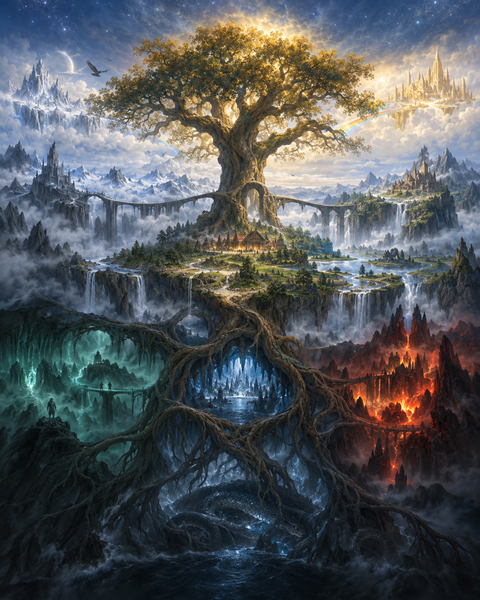
Modern illustrations can still be useful, especially for learning, but every artist has to make choices where the surviving sources don’t.
The gods themselves refuse to stay in their boxes
If the geography weren’t complicated enough, the inhabitants make it worse. Njörðr comes from Vanaheimr as part of the settlement between Æsir and Vanir, yet later lives among the gods and has his dwelling at Nóatún. Freyr is one of the Vanir, yet Álfheimr is given to him. Skaði comes from jötunn territory, travels into Ásgarðr demanding compensation for her father’s death, marries Njörðr and still remains strongly associated with her mountain home at Þrymheimr. A homeland, a dwelling, a divine affiliation and a family connection aren’t always the same thing.
Modern diagrams encourage us to place each god into the realm where we think they “belong.” The stories themselves are much more mobile. Gods travel, marry across boundaries, receive halls and territories, seek knowledge elsewhere and sometimes make their homes far from the places where they began. The mythology is full of crossings.
Hel, Niflheimr and the lower world
The lower regions are where a fixed Nine Realms chart really begins to struggle. Modern diagrams usually give Hel and Niflheimr separate positions because both names appear in the standard list. Snorri complicates that arrangement by telling us that Óðinn casts Loki’s daughter Hel into Niflheimr, where she is given authority over those sent to her.
We can still distinguish between Niflheimr as the ancient region of mist, frost and Hvergelmir, and Hel as ruler of the dead with her own halls and household. What becomes harder to insist upon is that they must always have been imagined as two completely separate worlds.
Then there is Niflhel, another lower-world name whose exact relationship with the others is far from clear.
Rather than three perfectly labelled compartments, what survives looks more like overlapping lower-world traditions involving cold, depth, the dead and Hel’s authority.
Svartálfaheimr and Niðavellir
The dwarven material presents a similar difficulty. Snorri associates Svartálfaheimr with dwarves, while Völuspá places a hall belonging to Sindri’s kin in Niðavellir. Modern lists often solve this by declaring them two names for the same realm. The surviving texts never actually tell us that.
It makes sense to discuss the two together because both are connected with dwarven places, but we can’t confidently merge them into one underground country with a single set of borders.
Again, the problem isn’t that Norse mythology has somehow failed to organise itself properly. The problem may simply be that our modern question — “Which exact box does this place belong in?” — isn’t one the surviving stories were trying to answer.
What about realms as layers or states of being?
One modern solution is to stop treating the realms as geography at all.
In these systems, the realms become overlapping layers, spiritual conditions or states of consciousness. Múspellsheimr might represent consuming force, Niflheimr cold and obscurity, Miðgarðr ordinary human existence, Álfheimr flourishing, while other realms become symbols of death, craft, wilderness or divine order.
This can be meaningful within modern spiritual practice, and it certainly avoids the problem of trying to squeeze everything onto one physical map. It creates another problem, though: the medieval sources don’t tell us that the Nine Worlds are psychological states, spiritual frequencies or invisible layers occupying the same physical space. Those are modern frameworks.
That doesn’t mean we can’t draw meaning from the imagery. Álfheimr can encourage reflection on flourishing because of its connection with Freyr. Niflheimr can evoke cold, winter and obscurity. Miðgarðr can make us think about human responsibility and the world we inhabit.
We can explore what a realm means without needing to claim that its symbolic meaning is what the realm literally is.
A place can mean more than one thing
Perhaps this is where some of the tension disappears. A home is a physical location, but it can also carry identity, memory and belonging. A river can genuinely mark a boundary while also having religious meaning. A hall can be a building while representing authority, hospitality and community. There’s no reason the places of Norse cosmology can’t work in similar ways.
Jötunheimr can be somewhere Þórr travels while also inviting thoughts about what lies beyond the safety of the enclosure. Hel can be a destination of the dead while raising questions about separation, grief and remembrance. Ásgarðr can be the gods’ home while its walls tell us something about protection and vulnerability.
Symbolism doesn’t require geography to disappear. The problem begins only when our interpretation replaces the story rather than growing from it.
Did pre-Christian Norse people have a map?
The honest answer is that we don’t know.
It can be tempting to say that pre-Christian Norse people simply didn’t care about cosmological diagrams, or that their worldview was entirely about relationships rather than geography. That goes beyond the evidence just as surely as claiming that they all used the same Nine Realms chart we see today.
No authoritative pre-Christian cosmological map survives. That tells us what we possess, not everything people once believed. Different regions and communities may have imagined the cosmos differently. Traditions changed across centuries. Poets shaped material for particular purposes, and only a small portion of what once circulated has survived.
Some inconsistencies may reflect regional traditions. Others may come from differences between poetry and prose, changes over time, the needs of individual stories or simply the loss of material that once made certain relationships clearer.
We should therefore be just as cautious about declaring that there was never a coherent system as we are about pretending we have successfully reconstructed one.
Snorri and the temptation to systematise
Much of what we know comes through texts written down in Christian societies, especially Snorri Sturluson’s Edda from thirteenth-century Iceland. Don’t get me wrong, Snorri is enormously valuable. Without his work, our understanding of Norse mythology would be much poorer.
At the same time, he often gathers scattered material into connected explanations, and scholars have long asked how his education, literary aims and Christian intellectual environment may have shaped the way he arranged older traditions. It’s a question that needs caution in both directions.
We can’t assume that every organised feature in Snorri must be Christian and therefore discarded. Nor can we assume that every contradiction in the poetry automatically preserves something older and more authentically pagan. The surviving mythology has layers, and we can’t always peel them apart cleanly.
So what are the Nine Realms?
Perhaps the most accurate answer is that they aren’t all one kind of thing. They are certainly places within stories. Characters travel to them, leave them, cross their boundaries and meet beings who belong there. Some behave like regions within a wider landscape, while others are described through height, depth or great cosmic distance. Their names and inhabitants can also carry religious and symbolic meanings beyond geography.
What the surviving sources don’t give us is a documented system of nine identical worlds arranged on one universally agreed chart. The familiar Nine Realms map is a modern attempt to organise scattered evidence. That doesn’t make it useless. It simply means we should know what we are looking at.
Using a map without mistaking it for the source
For teaching and learning, a Nine Realms diagram can be extremely helpful. Newcomers need somewhere to place unfamiliar names, and a visual map can show broad relationships very quickly. Ásgarðr can be placed in relation to Miðgarðr, Jötunheimr beyond the enclosure, Hel and Niflheimr in the lower regions, with Yggdrasill providing a visual centre. The problem begins when the diagram becomes more authoritative than the mythology.
Any map made today has to make decisions the sources leave open. It must choose which names count among the nine, whether Hel and Niflheimr are separate, whether Svartálfaheimr and Niðavellir should be combined, and exactly where each place belongs. Used honestly, it’s a teaching aid. It isn’t archaeological evidence for one universal pre-Christian Norse worldview.
Follow the journeys
Sometimes a more useful question than “Where does this realm always belong?” is simply, “What does this story tell us about the journey?”
Who’s travelling? Where have they come from? What are they looking for? What boundary must they cross, and who has authority once they arrive? Can they leave as easily as they entered? Those questions bring us back to the myths themselves.
Hermóðr reaches a guarded bridge on his road towards Hel. Óðinn enters Vafþrúðnir’s hall because the jötunn possesses knowledge worth seeking. Þórr walks into Útgarða-Loki’s stronghold and discovers that his enormous strength isn’t much help when he can’t understand what he’s facing.
The geography may not always line up perfectly from one source to another, but the journeys still show us how these places relate. Boundaries are crossed. Distances matter. Hosts and guardians have authority. Travellers leave familiar ground and enter places where different rules apply.
That tells us quite a lot, even without a perfect map.
The Nine Realms for a modern Norse Pagan
For modern Norse Pagans, we don’t have to choose between finding the realms spiritually meaningful and being honest about the historical evidence.
We can use a Nine Realms diagram while acknowledging that it’s reconstructed. We can contemplate the imagery of a realm without presenting our contemplation as pre-Christian theology. We can speak about nine worlds because the number nine genuinely appears in the sources while still recognising that the familiar list has been assembled from material scattered across different traditions.
There’s something worthwhile in leaving some uncertainty intact.
Norse mythology doesn’t become weaker because we can’t reduce its entire cosmos to one clean diagram. The stories give us roads, rivers, halls, bridges, mountains, roots, distant shores and guarded boundaries. They give us gods who leave their homes, jötnar whose knowledge draws Óðinn beyond Ásgarðr, a road leading the living towards the dead and a burning bridge carrying the gods across the heavens. Each journey reveals part of the world, but no surviving story reveals all of it.
Perhaps that’s the best way to approach the Nine Realms. Learn the names, follow the roads, notice the relationships and pay attention to where one story differs from another. Use the maps when they help, but don’t let the map become more important than the mythology it’s trying to explain.
We may never have one diagram capable of holding every surviving passage without contradiction. Fortunately, we don’t need one before we can enter the stories.
Sources and further reading
Primary sources:
- Poetic Edda, trans. Carolyne Larrington
- Prose Edda, trans. Anthony Faulkes
- Norse sagas, trans. Jackson Crawford
Scholarly context:
- Studies on Norse cosmology and mythic space
- Debates on Vanir, elves, and dwarves as categories
- Work on Christian-era influence on medieval Icelandic writing