Horse Sacrifice, Household Ritual and the Strangest Dinner Guest in Norse Literature
Today’s story comes with an adults-only warning!
This story contains horse anatomy, ritual handling of said anatomy, medieval sexual humour, an unusually enthusiastic old woman and a disguised Christian king who turns up uninvited and ruins everyone’s evening. It may also permanently change the way you react when someone says, “Would you like to come round for dinner?”
The story is called Vǫlsa þáttr, meaning The Tale of Völsi.
It may preserve a rare glimpse of Pagan ritual conducted within an ordinary household. It could also be a Christian writer’s deliberately ridiculous parody of Paganism. Most likely, it contains an uncomfortable mixture of both. Our main question is this:
Does Vǫlsa þáttr preserve a genuine fragment of pre-Christian ritual, or is it medieval Christian satire made from ingredients that merely looked Pagan? Before we hear the story, I have a question for you all: What is the strangest object you can imagine someone passing around the dinner table?
Unless somebody has already said, “A preserved stallion’s penis wrapped in linen and leeks,” the family in tonight’s story has everyone beaten. And if somebody did say that, I’m not sure whether to give them a prize or quietly reconsider inviting them to future gatherings.
Our story takes place at a remote farm in northern Norway. The household consists of an elderly farmer and his equally elderly wife. They have a lively son and a clever daughter. Two enslaved people also live with them, one man and one woman. The tale deliberately places them far away from other settlements. They are portrayed as an isolated household that has remained stubbornly Pagan while the rest of Norway is supposedly moving towards Christianity.
One autumn, the household’s stallion is butchered. While the animal is being prepared, the male thrall cuts off its penis and is about to throw it away. The farmer’s son happens to pass by and sees it. Being exactly as mature as we might expect a young man to be when unexpectedly presented with an enormous horse penis, he grabs it. He then runs over to where his mother, sister and the enslaved woman are sitting.
He waves it at the enslaved woman and announces that it certainly wouldn’t remain limp if she put it between her legs. The enslaved woman laughs. His sister is considerably less amused. She tells him to throw the disgusting thing away. At this point, any sensible mother might have agreed with her daughter and told her son to stop waving bits of horse anatomy at people.
This mother does not….
She looks at the penis and decides that it shouldn’t be wasted. She apparently sees something that the rest of the household has failed to recognise. Potential! No, not what you’re all thinking! The old woman takes it, dries or preserves it and wraps it carefully in linen with leeks or similar herbs. She stores it somewhere safe and begins treating it as a significant object (I know what you’re all thinking and shame on you!).
The narrator tells us that through the power of the Devil, the preserved organ grows stronger and increases until it can stand upright beside her. That statement immediately tells us something about the person preserving the story. Whatever the household believes is happening, the Christian narrator explains its power as demonic.
The old woman names the object Völsi. Every evening, after the meal has been served, she brings Völsi into the room. She places it in her husband’s lap and recites a verse. Her husband must then take it, compose a verse of his own and pass it to the next person.
Völsi travels around the table from one member of the household to another. Some participate more enthusiastically than others. Each person’s verse reflects their own character and feelings about the ritual. Some verses are ceremonial. Some are openly sexual. Some express disgust, and some make it clear that the speaker is only taking part because they have been given absolutely no choice.
However, every participant repeats the same formula:
Þiggi Mǫrnir þetta blæti.
This is usually translated as:
May Mǫrnir receive this offering.
We’ll return to Mǫrnir later because nobody knows with certainty who—or what—the name refers to. For now, just imagine the evening.
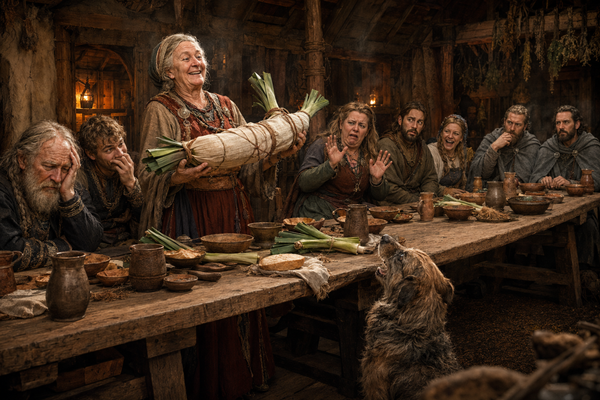
Dinner has finished. Everyone is sitting around the room. Then the elderly mother enters carrying a preserved erect horse penis wrapped in linen and leeks. She places it in her husband’s lap and makes him compose poetry about it. He passes it onwards. The son continues making sexual jokes. The daughter would rather be anywhere else. The male thrall complains that he is being forced to accept what he calls the red-nosed object. The enslaved woman appears considerably less horrified than some of the others.
This isn’t just a family dinner. It’s dinner, poetry night and mandatory horse-penis handling all rolled into one. We don’t know how often the ceremony supposedly took place, but the story presents it as a regular household practice.
Then King Óláfr arrives. The king in this tale is Óláfr Haraldsson, later remembered as Saint Óláfr. The historical Óláfr lost power in Norway and fled east. The story places this episode in 1029, when he was attempting to regain his kingdom. According to the tale, Óláfr hears that some people in remote areas remain Pagan. He decides to travel through the region and investigate. He is accompanied by two men, usually identified as Finnr Árnason and the poet Þormóðr Kolbrúnarskáld.
The three men disguise themselves in grey cloaks and approach the isolated farm. To conceal their identities, they all claim to be called Grímr, a name associated with disguise or concealment. That is their first mistake. If three strange men arrive at your house, all wearing grey cloaks and all claiming to have exactly the same name, something suspicious is happening. Either one is a king in disguise, or they are about to try selling you a new roof.
The farmer nevertheless welcomes them and allows them to stay. That evening, everyone gathers for the meal. Eventually, the old woman enters carrying Völsi. She begins the ceremony as normal. She recites her verse and places Völsi in her husband’s lap. Her husband contributes his verse and passes it onwards.
Völsi continues around the room, accompanied by sexual jokes, embarrassment, complaints and the repeated appeal to Mǫrnir. The disguised visitors are expected to join in. Fortunately for Óláfr, one of his companions is a talented poet. The three strangers are able to improvise verses and avoid revealing their identities.
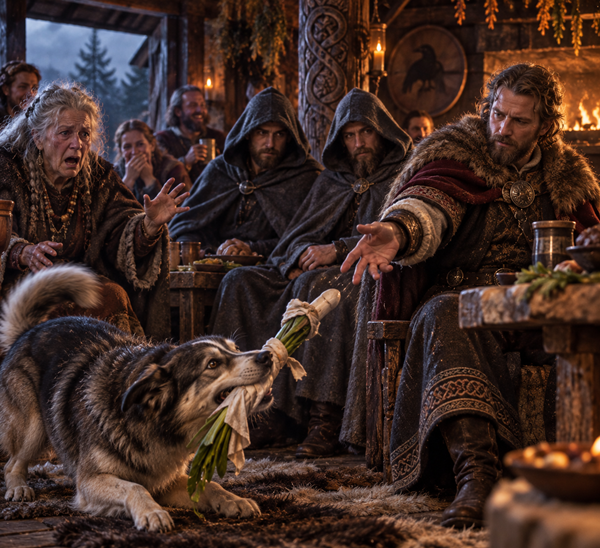
Eventually, Völsi reaches the king. Óláfr takes the object and produces a verse of his own. But instead of passing it respectfully to the next person, he throws it to the household dog. The dog grabs Völsi. The old woman is devastated. Her carefully preserved sacred object, which she has lovingly wrapped in linen and supported with leeks, has just been turned into a chew toy by a man she invited into her home.
Óláfr then removes his disguise and announces that he is the king. He preaches Christianity to the household, and the family eventually agrees to accept baptism. Within the story, this is presented as the end of their bizarre Pagan practice and another victory for Saint Óláfr. The household converts, the king continues his mission, and Völsi makes one of the least dignified exits in the whole of Old Norse literature.
Before we go any further, I have a question for everyone: If three strangers arrived at your home, lied about their identities, mocked your household ritual and fed your sacred object to the dog, who would you consider the villain of the story? I’m not saying Óláfr was a terrible dinner guest, but he certainly wasn’t getting invited back!
Now that we have heard the story, we need to ask where it came from.
Vǫlsa þáttr survives only in Flateyjarbók, or the Book of Flatey. Flateyjarbók is one of the greatest surviving Icelandic medieval manuscripts. Work on it began in 1387 and continued into the 1390s. It contains kings’ sagas, poems, genealogies, annals and shorter stories, including material that doesn’t survive anywhere else. The manuscript was produced by Christian scribes. The priest Jón Þórðarson copied much of its earlier material, including most of the saga in which our tale appears. Within Flateyjarbók, Vǫlsa þáttr is inserted into the extended saga of Saint Óláfr. This is extremely important.
The tale isn’t preserved in a Pagan household manual entitled One Hundred and One Uses for Leftover Horse Parts. It appears inside a Christian narrative celebrating a royal saint and his struggle against the remaining traces of Paganism. The story claims to describe events in 1029, but its only surviving manuscript was produced roughly 350 years later.
To put that into perspective, it would be a little like someone today writing down a detailed account of a private household ritual supposedly performed during the reign of King Charles II, without possessing an eyewitness report.
The tale claims some connection with older poetry or older verses, but we can’t prove how old those verses are. The surviving language, narrative and explanation have all passed through medieval Christian writers and scribes. We therefore have no evidence that the author personally witnessed a Völsi ceremony. We also have no independent Viking Age account telling us that Norwegian families routinely passed preserved horse penises around the dinner table. Doesn’t mean the entire story was invented though.
Medieval writers often created stories from a mixture of inherited traditions, familiar customs, folklore, jokes and their own imaginations. Even a hostile or comic account can preserve genuine details. The question isn’t simply whether the story is completely true or completely false. The better question is: what ingredients did the author use, and how old might some of those ingredients have been (by ingredients, I’m not referring to the horse knob)?
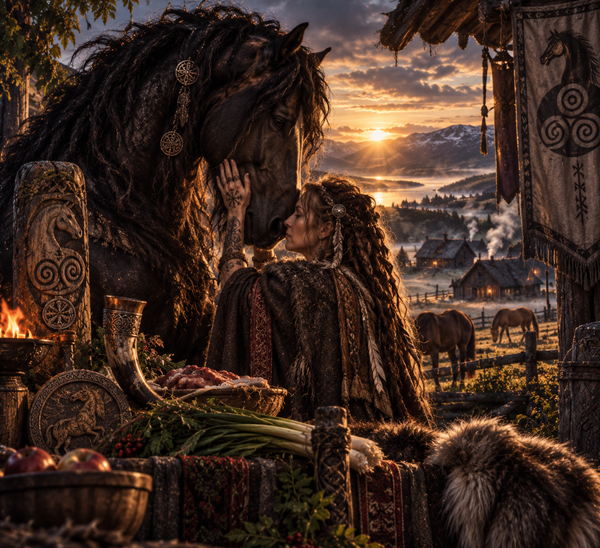
The first important ingredient is the horse. Although we can’t prove that Völsi was a genuine object of worship, the stallion wasn’t chosen randomly. Horses carried considerable religious, social and economic importance throughout the pre-Christian North. Archaeological and textual evidence connects them with sacrifice, ritual feasting, burial, status, travel and supernatural knowledge.
Horse remains have been discovered in graves and other ritual contexts. The sagas also remember horses being sacrificed and their meat eaten during communal gatherings. During Christianisation, eating horsemeat became a religious and legal issue in parts of Scandinavia. This wasn’t a simple disagreement about what should be served for dinner. Horse meat had become closely associated with Pagan sacrifice and communal ritual.
A stallion could also represent strength, virility, reproduction and the prosperity of the herd. Its sexual organ makes those associations rather difficult to overlook. Older scholarship frequently described stories like this as evidence of a fertility cult. That is possible, but we need to be careful.
The word fertility is sometimes used so broadly that practically every animal, seed, phallic object, female supernatural being and drinking vessel gets placed inside one enormous fertility cult. The Völsi ritual may have been connected with sexual or animal fertility. It might equally have concerned household prosperity, livestock, continuity, abundance or the preservation of the stallion’s strength.
The problem is that the tale never clearly explains what the family expects Völsi to do. They don’t ask it for children. They don’t specifically request a successful harvest, healthy animals or more stallions. They simply continue the ritual and repeat the request that Mǫrnir receive the offering.
If the author were describing a familiar Pagan ceremony, perhaps the original audience was expected to understand its purpose. Alternatively, the ritual may have been invented mainly to make the household appear obscene and ridiculous.
Phallic objects and stones have been discovered in Scandinavian archaeological settings. Some may have carried religious, protective or sexual significance. Their existence shows that phallic symbolism wasn’t foreign to the pre-Christian North. However, it doesn’t prove that every phallic stone represents a fertility god or that any of them were connected with the ritual described in this story. A stone shaped like a penis is certainly worth discussing, but we shouldn’t immediately label it “Freyr’s sacred knob” and consider the investigation complete…just saying.
Modern discussions also frequently connect Völsi with Freyr. Freyr is associated with prosperity, sexuality, animals and the famous phallic image commonly identified with him. However, Vǫlsa þáttr never says that the household is worshipping Freyr. The repeated formula is addressed to Mǫrnir, not Freyr. A connection with Freyr isn’t impossible, but it remains an interpretation. It isn’t something the story tells us directly.
So what do we think the household believed Völsi was doing for them? Was it protecting the family? Preserving the stallion’s strength? Encouraging fertility? Honouring an unnamed female power? Or had the old woman simply found an unusual hobby and taken it much further than anyone expected?
One of the most interesting features of the tale is that the ritual is controlled by the elderly woman.
The husband doesn’t create Völsi. The son finds the organ, but he initially treats it as a sexual joke. It is the mother who recognises it as something worth preserving. She wraps it, stores it, names it and brings it into the household ceremony. She also controls everyone else’s participation. Even her husband must receive Völsi when she places it in his lap.
This could preserve a memory of women directing domestic religious practices. Accounts of public sacrifice often focus on kings, jarls and male household leaders, partly because medieval literature is generally more interested in male political authority. It doesn’t mean women lacked important religious roles within the household. Women managed substantial areas of domestic life, including food production, textiles, storage and the internal running of the home. Ritual conducted within that space may also have fallen under female authority.
But the story may contain another layer of humour and criticism. Medieval literature often portrayed sexually assertive or magically knowledgeable older women as comic, dangerous or socially disruptive. The old woman’s devotion to Völsi is presented as excessive. Her husband participates but shows considerably less enthusiasm. She becomes the object’s chief guardian and defender. The Christian storyteller may therefore be mocking Paganism, female authority, old age and female sexuality all at once.
The household’s reactions also reveal differences in power. The daughter can openly express her disgust. The enslaved people have less freedom to refuse. The male thrall’s verse complains that he takes the object unwillingly. What appears to be a communal ritual isn’t necessarily voluntary for everyone. We might ask whether Völsi is truly bringing the household together—or whether the old woman is forcing everyone to participate in something only she deeply values.
Now let’s look at the verses. Völsi isn’t passed silently from person to person. Everyone must speak. The verses are presented as lausavísur, individual stanzas created in response to an immediate situation. Each participant reveals something through their verse. Some embrace the sexual humour. Others express reluctance or disgust.
However, everyone returns to the same fixed formula:
Þiggi Mǫrnir þetta blæti.
May Mǫrnir receive this offering.
This combination of improvisation and repetition gives the scene a ritual structure. The words change, but the refrain remains the same. It also means nobody can quietly pass Völsi beneath the table and hope not to be noticed. Everyone must hold it, address it and produce poetry. It’s essentially the most uncomfortable speaking circle ever devised.
Then we have the linen and leeks. One stanza describes Völsi as enlarged and raised, provided with linen and supported by leeks. Linen makes practical sense as wrapping material. The leeks may have helped preserve the object, but they may also carry symbolic significance.
Words connected with linen and leeks appear together in some much earlier Germanic runic inscriptions. This has led scholars to wonder whether the phrase in Vǫlsa þáttr preserves old ritual or magical language. Leeks may have been associated with health, growth, potency or preservation. While it doesn’t mean there was a universal leek spell practised unchanged for centuries, it does show that the medieval author may have inherited the combination through folklore, poetry or verbal tradition.
Nevertheless, it is a small detail that makes the story difficult to dismiss as a completely random invention. The author may have known something old—even if that old material was being used to tell a joke.
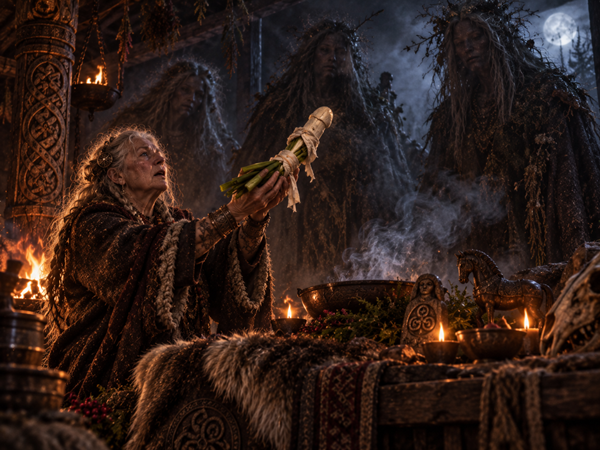
And now we reach the greatest mystery in the story. Who, or what, are Mǫrnir? The name appears throughout the ritual, but the tale never explains it. Its grammatical form seems to be plural, suggesting a group of beings rather than one individual.
Mǫrnir has been interpreted in several ways. The name may refer to giantesses, female supernatural powers, dísir or beings associated with the earth or an underworld ritual. Some scholars have attempted to connect Mǫrnir with Skaði or other named figures. Others have explored possible links with words concerning crushing, grinding or making tender. However, there is no interpretation accepted by everyone. Even our translation, “May Mǫrnir receive this offering,” leaves us with an unnamed and unexplained recipient. It creates an unusual dilemma. Is Völsi actually being worshipped?
The old woman certainly treats it with reverence, but the repeated words may indicate that Völsi is the offering, not the deity receiving it. Calling this “the worship of a horse penis” may therefore oversimplify the scene. It could be a preserved body part used as the focus of a ritual offering directed towards completely different beings. It doesn’t make the evening less strange, but it does change its possible religious meaning.
Now we can return to our central question. Does Vǫlsa þáttr preserve genuine Pagan practice?
There are good reasons to think it might contain older material. Horses genuinely carried religious importance. Horse sacrifice and ritual feasting are attested elsewhere. Phallic symbolism existed in Scandinavian culture. Linen and leeks may preserve older verbal traditions. The ritual takes place in the home and is led by a woman, which could reflect religious activity overlooked by sources focusing upon kings and temples. The ceremony also has a repeated formula, structured movement and expected participation. It feels more developed than a completely random dirty joke.
But there are equally strong reasons for caution. The tale survives only in a late fourteenth-century Christian manuscript. It appears within the saga of Saint Óláfr and ends with the saint destroying the ritual object and converting the household. The narrator explicitly attributes Völsi’s power to the Devil. The isolated family is portrayed as ignorant, sexually ridiculous and spiritually misguided. Óláfr doesn’t have to confront a wise and powerful Pagan leader. He defeats an elderly woman who has become emotionally attached to a preserved horse penis.
That is extremely effective Christian propaganda. If you wanted a Christian audience to believe that Paganism was filthy, foolish and unworthy of serious consideration, this story would do the job beautifully.
Scholar Clive Tolley addressed the problem directly in an article titled “Vǫlsa þáttr: Pagan Lore or Christian Lie?” The difficulty is that those aren’t the only two possibilities. A fictional or hostile story can still be constructed from genuine traditional material.
More recent scholarship uses the idea of the paganesque. Something paganesque appears Pagan to a medieval Christian audience without necessarily providing an accurate description of historical Paganism.
The horse, phallus, old woman, herbs, verses and mysterious supernatural beings combine to create something that feels convincingly heathen. But the scene may tell us just as much about how fourteenth-century Christians imagined Paganism as it does about religious practice in 1029.
The safest conclusion is that Vǫlsa þáttr isn’t reliable evidence of a widespread cult in which Norse households worshipped preserved horse penises. I see some of you are disappointed….
It may still contain fragments of older ritual, symbolic language and domestic custom that were reshaped into comedy and conversion propaganda. In other words, the author may have invented the meal, but some of the ingredients were probably real.
My own feeling is that Vǫlsa þáttr should neither be accepted literally nor dismissed completely. It’s too late, too Christian and far too deliberately comic to serve as a straightforward record of Viking Age religion. At the same time, it contains details that connect with wider evidence concerning horses, household religion, phallic imagery, poetic performance and the ritual authority of women. The story sits somewhere between memory, folklore, satire and propaganda.
It also reminds us that medieval people weren’t solemn figures walking around in muddy wool discussing fate all day. They laughed at dirty jokes, embarrassed one another, argued over family customs and sometimes found themselves holding something they would much rather have left alone.
So, if any of you decide to revive this particular household tradition, please remember three things. Make sure everybody consents, keep it away from the dog, and never invite three strangers called Grímr to dinner.
And so our tale comes to an end — with a household, a preserved horse penis, an increasingly enthusiastic evening ritual, and King Óláfr probably wondering what in the Nine Realms he had just walked into.
As wonderfully bizarre as Völsa þáttr sounds to us today, underneath all the comedy it leaves us with a fascinating little glimpse of household ritual, fertility, luck, old customs, and the awkward meeting point between older Norse practices and Christianity. We can’t know how widespread a ceremony like this really was, or how much the storyteller exaggerated things for comic or religious effect, but one thing is certain — somebody thought this story was worth writing down, and nearly a thousand years later we’re still talking about that poor horse’s penis.
If nothing else, tonight has taught us an important lesson: when somebody says, “I’ve found an interesting bit of Norse lore for Learning Night,” perhaps ask a few follow-up questions before agreeing to attend.
Thank you for joining me on this wonderfully strange journey through Völsi. May your hearth be warm, your luck be good, your ale be plentiful…
…and may nobody ever pass you a preserved horse penis at dinner.
References for the accompanying notes
The primary text survives in Flateyjarbók within Óláfs saga helga. The surviving verses and textual notes are available through the Skaldic Poetry of the Scandinavian Middle Ages database.
Clive Tolley examines the tale’s reliability and Christian framing in “Vǫlsa þáttr: Pagan Lore or Christian Lie?”
Elizabeth Ashman Rowe provides background on Flateyjarbók and its scribes in “Cultural Paternity in the Flateyjarbók Óláfs saga”
Merrill Kaplan’s 2024 book, The Paganesque and The Tale of Vǫlsi, explores the construction of apparently Pagan material in medieval literature. A scholarly review is available through Indiana University.