Some Norse myths shout with thunder, battle, and monsters. Others speak in names.
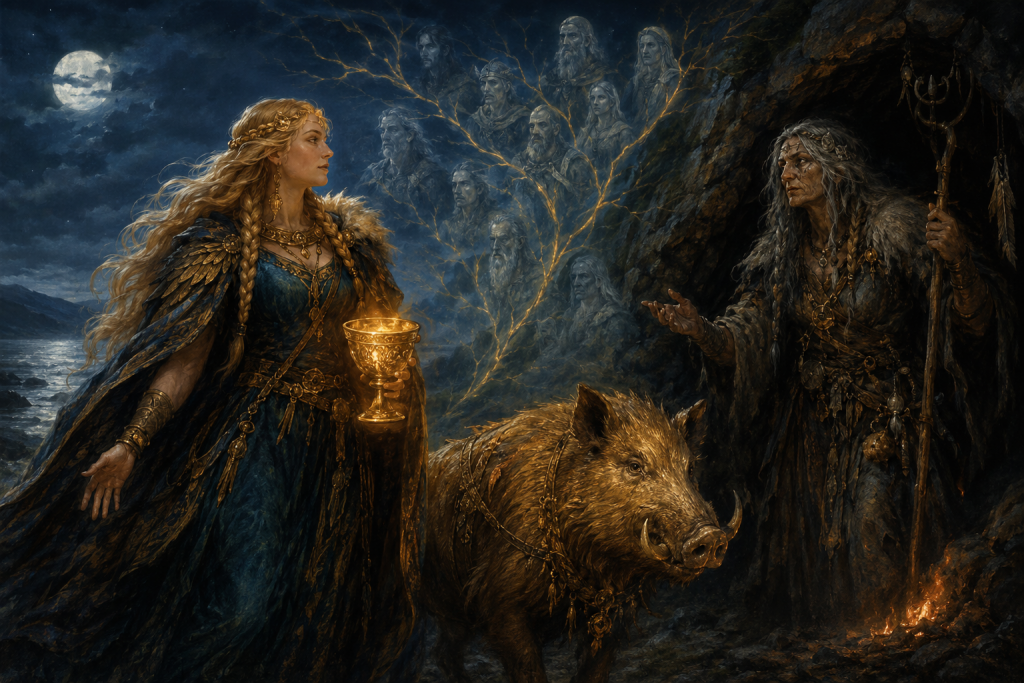
Hyndluljóð, The Lay of Hyndla, is one of those quieter but deeply powerful poems. It’s an Old Norse poem, often considered part of the Poetic Edda, found in the Flateyjarbók manuscript. It features the goddess Freyja coercing the giantess Hyndla to recite the genealogy of her human lover, Óttarr, to help him win a wager. The poem serves as a detailed collection of mythological and hero-saga names
Beneath that, the poem is about ancestry as power. Not just family pride, but inheritance, identity, spiritual force, and the danger of forgetting where you come from.
Who Is Hyndla?
Hyndla is a giantess, or jötunn-woman, and a seeress figure. She doesn’t appear often in the surviving myths, but in this poem she holds something valuable: memory. She knows bloodlines. She remembers ancestors, unions, heroes, and old connections reaching beyond ordinary human knowledge. In that sense, Hyndla is almost a living archive.
Freyja comes to her because Óttar needs proof of his ancestry. He has wagered his inheritance against another man, Angantýr, and to win, he must be able to recite his lineage correctly. So this isn’t a casual visit for tea and a natter. Freyja is demanding the knowledge Óttar needs to defend his inheritance.
Freyja as Guardian of the Line
Freyja is often described as a goddess of love, beauty, desire, and sensuality, but Hyndluljóð shows another side of her. Here, she is forceful, protective, and politically aware. She acts as Óttar’s divine advocate, stepping in when hidden knowledge stands between him and his rightful claim.
In the poem, Óttar has honoured Freyja with offerings, and she responds. That relationship gives the poem a strong sense of patronage. Freyja protects those who are devoted to her, not in a soft or distant way, but with fire, pressure, and absolute determination.
She is not just the golden goddess of desire here. She is the guardian of memory, inheritance, and bloodline.
The Boar Hildisvíni
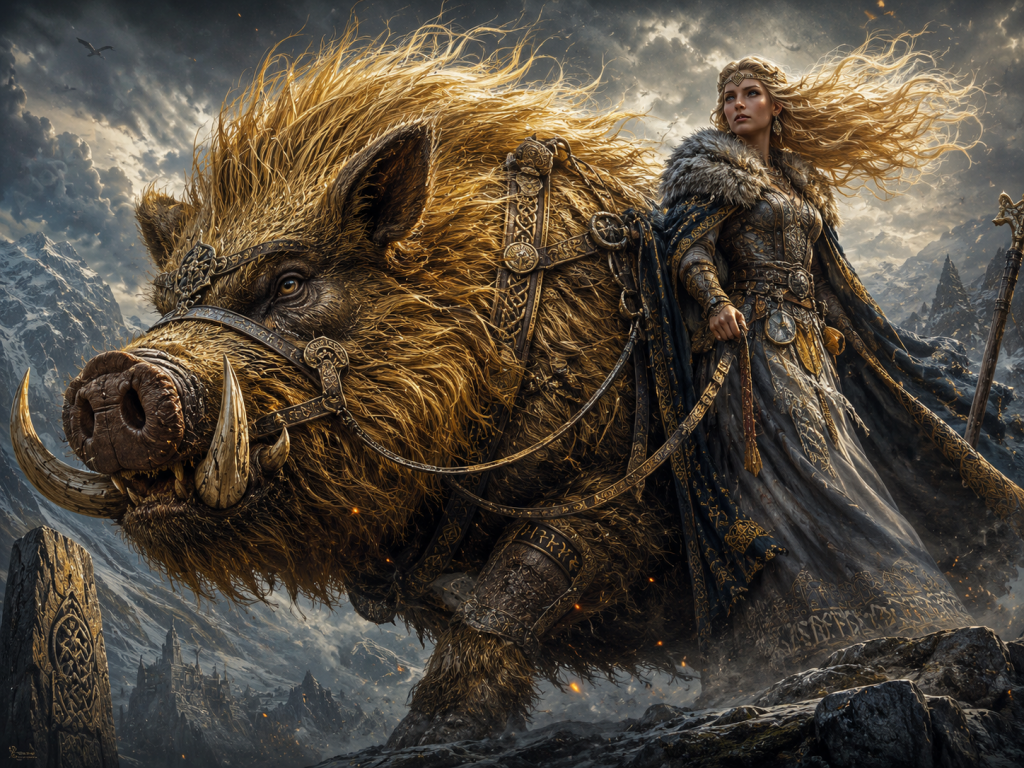
One of the strongest images in the poem is Freyja’s boar, Hildisvíni, whose name means “battle-swine.”
The poem suggests that Óttar is hidden in the form of this boar. Freyja presents Hildisvíni as her mount, but Hyndla sees through the disguise and recognises Óttar beneath it:
Hyndla spake:
6. “Falsely thou askest me, | Freyja, to go,
For so in the glance | of thine eyes I see;
On the way of the slain | thy lover goes with thee.
Ottar the young, | the son of Instein.”
The boar was a powerful symbol in the old Germanic world. It carried associations of protection, ferocity, fertility, and elite warrior status. We see boar imagery on objects such as the Benty Grange helmet from Derbyshire, the Sutton Hoo helmet, and Vendel-period warrior images from Scandinavia.
That doesn’t mean every boar image belongs directly to Freyja or the Vanir. History is rarely that neat. But it does show that the boar was a recognised symbol of protection and power throughout history.
So Óttar’s disguise isn’t random. In the shape of Freyja’s battle-swine, he’s concealed, protected, and marked as hers.
Bloodline as Legal Power
To most readers, the long lists of names in Hyndluljóð can be a lot to take in. Indeed, it runs from stanzas 12 to 45! But in the world that shaped these stories, names carried weight. A person’s ancestry affected status, alliances, inheritance, and legal rights. A bloodline wasn’t just personal history. It could decide who had the right to land, wealth, honour, and position.
This connects with the idea of óðal, ancestral land. In medieval Scandinavian law, inherited land rights depended on a family holding land across generations. To defend such a claim, lineage had to be known and proven.
Hyndluljóð is not a law code, but it reflects that wider cultural concern. If Óttar can’t remember and recite his line, he risks losing what belongs to him. Hyndla’s genealogy becomes a kind of verbal inheritance document. Each name strengthens the claim. Each ancestor anchors Óttar more firmly in his place.
Bloodline as Spiritual Inheritance
Ancestry was not only about property. The Norse worldview also included the idea of inherited luck, strength, and spiritual force: what we know as hamingja, often understood as fortune, power, or luck connected to a person, family, or bloodline.
But hamingja was not necessarily simple “good luck.” It was closer to the accumulated force of a family line: reputation, honour, protection, success, struggle, old obligations, and ancestral momentum. What comes down through a lineage may be a blessing, but it can also include burdens, unresolved debts, repeated patterns, and wounds that were never fully healed.
So when Óttar learns his lineage, he is not simply collecting names. He is reconnecting with everything that stands behind him: the strength, the history, the responsibility, and the weight of what has been carried before.
His ancestors become more than the dead of the past. They become the foundation beneath his feet, but also the reminder that inheritance is something we must understand, not simply accept blindly.
The Memory-Ale
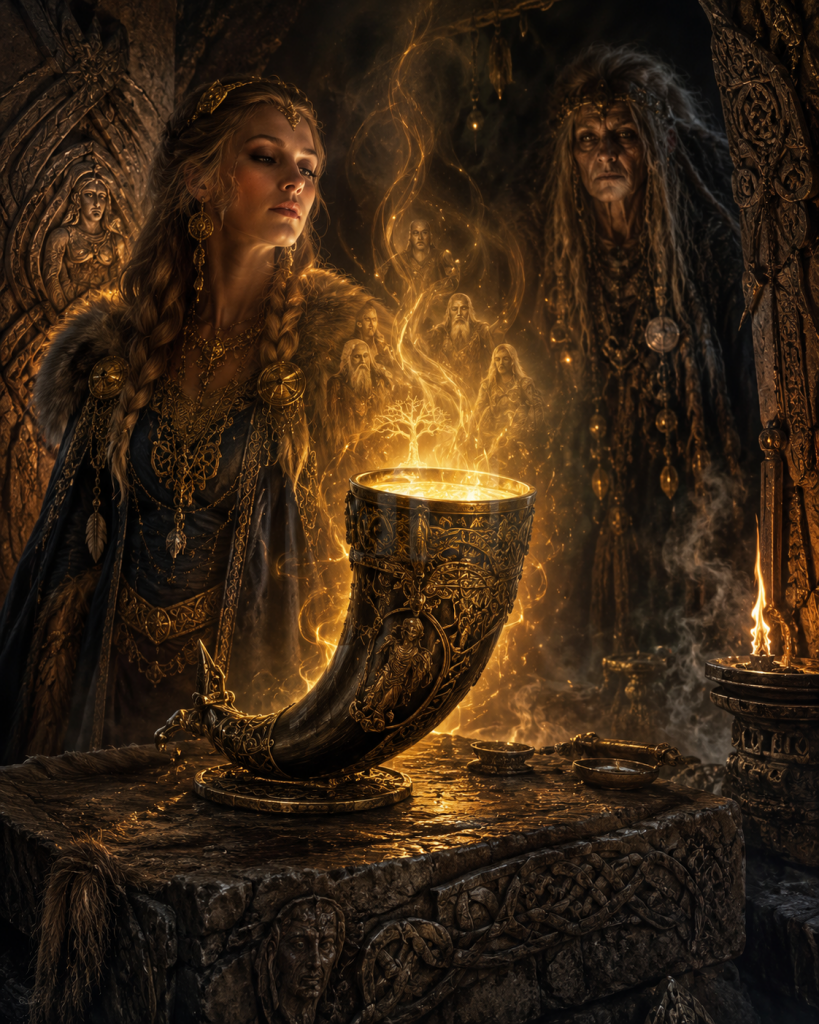
Near the end of the poem, Freyja demands that Hyndla give Óttar the memory-ale, or minnisöl, so he can remember everything he has heard when he faces Angantýr. This moment brings the whole poem together.
It is not enough for the knowledge to be spoken once. Óttar has to keep it. He must carry it into the dispute and use it when his inheritance is challenged. Memory becomes a form of protection for him. Without memory, a bloodline can be forgotten, weakened, or stripped of its rights. With it, Óttar can stand in the hall and speak his claim clearly. The memory-ale makes hidden knowledge usable.
The Tension Between Freyja and Hyndla
The exchange between Freyja and Hyndla is sharp from the beginning. Hyndla resists giving the drink to Óttar. She insults Freyja’s sexual morality and her many lovers, much as Loki did in Lokasenna. She then tries to withhold what she knows. Freyja pushes back with threats of fire and force:
Hyndla spake:
47. “Hence shalt thou fare, | for fain would I sleep,
From me thou gettest | few favors good;
My noble one, out | in the night thou leapest
As. Heithrun goes | the goats among.
48. “To Oth didst thou run, | who loved thee ever,
And many under | thy apron have crawled;
My noble one, out | in the night thou leapest,
As Heithrun goes | the goats among.”
Freyja spake:
49. “Around the giantess | flames shall I raise,
So that forth unburned | thou mayst not fare.”
This is a battle over who controls the past. Hyndla holds the hidden knowledge. Freyja wants it brought into the open for Óttar’s sake. Their conflict reflects a wider tension between concealment and revelation, between forgotten ancestry and remembered power.
Who has the right to speak the names?
Who decides whether a bloodline is remembered or lost?
That is the deeper struggle inside the poem.
Names as a Map
The genealogical lists in Hyndluljóð may feel dense, but they are not empty filler. For the original audience, many of those names would have carried associations with heroic legend, status, marriage alliances, and old claims to power. Names worked like map points. They showed where a person stood within a wider web of kinship and memory.
To know the names was to know the route. To forget them was to risk losing the path. This is why the poem still speaks strongly today. It reminds us that memory shapes identity. When people lose their stories, they become easier to uproot. When they remember, they stand with more strength.
Why This Story Is Still Important Today
Hyndluljóð is strange, sharp, and not always comfortable, but that is part of its power.
It reminds us that ancestry is not only about pride. It is not just a list of names, a family story, a line drawn neatly backward through time, or a DNA test that tells you a percentage of “Viking” ancestry. Lineage, in this deeper sense, is about what is carried: strength, wisdom, craft, courage, protection, and hamingja — the luck and force of a family moving through the generations.
But inheritance is not always clean. Families can also carry old grief, broken promises, repeated mistakes, bad luck, and debts that were never fully paid. Sometimes what comes down the line is a blessing. Sometimes it is a burden. Often, it is both. This is why memory is important.
When Óttar learns his ancestry, he is not simply collecting names. He is being handed the truth of what stands behind him. Freyja fights for that knowledge because without it, he cannot fully claim his place or defend what belongs to him.
For us, the lesson is not that bloodline makes us better than anyone else. That way lies arrogance, and frankly, the ancestors have seen enough of that nonsense already. The lesson is that remembering gives us choice.
When we know what we carry, we can honour the strengths, learn from the wounds, break the harmful patterns, and decide what we will pass on. We do not have to be ruled blindly by the past, but neither should we pretend it has no voice.
Hyndla keeps the hidden memory. Freyja forces it into the open. Óttar must carry it forward. And perhaps that is the real heart of the poem. Ancestry is not only what came before us. It is what we choose to do with what we have inherited.
Suggested References
Carolyne Larrington, trans., The Poetic Edda, revised edition, Oxford University Press.
Henry Adams Bellows, trans., The Poetic Edda: Hyndluljóð / The Poem of Hyndla.
Andy Orchard, Dictionary of Norse Myth and Legend.
Rudolf Simek, Dictionary of Northern Mythology.
H.R. Ellis Davidson, Gods and Myths of Northern Europe.
The British Museum collection entry for the Sutton Hoo helmet.
National Museum of Denmark material on völva graves and seeress staffs.
Studies on óðal inheritance in medieval Scandinavian law, especially discussions of Gulaþing and Frostaþing law.