Part Two: The Problem of the First Humans
Adam, Eve, Cain — and the Silence After Ask and Embla
In Part One we compared the beginnings of the biblical and Norse worlds, ending with Adam and Eve on one side and Ask and Embla on the other. Both traditions eventually place an original human pair near the beginning of the human story, which raises an obvious question if either account is treated as literal biological history.
Where does everybody else come from?
The surviving Norse sources barely acknowledge the problem. Genesis, on the other hand, manages to make it rather difficult to ignore.
Adam, Eve and their named children
Genesis names Cain and Abel first and Seth later. Cain kills Abel, and God condemns him to a life of wandering.
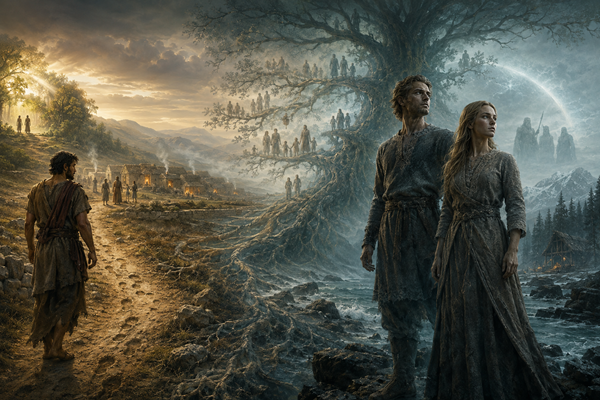
Cain’s response is curious. He fears that whoever finds him might kill him, so God places a protective mark upon him. Cain then travels to the land of Nod, has a wife, fathers a son and begins building a settlement or town.
The story suddenly seems much more populated than we might expect.
Who is Cain afraid will find him? Where did his wife come from? Who would inhabit the settlement he builds?
Genesis does later say that Adam had other sons and daughters. Traditional explanations therefore make Cain’s wife an unnamed sister or another close relative and understand the people Cain feared as members of his growing extended family. That solution can be fitted into the narrative, especially with the long lifespans Genesis gives its early generations, but the text itself never identifies Cain’s wife or explains the population around him.
The Hebrew word commonly translated as “city” can refer to a fortified or permanent settlement rather than the enormous urban centre a modern reader might imagine. Even so, the story assumes a social world without stopping to tell us how that world developed.
That probably tells us something important about the purpose of the Cain narrative. Its concern is murder, punishment, protection, family, agriculture, craftsmanship and the beginnings of settled society. It’s not trying to provide a complete population register.
The biological question
A more serious problem appears when Adam and Eve are treated as the sole biological ancestors of every modern human living only several thousand years ago.
Their children would necessarily reproduce with siblings or extremely close relatives, and the same problem would continue through subsequent generations. Close inbreeding greatly increases the likelihood that harmful recessive genetic variants will meet in the same offspring, while an initial population of only two people provides extremely limited genetic diversity.
Modern human genetics instead preserves a long and complicated history of populations moving, dividing, mixing and sometimes interbreeding with other hominin groups. Researchers use measures such as effective population size to investigate how many individuals contributed genetically to later populations. Effective population size isn’t the same thing as simply counting every person alive at the time, which is why popular claims that genetics has proved humanity “never fell below exactly 10,000 people” should be treated cautiously.
The broader conclusion is much firmer: present human genetic diversity is incompatible with a natural, recent origin from one isolated breeding pair.
“Mitochondrial Eve” and “Y-chromosomal Adam” don’t rescue that idea. Those names refer to the most recent individuals from whom particular surviving maternal and paternal genetic lines descend. They were surrounded by other people, they need not have lived at the same time, and they were certainly not the first woman and first man.
A miraculous creation of genetic diversity can’t be tested in the same way. Once supernatural intervention is added to the explanation, we have moved from population genetics into theology.
Why Adam’s ancestry became so important
Genesis devotes considerable attention to genealogy. Those family lines connect the earliest figures to later peoples and eventually to the ancestral stories of Israel.
Christian theology later gave Adam an even wider significance.
Genesis itself describes disobedience, expulsion, hardship and mortality, but the fully developed doctrine of original sin belongs to later Christian interpretation. It grew over centuries through readings of Genesis, Paul and other Christian writings, with Augustine giving inherited sin a particularly influential formulation in Western Christianity.
Under that theological framework, Adam becomes much more than an early ancestor. Humanity shares in the damaged condition associated with his fall, while Christ becomes the answer to Adam’s legacy.
That is one reason the biological question eventually became so significant. A scientific account in which humanity emerges gradually through populations forces theologians who accept that evidence to consider what Adam, the Fall and inherited sin mean without requiring every human being to descend biologically from one recent couple.
Christian answers vary considerably. Adam and Eve can be understood symbolically, archetypally, theologically or as representatives within a wider human population. Those are theological questions rather than scientific ones, but they show how much weight the biblical first couple came to carry.
And what happens after Ask and Embla?
The surviving Norse tradition gives us much less.
Völuspá describes the gods finding Ask and Embla and giving them the qualities required for human existence. It gives us no children and no genealogy.
Snorri goes slightly further. After describing their creation, he says that the races or generations of humankind descend from them. Then the narrative moves on.
No first child is named. There is no Norse Cain and Abel story, no account of the first marriage among their descendants and no attempt to explain the mechanics of populating Miðgarðr.
Taken literally as biology, that creates the same basic difficulty as any two-person beginning. The Norse sources simply show no interest in solving it.
Ancestry still mattered
That silence should never be mistaken for a lack of concern about ancestry in Norse society.
Kinship, inheritance, reputation and descent are everywhere in the sagas and medieval law codes. Royal dynasties and powerful families constructed genealogies connecting themselves to famous ancestors and, in some cases, to gods such as Óðinn or Freyr.
Those genealogies usually serve a particular purpose. They establish who someone is, where a family belongs, what status it claims or how authority is inherited. They don’t usually attempt to construct an unbroken biological family tree from every living person all the way back to Ask and Embla.
That gives the two traditions a very different emphasis.
Genesis develops the generations after Adam because genealogy becomes one of the threads connecting its earliest stories to everything that follows. In the Norse mythological material, Ask and Embla establish the presence of humanity in Miðgarðr and then largely leave the stage.
The myth has answered the question it was interested in answering.
Humanity is here.
Exactly how the first household became an entire population appears not to have troubled the surviving storytellers enough for anyone to preserve the explanation.
And sometimes the questions a tradition leaves unanswered are just as revealing as the ones it chooses to explore.
Source notes
The biblical material comes principally from Genesis 3–5, especially Genesis 4:14–17 and 5:4. The Norse comparison draws upon Völuspá 17–18 and Gylfaginning chapter 9. Modern population genetics reconstructs human history through patterns of genetic variation, population change, migration and interbreeding; “Mitochondrial Eve” and “Y-chromosomal Adam” refer to surviving genetic lineages rather than an original human couple. The discussion of original sin refers to the later development of Christian theology rather than treating the complete doctrine as something explicitly stated in Genesis itself.
Next in the series
Part Three: What Christian Writers Did With Norse Myth
Much of what we know about Norse mythology survived because medieval Christians wrote it down. That leaves us with an uncomfortable but fascinating problem: how do we distinguish an older tradition from the way a later Christian writer understood, organised or explained it?