Part One: Two Different Ways of Imagining Creation
Norse Creation and the World Beside Genesis
Christianity appears throughout this series because it eventually became the dominant religion across Scandinavia, changing laws, public worship, burial customs and the world in which older Norse stories were preserved. Comparing the two traditions can help us see more clearly what is distinctive about Norse cosmology while also showing why Christian influence has to be considered when we work with medieval sources.
We begin with creation. Genesis and the surviving Norse traditions approach the beginnings of the world very differently, and neither needs to be treated as a modern scientific account for us to take the stories seriously. Creation myths tell us about relationships: between gods and humans, between life and the landscape, and between the present world and whatever came before it.
One Bible, two beginnings
People often speak of “the biblical creation story” as though Genesis gives us one continuous account. The opening chapters actually preserve two distinguishable creation traditions placed beside one another.
Genesis 1 presents the familiar ordered sequence of creation. God speaks, light is separated from darkness, waters are divided, land and vegetation appear, the heavenly lights are placed in the sky, animals are created and humanity follows. Male and female humanity appear together, and the sequence culminates in the seventh-day rest.
Genesis 2 approaches the beginning from a different direction. Its attention is already on the land, which lacks rain and someone to cultivate it. The human is formed from the ground and receives the breath of life. The narrative then turns to the need for companionship, the animals and, finally, the creation of the woman from the man’s side.
The two accounts differ in vocabulary, emphasis and order. Genesis 1 places animals before male and female humanity, while a straightforward sequential reading of Genesis 2 places the formation of the man before the episode involving the animals and before the creation of the woman. Some translations render Genesis 2:19 as saying God “had formed” the animals, bringing the accounts into closer agreement. The Hebrew allows discussion over how the verse should be understood, which is one reason it’s better to recognise the two traditions than force every detail into a single chronology.
Biblical scholarship has long distinguished Genesis 1:1–2:4a from the Adam-and-Eve narrative beginning in Genesis 2. Their different concerns are especially noticeable. Genesis 1 is highly structured and cosmic; Genesis 2 is intimate, earthy and centred upon the human relationship with God, land, animals and one another.
That doesn’t diminish either story as sacred literature. It simply means that Genesis wasn’t written as a modern scientific explanation of cosmology.
Ginnungagap and the first life
The Norse beginning has a very different atmosphere.
In Völuspá, the völva remembers an ancient time before the familiar world existed. There was no earth beneath, no heaven above, no sea or shore and nowhere for grass to grow. There was Ginnungagap, the yawning gap.
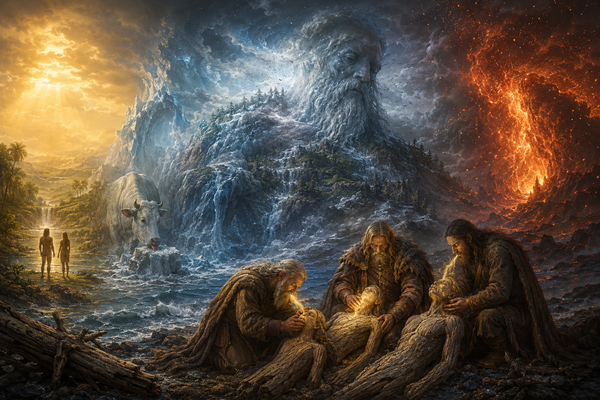
Snorri Sturluson gives us a fuller version in Gylfaginning. To one side lies fiery Múspellsheimr and to the other cold, mist-filled Niflheimr. Rivers flowing from Niflheimr freeze into ice and rime, while heat and sparks come from the direction of Múspellsheimr. Where these conditions meet, the frozen rime begins to melt and life takes form.
The first great being to emerge is Ymir, also called Aurgelmir in Vafþrúðnismál. He belongs to the earliest generation of beings and becomes an ancestor of the jötnar. More beings emerge from him while he sleeps.
Alongside Ymir appears Auðhumla, the great cow. Her milk nourishes him while she feeds by licking the salty rime-stones. As she licks, another figure slowly appears: hair on the first day, a head on the second and the whole being on the third. He is Búri.
Búri fathers Borr, and Borr has three sons with Bestla, daughter of the jötunn Bölþorn: Óðinn, Vili and Vé. From the beginning, the relationships between gods and jötnar are therefore tangled together through ancestry. The categories we sometimes imagine as two separate opposing “races” are much less tidy in the sources.
It’s also worth remembering where these details come from. Völuspá gives us the ancient void and the ordering of the world, while the fuller account involving Auðhumla and the meeting of Niflheimr and Múspellsheimr is preserved by Snorri. Snorri may be preserving older material, but we shouldn’t pretend every detail comes from one unified pre-Christian account.
The world made from Ymir
Óðinn, Vili and Vé eventually kill Ymir. His blood floods outward, destroying almost all the frost-jötnar, although Bergelmir and his household survive.
The brothers then use Ymir’s body to shape the world. His flesh becomes earth, his blood becomes sea and water, his bones and teeth become mountains and stones, his hair becomes vegetation, his skull becomes the sky and his brain becomes clouds. His eyebrows are used to create Miðgarðr, the enclosed realm prepared for humanity.
This idea does not depend upon Snorri alone. Grímnismál also describes the earth, sea, mountains, trees, sky and Miðgarðr being fashioned from Ymir.
Creation here is physical, violent and transformative. The older being is destroyed, yet he also remains everywhere. Earth, water, rock and sky are made from something that lived before the ordered world existed.
There is something almost unsettling about that image. The world beneath your feet isn’t merely scenery placed around you. It’s part of a chain of existence stretching back into the first beginnings.
Ask and Embla
Once the world has been shaped, humanity enters the story.
Völuspá tells us that Óðinn, Hœnir and Lóðurr find Ask and Embla on the land, lacking the qualities necessary for full human existence. The gods provide a series of gifts. Translating the Old Norse terms precisely is difficult, but they concern such things as breath or spirit, mind or inspired awareness, vitality, activity and outward appearance.
Snorri preserves another version. His gods are Óðinn, Vili and Vé, who find two pieces of wood beside the shore and shape them into human beings. They receive life, understanding, movement, human appearance, speech, hearing and sight. They are clothed, named Ask and Embla and given Miðgarðr as their home.
Ask’s name is closely associated with the ash tree. Embla is frequently identified with elm, although the meaning of her name remains uncertain, so it’s safer to speak of the pair as having a strong association with wood or trees.
The sources give us no children by name and no story of the first generations after them. Their purpose lies elsewhere. They explore the qualities that make a human being more than an unmoving form.
Two very different creations
Placed beside one another, the traditions reveal very different imaginative worlds.
| Genesis | Norse creation |
|---|---|
| God precedes and orders the created world. | Gods and jötnar arise within an already developing cosmos. |
| Genesis 1 emphasises creation through divine speech and separation. | The Norse world develops through encounter, birth, violence and transformation. |
| Humanity is formed from earth in Genesis 2. | Ask and Embla are associated with wood and are given the qualities of human life. |
| One God gives the human the breath of life. | Several gods contribute different gifts to Ask and Embla. |
| Adam and Eve become central to later Christian teachings about the Fall and inherited sin. | Ask and Embla commit no original offence that is passed to their descendants. |
| Early human generations become the subject of genealogies. | The descendants of Ask and Embla largely disappear from the surviving mythic narrative. |
The differences are more interesting when we allow each tradition to speak in its own language.
Norse creation begins with relationships already in motion. Heat meets cold. Gods have parents and grandparents. Æsir and jötnar share ancestry. The ordered world is fashioned from an older body, and humans appear within a cosmos that was already full of other beings.
Nothing begins in isolation. Each new stage grows from something that existed before it, and even destruction becomes part of creation.
Source notes
The principal Norse sources for this part are Völuspá, especially stanzas 3–6 and 17–18; Vafþrúðnismál, particularly the material concerning Aurgelmir/Ymir and Bergelmir; Grímnismál 40–41; and Snorri Sturluson’s Gylfaginning, especially chapters 4–9. The biblical comparison draws upon Genesis 1:1–2:25. Modern biblical scholarship commonly distinguishes the structured creation account of Genesis 1:1–2:4a from the Adam-and-Eve narrative that follows.
The Eddic poems survive in medieval manuscripts and may preserve material substantially older than those manuscripts. Snorri wrote in thirteenth-century Christian Iceland. He is indispensable precisely because he preserves information unavailable elsewhere, but his account has to be read alongside poetry, archaeology and other evidence rather than treated as a transparent transcript of Viking Age belief.
Next in the series
Part Two: The Problem of the First Humans
Adam and Eve give us Cain, Abel, Seth — and some awkward questions about the people apparently already waiting beyond Eden. Ask and Embla leave us with an entirely different kind of silence. Next we’ll look at what happens when a creation story gives us the first human pair but very little explanation of where everyone else came from.