
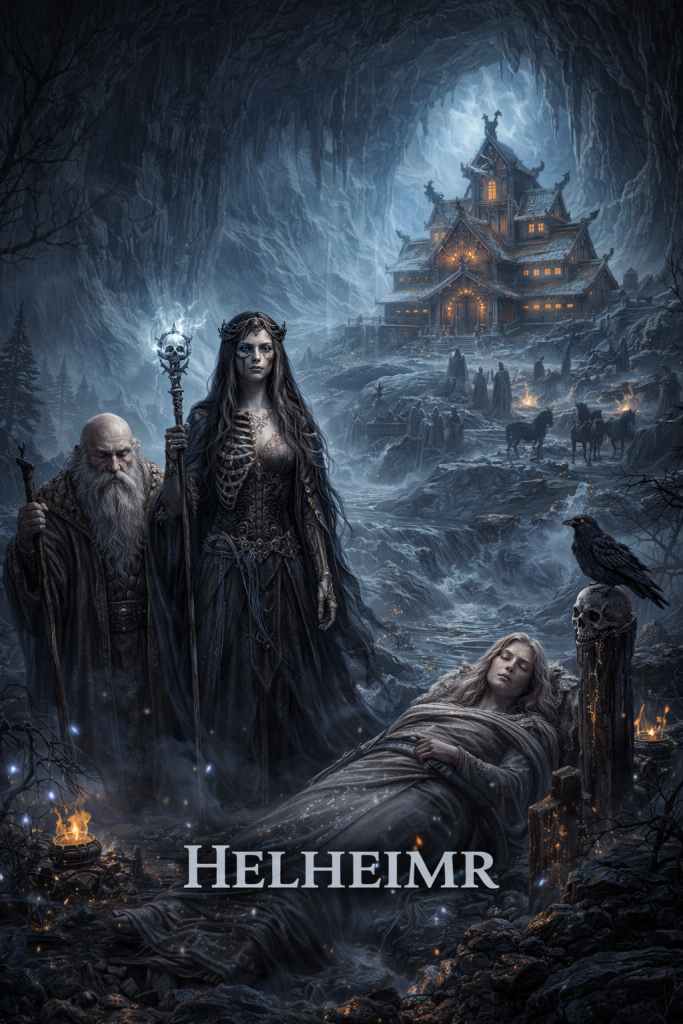
Helheimr is one of the most misunderstood realms in Norse cosmology — not because the sources are especially cruel, but because later ideas have been layered over it.
In the surviving myths, Helheimr is not a place of fiery punishment. It is a necessary realm. A holding-place for the dead who did not fall in battle. A cosmic counterweight to Valhöll and Fólkvangr. And a reminder that death, in Norse thought, was not a moral sorting hat — it was a fact of life.
Helheimr exists because most people die quietly.
Hel and Her Realm: Origin and Authority
Helheimr takes its name from Hel, daughter of Loki and the giantess Angrboða, sister to Fenrir and Jǫrmungandr. Unlike her siblings, Hel is not unleashed as a monster — she is appointed.
In Gylfaginning, Odin casts Hel down into Niflheim and grants her authority over those who die of sickness, old age, or other non-heroic causes. This is important: Hel does not seize power. She is given it.
Her role is administrative, not malicious.
Descriptions of Hel herself vary, but she is often portrayed as half living, half corpse — a visual reminder of her liminal function. She stands between life and death, not as an executioner, but as a keeper.
What Helheimr Is (and is not)
Helheimr is best understood as the default afterlife.
Most people do not die in battle. Most people do not earn a Valkyrie’s choosing. Helheimr exists to hold the many, not the few.
Neutral afterlife tradition
Several readings of the sources suggest Helheimr as a continuation space rather than a punishment zone — a realm where the dead dwell, possibly among kin, under Hel’s governance. The emphasis is on containment and order, not torment.
The presence of halls, gates, and attendants reinforces this: Helheimr is structured. It functions.
The Prose Edda’s darker tone
Snorri Sturluson’s Prose Edda describes Helheimr as cold, grim, and joyless — a place of hunger, frost, and bleakness. Many scholars note that this tone may reflect Christian-era influence, especially given how closely it aligns with medieval ideas of Hell as an undesirable fate.
That does not make Snorri useless — but it does mean his descriptions must be read with caution and context.
Náströnd is not Helheimr
One of the most important distinctions often lost in modern retellings is this:
Náströnd (“Corpse Shore”) is not the same as Helheimr.
Náströnd is described as a place of punishment for oathbreakers, murderers, and those guilty of extreme moral crimes. There, a great wyrm torments the dead.
This suggests a layered afterlife:
- Helheimr for the ordinary dead
- Náströnd for the truly dishonourable
Conflating the two flattens the cosmology — and turns Hel into something she is not.
Éljúðnir and the Halls of Helheimr
Hel’s primary hall is Éljúðnir, often translated as something like “Spray of Storms” or “Storm-Wet.”
The names associated with Hel’s household are grim, but symbolic rather than sadistic:
- Her dish is called Hunger
- Her knife is Famine
- Her threshold is Stumbling Block
- Her bed is Sickbed
These are not instruments of torture. They are descriptions of death itself — hunger, illness, weakness, crossing.
Helheimr does not punish people into death. It receives those already claimed by it.
The Beings Who Reside in Helheimr
Helheimr is not crowded with demons. Its inhabitants are primarily:
- The ordinary dead
- Those unclaimed by battle afterlives
- Those who died of age, sickness, or accident
Hel herself presides, but she is not shown constantly tormenting or judging. Her role is custodial.
The realm also contains gates, rivers, and boundary markers — emphasizing separation, not suffering.
Helheimr and Ragnarök
Helheimr has a significant — if understated — role in Ragnarök.
At the end of the age:
- Hel’s dead are said to rise and join the final conflict
- Loki himself emerges from confinement to lead forces against the gods
- The dead are no longer contained — the boundaries fail
This reinforces Helheimr’s cosmic function:
it is not just a resting place, but a reservoir.
When the structure of the cosmos collapses, even the quiet dead are released.
Helheimr Versus Valhöll and Fólkvangr
It’s tempting to frame Norse afterlives as “good vs bad,” but the sources don’t support that.
- Valhöll: for those who die in battle, tied to warfare and Odin’s needs
- Fólkvangr: Freyja’s receiving place, less clearly defined but still selective
- Helheimr: for everyone else
This isn’t a moral hierarchy. It’s a functional one.
Helheimr is not a failure-state. It’s the norm.
Scholarly Debate: was Helheimr softened or darkened?
Modern scholars often argue that Helheimr may originally have been more neutral, and that its later grimness reflects Christian storytelling pressures.
Key points of debate include:
- Whether Hel was originally feared or simply respected
- Whether Helheimr was imagined as bleak or merely distant
- How much Snorri’s descriptions reflect conversion-era theology
What most agree on is this:
Helheimr is not equivalent to Christian Hell, and reading it as such distorts Norse cosmology.
Helheimr Today: Why it Still Matters
For modern readers and practitioners, Helheimr offers something rare in myth:
- acceptance of ordinary death
- dignity for those who did not die gloriously
- a vision of death as containment, not condemnation
Helheimr reminds us that most lives end quietly — and that quiet endings still belong to the cosmic order.
Sources and further reading
Poetic Edda (trans. Carolyne Larrington):
- Völuspá (Hel’s dead and Ragnarök)
- Baldrs draumar (Hel’s realm and prophecy)
Prose Edda (trans. Anthony Faulkes):
- Gylfaginning (Hel, Éljúðnir, and the structure of Helheimr)
Sagas (trans. Jackson Crawford):
- References to Hel and death imagery across saga material