
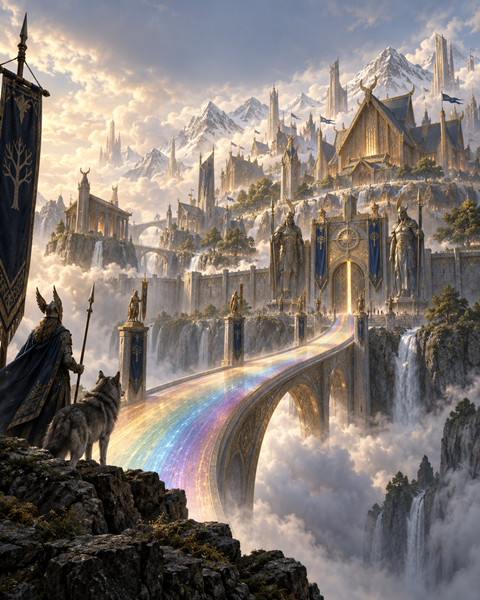
Ásgarðr: The Gods’ Enclosure Behind the Rainbow
Before Ásgarðr had its great defensive wall, a builder arrived with an offer. He would raise a fortification strong enough to protect the gods against their enemies. In return, he wanted Freyja, the sun and the moon.
In Snorri’s telling, the gods agreed to a bargain they believed the builder couldn’t fulfil. He had to finish within a single winter and could receive no help from another man. If anything remained unfinished when summer arrived, he would receive nothing. The builder asked only that he be allowed to use his stallion, Svaðilfari, and, following Loki’s advice, the gods agreed.
Then they watched the work advance far more quickly than expected. Svaðilfari hauled enormous stones, and as winter drew towards its end, the impossible bargain began to look dangerously achievable. The gods blamed Loki and threatened him unless he found some way to stop the work.
Loki took the form of a mare and lured Svaðilfari away at the crucial moment. Without the horse, the builder couldn’t finish. When he realised the bargain had been lost, his fury revealed him as a giant, and the gods called for Þórr, who killed him with Mjǫllnir. Loki later gave birth to Sleipnir, Óðinn’s eight-legged horse.
It’s an unsettling story to find at the walls of the gods’ home. Their security becomes bound up with a bargain, deception and the breaking of guarantees they had sworn to uphold. They protect what they can’t bear to lose, but the way they do so leaves uncomfortable questions behind.
Ásgarðr is therefore far more interesting than a perfect divine city floating peacefully above the human world. It’s a home the gods build, defend, govern and worry about losing.
The enclosure of the Æsir
The name Ásgarðr is usually understood as the “enclosure of the Æsir.” The garðr element carries the idea of a yard, enclosure or bounded space, just as it does in Miðgarðr.
For people whose homes, animals, crops and livelihoods depended upon fences, walls and defended settlements, the difference between inside and outside was practical. An enclosure created a place where something could be protected, while its very existence acknowledged that danger lay beyond it.
We should be careful not to turn this into an overly tidy philosophy in which everything inside the fence represents order and everything outside represents chaos. The surviving stories are far more complicated than that. Even so, the language of enclosure is real, and the myths repeatedly return to boundaries, gates, bridges, watchmen and walls.
Ásgarðr is a protected divine space, but it’s not safe by default. Its security depends upon work, vigilance, cooperation and defence, and even then it remains vulnerable. The wall-builder story begins by showing us a realm whose inhabitants know that protection has to be made rather than simply assumed.
The road across Bifröst
The most famous approach to Ásgarðr is Bifröst. Snorri identifies the bridge with the rainbow, creating one of the most recognisable images in Norse mythology: a brilliant path connecting earth with the world of the gods. Yet its beauty doesn’t make it an open road.
Near its end stands Himinbjörg, Heimdallr’s dwelling. Heimdallr keeps watch over the bridge and guards the gods against the approach of the mountain-giants. The entrance to Ásgarðr therefore combines splendour with watchfulness, and that mixture appears repeatedly throughout the realm. Gold, magnificent halls and beauty exist alongside preparation for dangers that may come through the gates.
Even the road of the gods requires a guardian.
Not one palace, but a world of halls
When people picture Ásgarðr, it’s easy to imagine a single enormous golden fortress containing all the gods. The surviving texts give us something more varied. We encounter halls, sanctuaries, meeting-grounds, high seats and divine dwellings, each associated with different gods and different parts of communal life. The sources don’t arrange them neatly on one consistent map, so it’s better to think of them as glimpses of the wider world in which the gods live rather than addresses in a mythological city directory.
Some are places of feasting, while others are associated with law, judgement, conversation, watchfulness or the dead. Together they give Ásgarðr the feeling of a divine community in which power isn’t merely defended behind walls but exercised through councils, settlements, relationships and shared spaces.
Iðavöllr: where the gods begin
In Völuspá, the gods gather at Iðavöllr during the early days of the world. They establish sanctuaries, work at a forge and make tools and precious things. The scene gives us a community taking shape through shared activity. The gods aren’t simply placed inside a completed divine kingdom; they gather, build, make and organise. Civilisation, in the mythic sense, is something they participate in creating. Ásgarðr is therefore not only a protected home but also a place where order emerges through meeting, making and agreement.
Iðavöllr appears again after Ragnarök. The place associated with the gods gathering near the beginning of the world becomes a gathering-place once more after that world has been shattered, linking creation, memory and renewal across the mythic age.
Glaðsheimr and Vingólf
Snorri gives us some of the clearest architectural images associated with the gods through Glaðsheimr and Vingólf. Glaðsheimr is described as a splendid building containing seats for the gods, while Vingólf is associated with the goddesses. These shared spaces give Ásgarðr structure beyond the individual homes of particular gods.
Their splendour isn’t only decorative. In a society where halls and assemblies carried political and social meaning, seats could express rank and authority. Where people sat, who occupied the higher place, who spoke and who listened all belonged to the way power was made visible.
For a Norse audience familiar with halls, assemblies and ranked social spaces, these divine gathering places would have carried associations far beyond their gold and beauty.
Valhǫll: splendour beneath the shadow of Ragnarök
The best-known hall associated with Ásgarðr is Valhǫll. Grímnismál places it in Glaðsheimr and gives the hall unmistakably martial imagery. Spear-shafts form its rafters, shields cover its roof, and coats of mail lie across its benches.
Here Óðinn gathers those among the slain who are chosen for him. In Snorri’s account, the einherjar fight each day and feast afterwards, preparing for the conflict they know will eventually come. Valhǫll therefore combines abundance with the shadow of Ragnarök. There is meat, drink, companionship and glory, but none of it means danger has passed. The warriors are gathered precisely because the gods know that one day they will need them.
Even one of Ásgarðr’s most celebrated halls carries the knowledge that its walls won’t hold forever.
Freyja, Fólkvangr and Sessrúmnir
Óðinn doesn’t receive all those who fall in battle. Grímnismál tells us that Freyja receives half of the slain in Fólkvangr, while Snorri names her spacious hall Sessrúmnir.
Her role complicates the popular image of the Norse afterlife as though Valhǫll alone receives those who die in battle. It also reminds us that the divine world isn’t simply Óðinn’s kingdom populated by lesser gods. Freyja possesses her own authority and her own relationship with the dead.
Her presence also reflects the intertwining of Æsir and Vanir. After conflict and settlement between the two divine groups, their lives become connected through alliance, exchange and family relationships. The wider world of the gods therefore carries older divisions within it rather than erasing them completely.
Nóatún and the sea-loving Njǫrðr
Njǫrðr’s dwelling is Nóatún, a name strongly associated with ships and the sea.
Njǫrðr is Vanir by origin, yet he becomes part of the gods’ shared world following the settlement between the divine groups. His presence there doesn’t erase his own associations or identity. The sea remains central to him, and his dwelling reflects that character.
This is another reason the image of Ásgarðr as one uniform golden city can be misleading. The divine dwellings retain their own qualities, shaped by the gods connected with them.
Þórr in Bilskirnir
Þórr has the enormous hall Bilskirnir, located in Þrúðvangr. Grímnismál describes it as containing an extraordinary number of rooms, fitting the larger-than-life quality that surrounds Þórr elsewhere in the mythology.
We should still resist forcing every named region and hall into an exact city plan. The sources give us locations and relationships without always explaining precisely how one place sits beside another.
Bilskirnir nevertheless gives Þórr a recognised home within the world he repeatedly leaves in order to confront threats beyond it. His stories often move outward into jötunn territory before returning to the protected world of the gods, creating a repeated movement between enclosure and wilderness.
Ýdalir and Ullr
Ullr’s dwelling is Ýdalir, usually understood as the “Yew Dales.” The name naturally evokes yew, a wood long associated with bows, while Ullr himself is connected with archery and skiing.
Ýdalir offers another glimpse of how varied the gods’ dwellings could be. Ásgarðr isn’t made only from councils, fortifications and warrior halls. Its divine landscape also contains places whose names suggest woodland, hunting and very different ways of inhabiting the sacred world.
The realm of the gods is richer than gold, stone and thrones.
Sökkvabekkr: Óðinn and Sága beside the water
At Sökkvabekkr, cool waves flow around the dwelling where Sága and Óðinn sit together drinking from golden vessels.
It’s a quieter image than many of those associated with Ásgarðr. Óðinn appears elsewhere as a seeker of knowledge, ruler, wanderer, magician and god preparing obsessively for catastrophe, yet here we simply glimpse two figures beside the water sharing a drink.
Scenes like this make the divine world feel lived in. Not everything happening in Ásgarðr is a council, a battle preparation or a cosmic crisis. The gods also share space, conversation and companionship.
Glitnir and the settling of disputes
Forseti’s hall Glitnir brings us back to the work of maintaining peace within a community. Its gold pillars and silver roof make it magnificent, but its purpose is equally striking. In Snorri’s account, people bring disputes before Forseti, and those who come to him leave reconciled.
Strong walls alone can’t preserve a community if conflict within them is allowed to tear it apart. Ásgarðr therefore contains both the means to defend against external threats and a place associated with resolving disputes among those already inside.
Þórr may confront dangers beyond the enclosure, while Forseti represents another kind of protection: preventing disagreement from becoming lasting division.
Breiðablik and the limits of safety
Baldr’s home is Breiðablik, described as a place of remarkable purity where little that is unclean can be. The image suits Baldr, whose beauty and goodness are repeatedly emphasised, but his story also exposes the limits of even the most sacred dwelling. No beautiful hall, however pure, can prevent the events that lead to his death.
The tragedy reaches directly into the community of the gods and changes it permanently. Ásgarðr’s walls may keep some dangers outside, but they can’t protect its inhabitants from every threat, particularly those arising from relationships, choices and events already unfolding within their own world.
Fensalir and Frigg
Frigg’s dwelling is Fensalir, often interpreted through its name as something like “Fen Halls” or “Marsh Halls.” It appears in the story surrounding Baldr’s death when Loki visits Frigg and learns about the oath she obtained from almost everything in existence.
Once again, a divine home becomes part of a much larger tragedy. These halls aren’t static monuments existing only to decorate a cosmological map. Conversations take place within them, information passes from one person to another, decisions have consequences and vulnerabilities can be revealed. Eventually, grief reaches even the places intended to be home.
Hliðskjálf and the limits of seeing
One of the strongest images of divine authority is Óðinn sitting upon Hliðskjálf, the high seat associated by Snorri with Valaskjálf. From there he can look out across the worlds. It’s an extraordinary image of sight and reach, yet the myths repeatedly show that knowledge isn’t the same thing as control.
Óðinn possesses immense wisdom and still seeks more. He questions seeresses, sacrifices for knowledge, sends ravens across the worlds and continually prepares for dangers he knows are coming. Even from the high seat, he can’t simply command fate away. Hliðskjálf therefore becomes more interesting than a throne of omnipotence. It offers extraordinary perspective while preserving the limits of what even Óðinn can know and prevent.
The hall-world behind the myth
The great halls of Ásgarðr would have carried familiar associations for the audiences who heard these stories. Archaeology can’t prove Ásgarðr as a literal place, nor can an excavated hall be identified as the earthly model for a particular divine dwelling. It can, however, help us understand what ideas such as hall, high seat, feast, enclosure and cult meant within the society that produced and preserved these traditions.
At sites such as Tissø in Denmark, archaeology has revealed elite complexes where large halls stood near spaces associated with ritual activity, feasting and political authority. Similar discoveries elsewhere in Scandinavia show that religion, hospitality, gift-giving, leadership and spectacle could occupy the same physical environment.
When myths describe a gold-bright world of halls, assemblies, high seats and feasts, they are drawing upon forms of social space their audiences already understood. The gods’ halls were mythic, but the connection between halls and authority belonged to the human world as well.
Where exactly is Ásgarðr?
Modern cosmological diagrams make this question look easier than it is. Snorri sometimes uses language that encourages readers to imagine Ásgarðr in or near heaven, and his description of Bifröst connecting earth with the gods’ world strengthens that impression. The poetic material doesn’t always behave like a modern diagram of separate planets or dimensions, however. We encounter halls, plains, roads, bridges and regions without being given a universally consistent arrangement.
The sources consistently present Ásgarðr as a divine enclosure associated with the gods, their dwellings, gatherings and authority, but they don’t provide a single map that resolves every geographical question. Sometimes the realm appears most clearly as a place, while in other stories its meaning comes through what the gods do there.
A realm of order and anxiety
Ásgarðr is often described as a centre of divine order, but the stories never show that order as effortless. The gods build walls because they fear attack. Heimdallr watches Bifröst because something may cross it. Óðinn seeks knowledge because he never knows enough. Forseti settles disputes because conflict exists even among those within the enclosure. Valhǫll prepares warriors because Ragnarök is coming.
The wall-builder story adds another layer by showing the gods making a dangerous bargain and then struggling with its consequences. Ásgarðr isn’t simply order opposed to chaos. It’s a place where order must continually be maintained through choices, relationships, vigilance, agreements and sometimes deeply questionable decisions.
That makes the gods’ home far more complicated than a perfect heaven. Its inhabitants possess extraordinary power, but they still live with uncertainty, disagreement and consequences.
When the defences finally fail
Eventually, all of that preparation isn’t enough. In Snorri’s account of Ragnarök, Bifröst breaks beneath the advancing forces of Muspell. The bridge that connected the gods’ home with the wider cosmos can no longer withstand what comes across it, and the ordered world the gods have spent so long building and guarding begins to collapse.
Völuspá, however, doesn’t leave the story entirely in destruction. After Ragnarök, the surviving gods gather again at Iðavöllr. They remember what has happened, and golden gaming pieces are found once more in the grass, recalling the earlier world.
The place associated with the gods gathering near the beginning becomes a place of gathering after the end. The halls and bridge of the old world may not survive unchanged, but meeting, remembering and the possibility of building life again remain.
Ásgarðr for a modern Norse Pagan
For modern Norse Pagans, Ásgarðr can offer much more to contemplate than the idea of a heavenly home for the gods.
Its stories can lead us to consider what makes a home or community worth protecting and what responsibilities come with that protection. The wall-builder story shows how fear can drive people towards bargains and decisions whose consequences are difficult to escape. Glitnir offers an image of conflict being resolved within the community, while Hliðskjálf reminds us that greater knowledge doesn’t give absolute control.
Iðavöllr gives us another perspective: communities are made through gathering, working and creating together, and after catastrophe the surviving gods gather there again.
Ásgarðr also shows that strong boundaries don’t require complete isolation. Bifröst connects the gods’ world to elsewhere, gods travel beyond their walls, outsiders enter, and information, danger and relationships continually cross the edges of the enclosure.
Its stories are filled with friendship and rivalry, judgement and reconciliation, feasting and preparation, wisdom and mistakes. The gods build their home, defend it and share it, knowing all the while that even divine walls can’t preserve a world forever.
When the old order finally falls, the story returns not to an untouched fortress but to gods gathering again at Iðavöllr. What continues is the possibility of remembering, meeting and beginning again.
Sources and further reading
Primary texts:
- The Poetic Edda, trans. Carolyne Larrington (Oxford University Press, rev. ed.).
- Edda: Prologue and Gylfaginning, trans./ed. Anthony Faulkes (standard reference translation).
Helpful scholarship / context:
- Terry Gunnell / or Stockholm University Press open scholarship (incl. T. Kuusela on myth interpretation and method).
- Clive Tolley / C. Abram on cosmological models and why “maps” don’t behave like modern diagrams.
- Archaeology of elite halls and cult buildings (Gudme, Tissø, Uppåkra) for the real-world “hall culture” backdrop.
- (Optional, for modern discourse hygiene) Jackson Crawford on popularised but wobbly terminology.
- Poetic Edda (Carolyne Larrington) — Grímnismál (the hall list)
- Prose Edda (Anthony Faulkes) — Gylfaginning (Snorri’s Asgarðr build-out, Freyja/Sessrúmnir, Heimdallr framing, etc.)
- Poetic Edda (Larrington) — Vǫluspá (for the other “hall” traditions that aren’t Asgarðr-based)