If Niflheimr is stillness and cold, Múspellsheimr is motion and flame. It is not merely a land of fire, but a primordial state of energy, heat, and destructive potential. In Norse cosmology, Múspellsheimr is as ancient as the void itself — older than gods, older than humans, older than the ordered world.
Without Múspellsheimr, nothing could move.
Without Niflheimr, nothing could take shape.
Creation begins when fire and ice meet.
The world ends when fire breaks loose again.
Múspellsheimr in the Beginning: Fire at Creation
Before the world existed, there was Ginnungagap, the yawning void. On one side lay Niflheimr, heavy with frost, mist, and frozen rivers. On the other lay Múspellsheimr, blazing with sparks, heat, and light.
When the warmth of Múspellsheimr reached across the void and met Niflheimr’s rime, the ice began to melt. From that melting came Ymir, the first being, and Auðhumla, whose milk sustained him.
Múspellsheimr provides the spark of animation.
Niflheimr provides the material of form.
This is one of the clearest expressions of Norse cosmology: the world is not created from goodness or intention alone, but from opposing forces colliding.
The Nature of Múspellsheimr
Múspellsheimr is not described in detail. We are not given halls, rivers, or landmarks in the way we are elsewhere. That absence is meaningful.
Múspellsheimr is not a place meant to be lived in. It is:
- hostile to order
- lethal to structure
- resistant to containment
It exists as pure force, not culture.
This distinguishes it sharply from realms like Jötunheimr or Helheimr, which have societies, rulers, and internal logic. Múspellsheimr is fire before fire is tamed.
The Inhabitants of Múspellsheimr
The beings associated with Múspellsheimr are the Múspellsynir — the sons of Muspell — commonly called fire-giants.
These beings are not tricksters or negotiators. They are not wisdom-keepers or boundary-testers. They are agents of destruction, tied directly to the end of the world.
Surtr: the flame-bearer
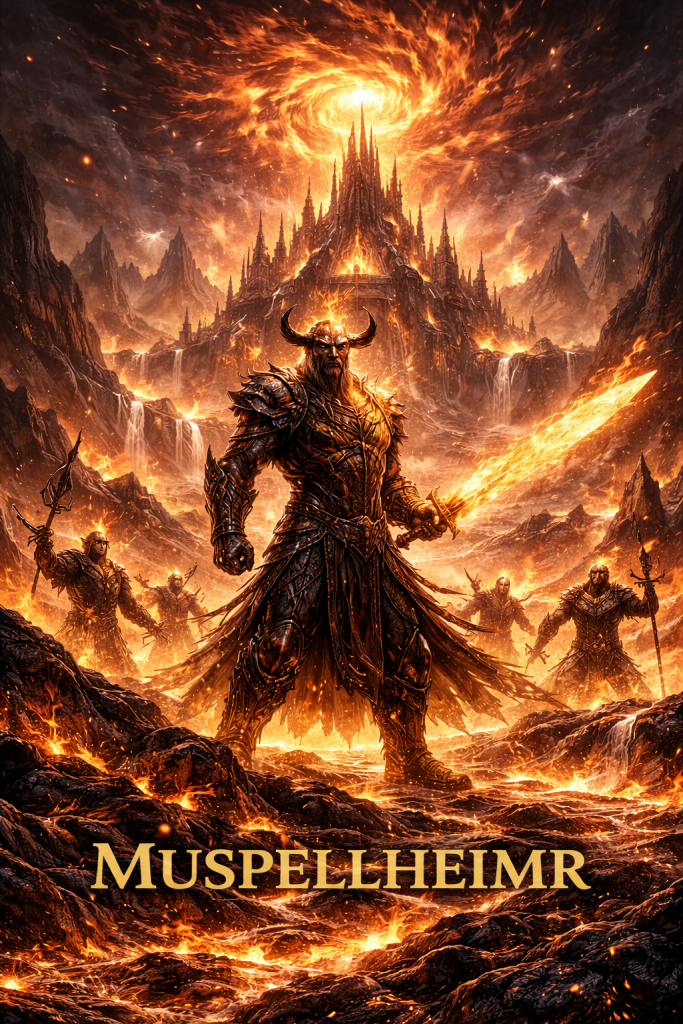
At the heart of Múspellsheimr stands Surtr, the great fire-being whose name means “Black” or “Darkened.” He is described as standing at the border of the realm with a flaming sword, guarding it from intrusion.
Surtr is not portrayed as chaotic or mindless. He is inevitable.
At Ragnarök, Surtr advances at the head of the fire-host. His sword burns brighter than the sun, and with it he sets the world aflame. After the final battles, Surtr’s fire consumes everything — gods, land, and sky alike.
He is not punished for this. He fulfills his role.
Múspellsheimr and Ragnarök: fire unleashed
Múspellsheimr is quiet until the end.
At Ragnarök:
- the sons of Muspell ride forth
- the sky splits
- Bifröst shatters beneath their weight
- fire spreads across the worlds
Surtr fights Freyr — a symbolic clash between fertility and destruction, growth and ending. Freyr falls, lacking the sword he once gave away, underscoring a recurring theme: even generosity can have fatal consequences.
After the battles are done, Surtr’s fire sweeps across everything. Mountains burn. Seas boil. The ordered cosmos collapses into flame.
This is not presented as evil. It is presented as necessary.
The old world cannot be renewed until it is completely undone.
Fire and Renewal: Destruction as Transformation
One of the most misunderstood aspects of Múspellsheimr is the idea that fire only destroys.
In Norse myth, fire clears space.
After Ragnarök, a new world rises:
- green
- fertile
- cleansed
Life returns. Humans survive. Gods are reborn or return from hiding.
Múspellsheimr’s fire does not annihilate existence forever. It resets the conditions under which existence can begin again.
Creation begins in fire.
Renewal requires it.
Múspellsheimr and Balance in the Nine Worlds
Múspellsheimr is often framed as “evil” in simplified retellings. The sources do not support that.
Instead, Múspellsheimr represents:
- unchecked energy
- motion without restraint
- the danger of excess
- and the power of endings
Without fire, the world freezes into stasis.
With too much fire, it is consumed.
The Nine Worlds exist in tension because both are present.
Múspellsheimr Today: Why it Still Matters
For modern readers and practitioners, Múspellsheimr speaks to:
- burnout
- collapse after excess
- necessary endings
- the courage to let something burn so something new can grow
It reminds us that not all destruction is failure. Some destruction is release.
Múspellsheimr is the primal realm of fire and motion — the force that ignites creation, destroys the old world at Ragnarök, and clears the way for renewal.
Sources and further reading
Poetic Edda (trans. Carolyne Larrington):
- Völuspá (creation, Ragnarök, Surtr)
- Vafþrúðnismál (cosmic origins)
Prose Edda (trans. Anthony Faulkes):
- Gylfaginning (Ginnungagap, Múspellsheimr, Surtr)
Sagas (trans. Jackson Crawford):
- Contextual references to fire, destruction, and world-ending motifs