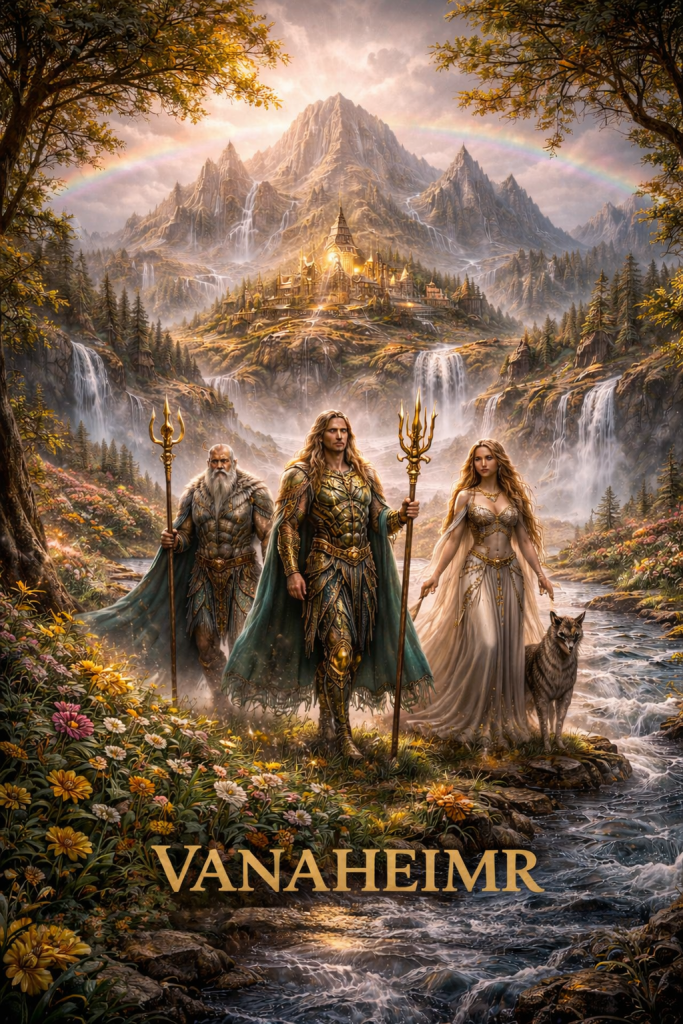
If Ásgarðr often reads like a fortress and a court, Vanaheimr feels like something older in the bones: land, luck, peace, growth, and the kind of sacred power that doesn’t need a throne to be real.
And yet… Vanaheimr is mostly off-stage in the surviving sources. That absence is part of its mystery — and part of why people argue so fiercely about what it even is. We don’t get a travelogue. We get a name, a handful of key lines, and a trail of Vanir gods whose presence in the myths is anything but minor.
So this is one of those realms where it’s important to separate:
- What the texts actually say
- What Snorri organises into a narrative system
- What historians and archaeologists can support
- What modern practitioners build from all of the above
Where Vanaheimr Appears in the Sources
Vanaheimr is explicitly named, but it’s not described like a landscape. Its strongest anchor is Njörðr.
In Vafþrúðnismál (Poetic Edda), a giant states that Njörðr was “made” in Vanaheimr, was given as a hostage to the gods, and will return to the Vanir at the end of the world.
That one passage does a lot of heavy lifting:
- Vanaheimr is treated as a real place within the mythic worldview, not only an idea.
- Njörðr’s connection to it is fundamental, not a decorative “background detail.”
- The Vanir aren’t a footnote — they’re a divine group with enough weight to trade hostages with the Æsir and remain their own power in the cosmic story.
The Vanir: Who They Are (beyond the simplified version)
A lot of modern summaries go: “Æsir = war, Vanir = fertility.”
It’s not wrong, but it’s not enough.
The Vanir are strongly linked with:
- peace and prosperity
- fertility and abundance
- land and landscape
- frith (peace as an active, maintained state — not just “no conflict”)
- a kind of sacred authority that feels less like “court politics” and more like life-force, reciprocity, and right relationship
In other words: the Vanir aren’t just “nature gods.” They are the mythic powers of thriving — the forces that make a people’s life and luck steady enough to endure.
That’s why Vanaheimr matters. It isn’t simply “where some gods live.” It’s the homeland of a divine tradition with its own flavour of holiness.
Named Places and “Halls” Linked to Vanir Gods
Nóatún (Njörðr)
Njörðr’s dwelling is Nóatún — a name that feels like safe harbour, ship-enclosure, shoreline protection. It’s one of the clearest “home-base” details we get for a Vanir god. The sources don’t always pin Nóatún to “inside Vanaheimr” in a literal cartographic way, but it’s absolutely Vanir-coded in tone.
Fólkvangr and Sessrúmnir (Freyja)
Freyja receives half of the slain, and in Snorri’s telling her hall is called Sessrúmnir. Again: strongly tied to a Vanir goddess, but not mapped with a ruler.
Álfheimr (Freyr)
Snorri says Álfheimr was given to Freyr as a “tooth-gift.” This is one of the reasons people argue whether the “realms” are cleanly separate, or overlapping categories of being. Freyr is Vanir, but his gifted domain is elf-linked — which tells you the cosmology can be porous.
Takeaway: if someone asks “what halls are in Vanaheimr,” the most accurate answer is: the sources don’t list them like they list some Æsir halls — but they do give the Vanir gods named strongholds and sacred zones that clearly belong to the Vanir sphere.
The Æsir–Vanir War: why Vanaheimr is a cosmic turning point
Even when Vanaheimr is quiet on the page, the Vanir conflict is one of the great turning gears of the mythic world.
The war and the settlement
The tradition describes a war between Æsir and Vanir that ends in a truce — and crucially, an exchange that binds both sides.
In Snorri’s narrative system, this includes hostages being traded, with Njörðr moving into the Æsir sphere as part of that settlement. Whether every detail is “old” in the same way is debated, but the pattern itself is very stable: the divine world survives by making terms, not by wiping the other side out.
Peace made into substance: Kvasir
In Skáldskaparmál Snorri tells the story of the peace being sealed by both sides spitting into a vat, and from that token they shape Kvasir, a wisdom-being whose blood later becomes the Mead of Poetry.
Even if you’re cautious with Snorri’s framing, the symbolism is unmistakable:
peace becomes a thing, and that thing becomes inspiration and culture.
That’s one of the most Vanir-feeling ideas in the entire mythic tradition: peace not as a passive state, but as a binding force that creates life, art, and continuity.
“Njörðr Was Sent Eastward” — does that place Vanaheimr west of Ásgarðr?
You’ve seen the claim: Njörðr travelled eastward to Ásgarðr from Vanaheimr, suggesting Vanaheimr lies west of Ásgarðr.
There is a seed for this: in Lokasenna, Loki mocks Njörðr and throws in the “sent eastward” line.
- Lokasenna is flyting — an insult contest. It’s not a geography lesson.
- “Eastward” might reflect a directional tradition, or a poetic jab, or a worldview where “east” carries symbolic weight.
And there’s a second complication: Snorri’s euhemerised “history-style” material places “Vanaland/Vanaheimr” in a very different kind of location altogether (as part of his attempt to frame gods as legendary human figures tied to real-world geography).
So the grounded approach is:
We can look at the “eastward” line, but we shouldn’t treat it as a reliable compass bearing. It’s evidence of movement and hostage-status, not proof of a fixed map.
Vanaheimr in History and Soil: What We Can Support
We can’t excavate Vanaheimr like a postcode. But we can support that Vanir-flavoured cult and identity mattered in Scandinavia.
Place-names and cult centres
Scholars who study theophoric place-names (place-names containing deity names) show strong regional clustering for certain gods — and Freyr in particular has powerful place-name concentration in Sweden. That aligns well with the long-running sense that Freyr’s cult was especially strong there.
Uppsala and prosperity cult traditions
Freyr is repeatedly framed as a prosperity figure — a god of good seasons, growth, and peace worth having. Later written traditions connect him with elite centres and cult prestige.
Wagon/procession traditions and “peace that travels”
A useful wider Germanic parallel is Tacitus’ description of Nerthus, a sacred figure whose wagon procession brings peace wherever it moves. Scholars have often compared this kind of “ritual movement that changes the social weather” with Scandinavian traditions around land-linked divinities and prosperity cult.
None of this “proves” Vanaheimr as a place — but it supports the idea that Vanir religion is not a modern invention. It reflects something real: a divine flavour tied to land, peace, prosperity, and communal stability.
Scholarly debate: are the Vanir (and Vanaheimr) a stable category?
There’s a known scholarly argument that “Vanir” as a clearly separate divine “tribe” may be less stable in pre-Christian tradition than later retellings suggest — with pushback from scholars who argue that differences in cult, motif, and mythic function are meaningful even if the lines aren’t perfectly crisp.
So the honest middle path is:
- The sources clearly present Njörðr, Freyr, and Freyja as a cluster with shared themes.
- “Vanir vs Æsir” is a useful model, but it may be fuzzier at the edges than modern charts make it look.
- Vanaheimr might function as both a realm-name and an origin-layer — a mythic homeland that matters even if it’s not described like a tourist destination.
Vanaheimr “Today”: Why Modern Practitioners Still Care
In modern Norse Pagan practice, Vanaheimr often stands for:
- right relationship with the land (reciprocity, not aesthetics)
- frith (peace as practice, not a mood)
- luck, prosperity, household steadiness
- fertility as life-force (gardens, creative work, family lines, harvest, survival)
So even if someone doesn’t “journey to Vanaheimr,” they can still live its logic:
tend what feeds you, keep peace worth having, and honour the powers that make life grow.
Vanaheimr is less a “tourist realm” in the sources and more a mythic homeland for the Vanir — the powers of peace, prosperity, and land-linked holiness that even the Æsir had to make terms with.
Sources and further reading
Primary sources:
- The Poetic Edda, trans. Carolyne Larrington:
- Vafþrúðnismál (Njörðr’s origin in Vanaheimr; hostage; return at world’s end)
- Lokasenna (Njörðr “sent eastward” line in the insult exchange)
- Edda: Prologue and Gylfaginning and related materials, trans./ed. Anthony Faulkes:
- Gylfaginning (Vanir/hostage context; Njörðr, Freyr, Freyja details)
- Skáldskaparmál (Kvasir and the spittle-vat peace story)
- Germania, Tacitus (Nerthus procession tradition as a wider Germanic parallel)
Good scholarly support:
- Stefan Brink on theophoric place-names (Freyr clustering / regional cult signals)
- Rudolf Simek on debates around the Vanir category
- Terry Gunnell on Vanir religion motifs and interpretive frameworks