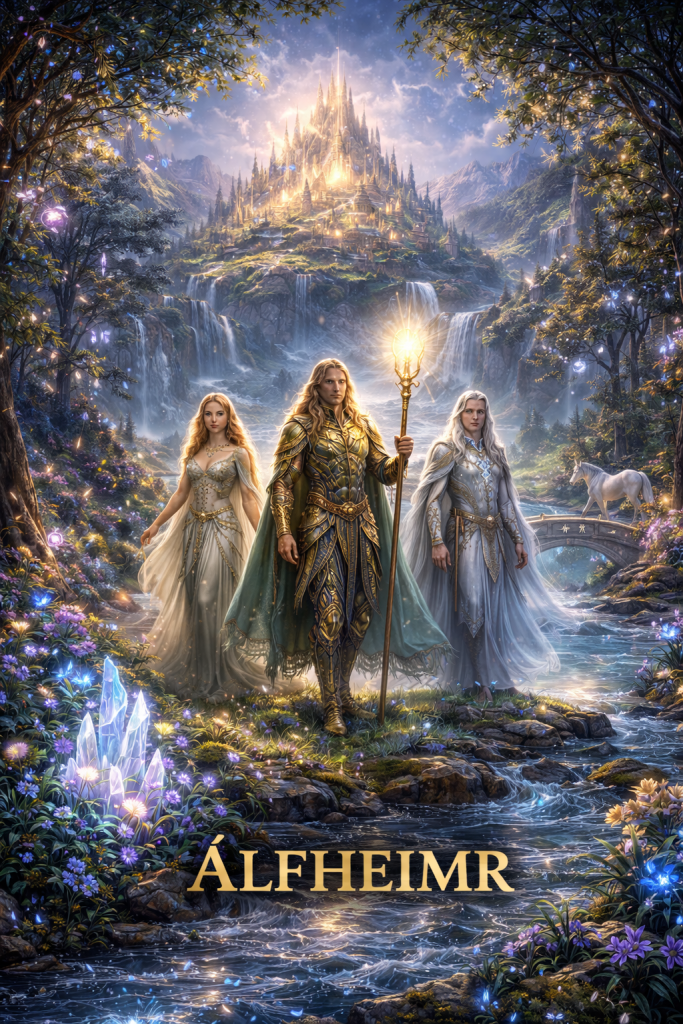
Álfheimr is one of the quiet realms in Norse cosmology — not because it’s unimportant, but because it exists just slightly out of focus. It’s close to the gods, close to the land, and close to humanity in ways the myths hint at rather than spell out.
If Jötunheimr is the wild outside and Ásgarðr the fortified centre, Álfheimr feels like a threshold realm: luminous, cultivated, fertile, and inhabited by beings who are neither gods nor mortals, but something in between.
Where Álfheimr Appears in the Sources
Álfheimr is explicitly named in the Prose Edda, where Snorri states that it was given to Freyr as a “tooth-gift.” That single line has shaped almost every later understanding of the realm.
What matters here isn’t the gift itself, but what it implies:
- Álfheimr is associated with Freyr, a Vanir god of fertility, prosperity, peace, and good seasons.
- The Light Elves are therefore placed under the influence of a deity tied to growth, abundance, and life-force, rather than war or judgment.
- Álfheimr sits comfortably within the divine order, but is not an Æsir stronghold.
Unlike realms such as Ásgarðr or Jötunheimr, Álfheimr doesn’t come with long narrative episodes set inside it. Instead, it shows up through who its inhabitants are, how they’re described, and how they relate to gods and humans.
The Light Elves (Ljósálfar)
Snorri describes the Ljósálfar, the Light Elves, as:
- more beautiful than the sun,
- luminous in appearance,
- and associated with goodness and brightness.
That description has had an outsized influence on modern imagery, but it’s worth grounding it a little.
The Light Elves are not presented as fluffy, harmless sprites. In the wider Germanic worldview, elves are:
- powerful,
- capable of blessing or harm,
- deeply tied to land, fertility, and health,
- and not always safe to offend.
In Old Norse culture, álfar are closely linked to:
- ancestral spirits,
- fertility rites,
- burial mounds,
- and household prosperity.
This suggests that Álfheimr may not be “far away” in the way Muspelheimr or Niflheimr are. It may instead represent a parallel layer of reality, overlapping with the human world — especially rural land, farms, and ancestral ground.
Álfheimr and Freyr: Fertility, Prosperity, and Sacred Balance
The connection between Álfheimr and Freyr is not accidental.
Freyr’s core domains include:
- fertility of land and people,
- abundance and peace,
- prosperity without conquest,
- and right timing — seasons, harvests, growth cycles.
Placing Álfheimr under Freyr’s influence frames the Light Elves as guardians and embodiments of life-force, rather than abstract spirits of light.
This also helps explain why elves appear in later folklore as:
- bringers of blessing,
- sources of illness if angered,
- beings who must be respected rather than worshipped like gods.
Álfheimr, in this sense, isn’t a palace-realm. It’s a fertile domain, aligned with the rhythms that keep the world alive.
Are there halls in Álfheimr?
Unlike Ásgarðr, the sources do not name specific halls in Álfheimr.
This absence is important.
Álfheimr is not described as a realm of thrones, courts, or monumental architecture. Its power appears to lie in presence rather than structure. That fits with how elves function across Germanic tradition: not as rulers in halls, but as beings embedded in land, mounds, groves, and hidden places.
Rather than named halls, Álfheimr is better understood as:
- a cultivated, luminous realm,
- structured by fertility and balance,
- and ruled indirectly through Freyr’s authority rather than explicit kingship.
Light Elves, Dark Elves, and the Question of Balance
Snorri draws a distinction between:
- Ljósálfar (Light Elves), associated with brightness and beauty, and
- Dökkálfar or Svartálfar, associated with darkness and subterranean spaces.
Modern readers often try to turn this into a moral split — “good elves vs bad elves.” The sources don’t support that cleanly.
A more useful way to read it is balance.
Light Elves are associated with:
- surface fertility,
- visible abundance,
- growth and health.
Dark Elves / Svartálfar are associated with:
- underground spaces,
- craft and creation,
- transformation through pressure (metal, stone, forging).
Together, they represent two halves of making and maintaining the world:
- what grows above ground,
- and what is shaped below it.
Álfheimr and Svartálfheimr are not enemies. They are counterweights.
Elves and Humans: Blurred Boundaries in Saga Tradition
While the Eddas keep elves slightly distant, later saga material lets the boundary blur.
In texts such as Þiðreks saga and Hrólfs saga, there are hints and motifs suggesting:
- unions between elves and humans,
- extraordinary beauty or skill traced to elven ancestry,
- and elite lineages claiming descent from non-human beings.
These stories don’t give us a systematic theology of elf–human interbreeding, but they do reinforce an important idea:
elves are close enough to humanity to mix with it.
That closeness supports the idea that Álfheimr is not unreachable — it’s adjacent. It touches the human world through bloodlines, land, and inherited luck.
Álfheimr, Ancestors, and the Land
One of the strongest undercurrents running beneath Álfheimr is its link to ancestral presence.
In Norse culture:
- elves are sometimes equated with honoured dead,
- álfablót (elf sacrifices) were household rites rather than public cult,
- and these rites were tied to land, fertility, and family prosperity.
Seen this way, Álfheimr may function less like a distant “world” and more like a mythic name for the luminous aspect of ancestral and land-based spirits.
That interpretation doesn’t contradict the sources — it explains why Álfheimr is important, but rarely dramatized.
Álfheimr in the Wider Cosmology: Place or Layer?
Scholars and practitioners alike debate whether Álfheimr is:
- a distinct realm like Ásgarðr,
- a region within another realm,
- or a parallel layer of existence overlapping the human world.
The sources allow for all three readings.
What they do not support is a rigid, modern “map” where every realm sits neatly stacked. Álfheimr especially resists that. It behaves more like a mode of being than a location with borders.
Álfheimr Today: Why it Still Matters
For modern Norse Pagans and Heathens, Álfheimr often represents:
- respect for land spirits,
- fertility in the broad sense (health, creativity, prosperity),
- ancestral continuity,
- and balance rather than dominance.
It’s a realm that asks for right relationship, not conquest or control.
In that way, Álfheimr feels remarkably current: a reminder that not all power is loud, not all sacredness wears a crown, and not all worlds are meant to be ruled.
Álfheimr is the luminous realm of the Light Elves — a place of fertility, ancestral presence, and quiet power, bound to Freyr and balanced by the darker, deeper forces of the world.
Sources and further reading
Primary sources:
- Prose Edda, trans. Anthony Faulkes — Álfheimr given to Freyr as a tooth-gift; Light/Dark Elf distinctions.
- Poetic Edda, trans. Carolyne Larrington — contextual references to elves, fertility, and cosmology.
- Þiðreks saga, trans. Jackson Crawford — saga motifs involving elves and human lineage.
- Hrólfs saga, trans. Jackson Crawford — legendary material hinting at elf–human interactions.
Scholarly context:
- Discussions of álfablót and household cult.
- Studies on elves as ancestral or land spirits in Norse belief.
- Comparative Germanic folklore on elves and fertility spirits.