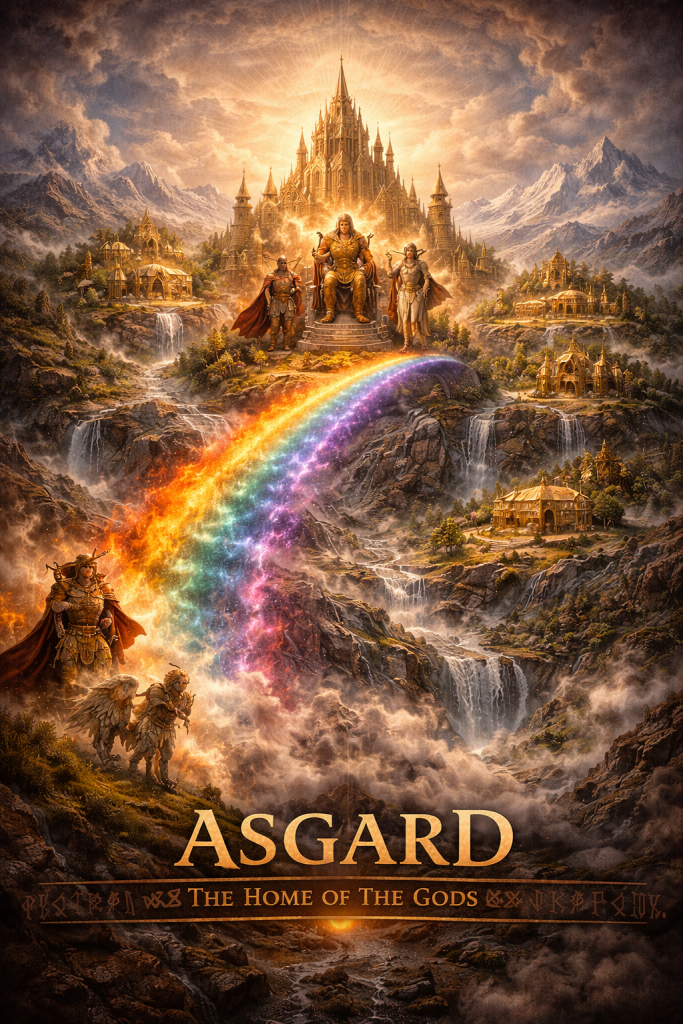
Ásgarðr isn’t just “where the gods live.” In the stories, it’s a border — a bright, defended inside-space that exists because there’s an outside. It’s the place of halls, vows, feasts, judgement, and rule, but it’s also the place where the gods show their fear (and their politics) by building walls, keeping watch, and controlling who gets in.
If Midgarðr is the human world “within the fence,” then Ásgarðr is that same idea turned up to mythic scale: the divine enclosure — the inner court where order is made, displayed, and protected.
Where Ásgarðr Shows Up in the Sources
Ásgarðr appears across the core mythic materials — but you’ll notice something quickly: the poems don’t give you one neat map. They give you moments: a hall, a bridge, a meeting-place, a wall, a seat of power. Snorri (in the Prose Edda) gives the most structured “tour,” but he’s writing later and organising older material into a cleaner system.
Key places to look
- Poetic Edda (Larrington): Völuspá (the gods gathering and building; Iðavöllr), Grímnismál (a roll-call of divine dwellings, including the famous hall material).
- Prose Edda (Faulkes): Gylfaginning for “Bifröst is the way in,” for Gladsheim/Vingólf, and for the wall-builder episode that ends with Sleipnir.
- Later saga-style retellings / euhemerised material: important for reception history, but not the cleanest “pagan snapshot.”
The Name: What Ásgarðr is Supposed to Feel Like
Ásgarðr (Old Norse: Ásgarðr) is commonly glossed as “enclosure of the Æsir.” The -garðr element matters: it’s the same “yard / enclosure / fenced space” idea that shows up in Midgarðr too — a worldview built on boundaries.
That doesn’t mean we have to turn everything into a tidy “inside vs outside” philosophy chart — modern Heathen internet sometimes overbuilds that idea — but the fence/enclosure sense is real, and the myths lean on it hard.
What the Texts Actually Give Us
1) The way in: Bifröst (and the “heaven” language)
In Gylfaginning (Faulkes), the gods’ road is a bridge “called Bifrost… what you call the rainbow.”
That “heaven” phrasing is part of Snorri’s narrative voice — useful, but worth noticing. Sometimes he sounds like he’s translating older myth-logic into a more medieval-Christian conceptual frame.
2) The gold-bright hall-world: Gladsheim and Vingólf
Still in Gylfaginning, Snorri places major structures in Ásgarðr — including Gladsheim (associated with the thrones of the gods) and Vingólf (a hall linked with the goddesses). The whole description is soaked in “gold” imagery.
(And yes: if you’ve been watching for how often gold turns up in Norse myth as both splendour and danger — you’re not imagining it.)
3) “Fortify it”: the wall-builder and the birth of Sleipnir
This is one of the most important Ásgarðr stories for understanding what Ásgarðr is. The gods want security “against mountain-giants and frost-giants,” so they bargain with a builder to raise a fortification — a bargain that spirals into deception, oath-pressure, Loki’s mess, and the origins of Odin’s horse.
This episode is doing mythic work on multiple levels:
- Ásgarðr is not “safe by default.” It’s defended because it can be threatened.
- The gods use contracts. They negotiate, set conditions, invoke witnesses, bind terms.
- Loki is a structural fault-line. Not “random chaos,” but the point where the system breaks open and reveals what it’s made of.
For a more scholarly read of how these myths build meaning (not just plot), Dr. Tommy Kuusela is genuinely useful — and very readable.
What’s in Ásgarðr (and what’s associated with it)
Different poems and prose passages emphasise different divine “addresses,” but these are the big ones you’ll see readers circle again and again:
The hall-complex vibe
Ásgarðr repeatedly shows up as a place of:
- feasting
- council
- judgement
- status-display
- high seats and watching
That “high seat / sight / rule” theme is so strong that scholars have even used it as a jumping-off point to discuss aristocratic ideology around Óðinn (and how power imagines itself watching the world).
Valhǫll in Gladsheim
In Grímnismál (Larrington), you get the clean famous line that Valhǫll is in Gladsheim and Odin chooses the slain. (This is one of those places where the poems are very crisp — and that crispness is why people quote it so much.)
Iðavöllr: the meeting-place
Völuspá uses Iðavöllr as a kind of mythic “assembly-ground” where the gods meet and build — and later, after catastrophe, meet again in the renewed world. (You don’t have to over-map it; you just have to notice that Ásgarðr is also where the gods do civilisation: making things, naming things, ordering things.)
Ásgarðr in Text and Soil: what archaeology can (and can’t) add
Archaeology will never “prove Ásgarðr” as a literal place — but it can absolutely sharpen your sense of what a Norse audience understood when a poem says “hall,” “seat,” “enclosure,” “gold,” “feast,” “cult,” “power.”
Across Scandinavia, archaeologists have excavated elite central places with massive halls and sometimes smaller cult buildings nearby — places where politics, religion, gift-giving, and spectacle are tangled together.
A few accessible examples:
- Gudme (Denmark): the National Museum of Denmark presents the site’s prince’s hall and its scale very plainly.
- Tissø (Denmark): the National Museum discusses the magnate complex and cult context at the site.
- Uppåkra (Sweden): research on the hall/cult-building core gives a strong “this is what a powerful hall-world looked like” grounding.
- Broader syntheses of pre-Christian cult sites pull these patterns together across regions.
So when Ásgarðr shows up as a gold-bright hall-centre behind defences, you’re not reading fantasy-worldbuilding in a vacuum — you’re reading myth through the lens of a culture that knew exactly what it meant to be inside the palisade when the stakes were real.
The Debate: Where (and what) is Ásgarðr, exactly?
This is where people get loud — because Ásgarðr sits right at the fault-line between “myth as map” and “myth as meaning.”
1) “It’s in the sky / it’s heaven”
Snorri’s prose often leans that way in phrasing, and later readers love the simplicity. But it can flatten older, weirder cosmology into something too familiar.
2) “It’s a different region of the same world”
A lot of the poetic material reads more like connected spaces (halls, plains, bridges, paths) than like planets floating in separate dimensions. That doesn’t make it “literal geography” — it just means the poets didn’t always think in clean vertical layers.
3) “It’s a model: inside-the-fence order”
This is popular in modern Pagan explanation-land — and it’s genuinely helpful as long as you don’t turn it into a rigid doctrine. Even the terminology people throw around online can be shakier than they think. Crawford has called out how internet Heathenry can accidentally build big theories out of tidy modern phrases.
4) “Stop trying to pin it down”
Some scholars (and plenty of serious practitioners) treat Ásgarðr as something like a mythic ‘power-centre’: a symbolic enclosure of divine authority that can show up as hall, as fortress, as meeting ground, as seat — depending on what the story needs.
The sources describe Ásgarðr consistently as the gods’ enclosed, hall-centred home — but they don’t give a single, universally consistent map of where it sits in the cosmos.
Working with Ásgarðr
- Ásgarðr as boundary: what’s protected, what’s permitted, what’s kept out.
- Ásgarðr as hall-world: culture, feasting, rule, judgement, status, and the performance of power.
- Ásgarðr as anxiety: the wall exists because the gods know they can be reached.
- Ásgarðr as consequence: bargains have teeth; oaths have weight; loopholes come back to bite.
The Halls of the Gods
When people picture Asgarðr, they usually picture walls, towers, and a single “capital city.” The texts are a bit weirder (and honestly more interesting). They give us named halls — sacred spaces with a specific vibe, a specific resident, and often a specific function.
A lot of these appear in Grímnismál (Poetic Edda; trans. Carolyne Larrington), which reads like a mythic “address book” of divine dwellings. Snorri then repeats and expands some of them in Gylfaginning (Prose Edda; trans. Anthony Faulkes). (Heimskringla)
Key halls and holy places linked with Asgarðr
Valhǫll (Valhalla) — Óðinn’s hall, where the chosen slain are gathered by the valkyrjur. It’s less “heaven” and more “warrior afterlife + training ground + feast hall,” and it’s one of the strongest Asgarðr anchors in the popular imagination. (Grímnismál; also echoed by Snorri.) (Heimskringla)
Fólkvangr & Sessrúmnir — Freyja’s territory and hall. The poems tell us Freyja receives half of the slain, and Snorri explicitly names Sessrúmnir as her hall. Whether you label this “in Asgarðr” depends on how you’re using the word: the sources place it among the gods’ domains, but they don’t give us a tidy city map. (Grímnismál; Gylfaginning.) (Heimskringla)
Bilskirnir (in Þrúðvangr) — Þórr’s hall, famously described as enormous. This one is straight out of Grímnismál and is one of the clearest “named home-base” details we have for Thor. (Heimskringla)
Valaskjálf & Hliðskjálf — Óðinn’s hall, associated with the high-seat Hliðskjálf, the “seeing-seat” from which he looks out across the worlds. (Grímnismál; also in Snorri.) (Heimskringla)
Fensalir — Frigg’s dwelling, often glossed as “fen-halls” or “marsh-halls,” with a strong water/mist feel in the name. (Grímnismál; referenced in Snorri’s mythic geography too.) (Heimskringla)
Breiðablik — Baldr’s hall, described as a place where nothing impure can be. It’s basically the mythic concept of untouchable sanctity given architecture. (Grímnismál; Gylfaginning.) (Heimskringla)
Glitnir — Forseti’s shining hall, tied to settlement, law, and the cooling of disputes. (Grímnismál; Gylfaginning.) (Heimskringla)
Himinbjörg — Heimdallr’s dwelling. The poem places it as his hall; Snorri connects Heimdallr to the bridge as its guardian, so in modern retellings Himinbjörg often gets positioned “near” Bifrǫst — but the sources give it as a name and role more than a pin on a map. (Grímnismál; Gylfaginning.) (Heimskringla)
Nóatún — Njǫrðr’s home (“ship-enclosure / harbour-place” in feel). This is a good one to include in Asgarðr discussions because Njǫrðr is Vanir by origin — and after the Æsir–Vanir settlement, the myths place Vanir figures in the gods’ wider world. (Grímnismál; Gylfaginning.) (Heimskringla)
Glaðsheimr & Vingólf — Snorri’s “divine civic buildings”: Glaðsheimr as a major hall of the gods (often treated like an assembly/seat of power), and Vingólf as a hall associated with the goddesses. These are very handy for giving Asgarðr a sense of structure beyond “a sky castle.” (Gylfaginning.)
Sökkvabekkr — the hall linked with Sága, with a strong water/river imagery. It’s one of those details that makes the divine world feel lived-in rather than purely warlike. (Grímnismál.) (Heimskringla)
Ýdalir — Ullr’s place, usually read as a “yew dales” / hunting-archery vibe in the name. Another good reminder that the gods’ world isn’t only thrones and battles. (Grímnismál.) (Heimskringla)
Two quick notes
- Not every famous hall is “in Asgarðr.” Some halls show up in end-times / other-realm contexts. For example, Vǫluspá mentions a golden hall linked with Sindri’s name up in Niðavellir territory — that’s not Asgarðr, even though modern summaries sometimes lump it in. (Heimskringla)
- The sources don’t always agree on layout. They’re more interested in function and symbolism than a consistent diagram.
Ásgarðr is the gods’ shining “inside-the-fence” world — a hall-centre of power and order that still needs walls, watchfulness, and hard bargains to stay standing.
Sources and further reading
Primary texts:
- The Poetic Edda, trans. Carolyne Larrington (Oxford University Press, rev. ed.).
- Edda: Prologue and Gylfaginning, trans./ed. Anthony Faulkes (standard reference translation).
Helpful scholarship / context:
- Terry Gunnell / or Stockholm University Press open scholarship (incl. T. Kuusela on myth interpretation and method).
- Clive Tolley / C. Abram on cosmological models and why “maps” don’t behave like modern diagrams.
- Archaeology of elite halls and cult buildings (Gudme, Tissø, Uppåkra) for the real-world “hall culture” backdrop.
- (Optional, for modern discourse hygiene) Jackson Crawford on popularised but wobbly terminology.
- Poetic Edda (Carolyne Larrington) — Grímnismál (the hall list)
- Prose Edda (Anthony Faulkes) — Gylfaginning (Snorri’s Asgarðr build-out, Freyja/Sessrúmnir, Heimdallr framing, etc.)
- Poetic Edda (Larrington) — Vǫluspá (for the other “hall” traditions that aren’t Asgarðr-based)