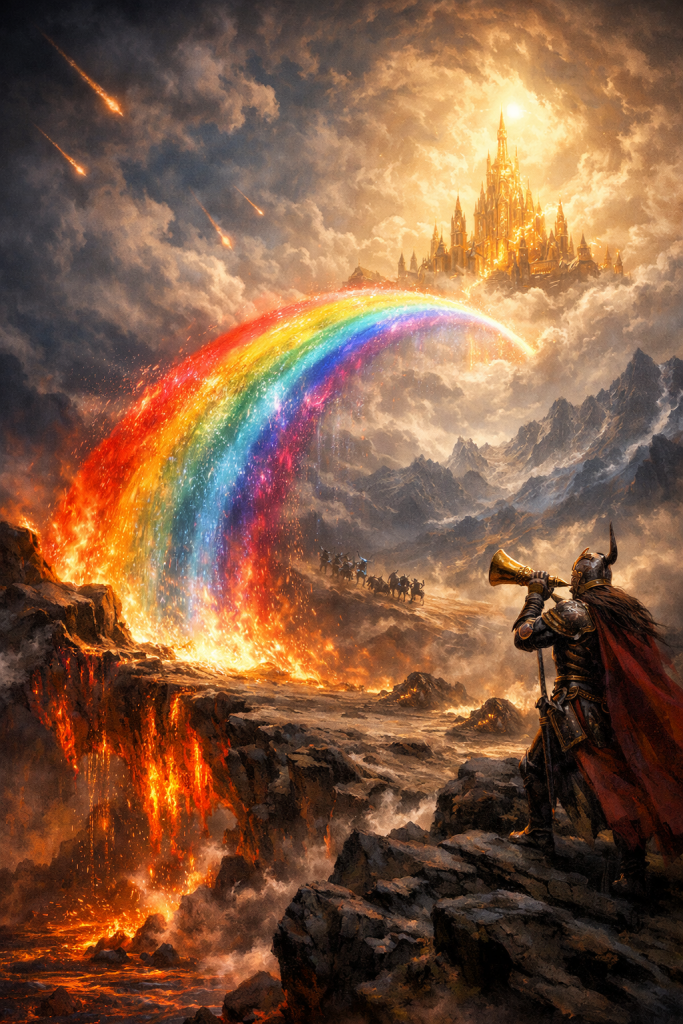
There’s a reason Bifröst gets remembered as “the rainbow bridge” — it is dazzling — but the older vibe in the sources is less “pretty sky-arc” and more hot, guarded, dangerous threshold.
Bifröst is what happens when a myth needs a clear boundary between worlds… and then immediately reminds you that boundaries can fail.1,2
Where Bifröst Appears in the Sources
Bifröst shows up in both of our big myth reservoirs:
- Poetic Edda (especially Grímnismál and Fáfnismál), where it’s often called Bilröst and also described as Ásbrú (“the Æsir’s bridge”).1,2
- Prose Edda (Gylfaginning and a brief nod in Skáldskaparmál), where Snorri gives the fullest “explain it like a map” description: three colours, burning fire in the red, Heimdall guarding it, and its doom at Ragnarök.2,3
- Skaldic poetry (via Snorri’s quotation tradition), where Bifröst is remembered in poetic diction as something like “the powers’ way” — which tells you it’s not just a bridge, it’s a route of divine movement.3
That mix matters because the Poetic Edda tends to speak in compressed myth-language, while Snorri often tries to systematise (and sometimes tidy up) what the poetry leaves sharp-edged.1,2
What the Text Actually Gives Us
1) It’s a world-connection — but also a fortified border
In Gylfaginning, Bifröst is built “from earth to heaven,” and Snorri explicitly says people call it a rainbow. He also stresses it’s made with exceptional skill and has three colours.2
Then comes the key detail that gets skipped in fluffy retellings:
the red is burning fire, and that fire functions like a ward — keeping frost-giants and mountain-giants from simply strolling into “heaven.”2
So even in the “rainbow” framing, Bifröst is not a gentle invitation. It’s a guarded point of access.2
2) Heimdall is posted there for a reason
Snorri places Himinbjörg (“Heaven’s cliff / sky-mountain”) at the point where Bifröst reaches heaven, and he puts Heimdall there as the watchman.2
Whether you read Heimdall as sentry, gatekeeper, or living alarm-bell, the symbolism is consistent: this crossing matters, and someone is always watching it.2
3) The gods ride it — but Thor does not
One of my favourite “small” details (because it’s so revealing) is that the gods ride across daily… but Thor wades rivers instead, because the god-bridge burns. In Grímnismál, that detail is tied to the idea of the gods going to give judgement near the world-tree.1,2
That single image does a lot:
- Bifröst is holy infrastructure (used regularly by the gods).
- It’s also hazardous (not everyone crosses the same way).
- And it links the bridge straight into the wider cosmic court / fate / world-tree complex.1,2
Bifröst and Ragnarök: the bridge that will fail
Snorri is blunt: when the sons of Muspel ride forth at Ragnarök, Bifröst breaks.2
The Poetic Edda gives a parallel image in Fáfnismál: Bilröst breaks during the end-time journeying, and the horses have to swim the “mighty river.”1
So the myth keeps the tension alive:
the bridge is strong, crafted, defended — and still not secure against the final breach.1,2
That’s classic Norse cosmology: order exists, but it’s contested, and even the gods don’t get permanent guarantees.1,2
Name-notes: Bifröst, Bilröst, and Ásbrú
You’ll see all three forms:
- Ásbrú = “Æsir’s bridge” (a functional name)
- Bilröst / Bifröst = the debated poetic name1,2
Scholars often point out two competing “feelings” in the name:
- Bil- can suggest something like “a moment / fleeting glimpse” → an image that appears and vanishes
- Bif- can link to “shimmer / shake / tremble” → movement, vibration, unstable light5,6
Either way, the name itself leans into ephemeral phenomenon, not a stone roadway you can put on a tourist map.5,6
So… is it really a rainbow?
This is where the fun arguments live — and where people start talking past each other.
The “Rainbow” Case
Snorri outright says you can call it a rainbow, and he describes three colours, with red as fire.2
So if someone wants to read Bifröst as a mythic rainbow with a fiery defensive edge, they’re not pulling it out of nowhere.2
The “Milky Way” case
Some scholars have proposed Bifröst may originally have been understood as the Milky Way — a bright band that looks like a road in the sky, and a natural candidate for a “bridge between worlds.”7,8
This can also mesh nicely with the way Ásbrú sounds like a route rather than a weather event.7,8
The “Aurora” Case
There’s also modern scholarly work arguing the aurora borealis fits the “fiery / strange / unstable” tone better than a typical rainbow does, especially if you’re leaning into the idea of something that moves, flares, and looks like battle-light in the sky.7
Why the Disagreement Doesn’t Break the Myth
The sources don’t give us one clean scientific identification. They give us mythic behaviour:
- It connects worlds
- It’s guarded
- It burns
- It breaks at Ragnarök1,2
Those features can sit beside a rainbow or a sky-road or the aurora, depending on which lens you’re using: poetic, cosmological, or natural-phenomenon.1,2,7
Bifröst is the mythic “way between worlds,” and later tradition (especially Snorri) strongly associates it with the rainbow — but scholars have argued for other celestial readings too.2,7,8
Working with Bifröst as an archetype
If Yggdrasil is the structure, Bifröst is the crossing.
Bifröst as a living myth-pattern can speak to:
- Threshold work: the line between “here” and “there,” where rules change.
- Spiritual discipline: access is not casual; it’s guarded, earned, watched.
- The cost of connection: the bridge is beautiful, but it burns.
- The truth about endings: some structures are meant to fail when the final storm hits — not because they were pointless, but because nothing in the mythic world is immune to time.1,2
A quick debate note for those readers who like to argue about maps
People often talk about the Nine Realms as if they sit on a tidy vertical diagram, but Bifröst complicates that. In Snorri, it’s “earth to heaven,” yet it’s also a daily route to a sacred court-space, guarded at a boundary-point, and destined to break under invasion.2
That doesn’t read like a motorway. It reads like a mythic boundary-mechanism — which is exactly why debates about “alternate dimensions vs one landscape” keep coming back.2
Notes
- The Poetic Edda, trans. Carolyne Larrington — see Grímnismál (Thor wading; burning bridge) and Fáfnismál (Bilröst breaking).
- Snorri Sturluson, Edda (Prose Edda), trans. Anthony Faulkes — Gylfaginning (Bifröst: earth-to-heaven; three colours; red as burning fire; Heimdall at Himinbjörg; Ragnarök).
- Snorri Sturluson, Edda (Prose Edda), trans. Anthony Faulkes — Skáldskaparmál (skaldic quotation; “the powers’ way”).
- John Lindow, Norse Mythology: A Guide to the Gods, Heroes, Rituals, and Beliefs (Bifröst/Gjallarbrú parallels; general reference context).
- Rudolf Simek, Dictionary of Northern Mythology (entry discussions commonly used for name/meaning overviews).
- Andy Orchard, Dictionary of Norse Myth and Legend (entry discussions commonly used for name/meaning overviews).
- Christopher A. Matthew (2024), “bifröst (the rainbow bridge) and the norðrljós (the northern lights) in Norse mythology,” European Journal of Science and Theology 20(3), 35–47 (aurora argument; also reviews Milky Way proposals).
- Mathias Nordvig (2012), Saga Conference preprint (discussion of de Vries’ Milky Way interpretation and etymology line).