One of the first questions people ask when they encounter Norse cosmology is deceptively simple:
“Where are the Nine Realms?”
Are they stacked like floors?
Spread across a map?
Different dimensions?
Or symbolic states layered onto the same world?
The short answer is: the sources don’t agree — and they probably never meant to.
The Norse did not leave us a single, authoritative cosmological diagram. What they left instead are poems, stories, names, journeys, and contradictions. Understanding the Nine Realms means learning to live with that ambiguity rather than trying to flatten it.
What the Sources Actually Give Us (and what they don’t)
Across the Poetic Edda, Prose Edda, and sagas, we encounter the names of realms again and again:
Ásgarðr, Miðgarðr, Jǫtunheimr, Vanaheimr, Álfheimr, Svartálfaheimr / Niðavellir, Helheimr, Niflheimr, and Múspellsheimr.
What we do not get is:
- a single map,
- consistent directions,
- or a clear explanation of how these realms relate spatially.
Instead, the texts describe:
- movement between realms,
- boundaries that can be crossed or guarded,
- and functions each realm serves in the cosmic order.
That suggests the Nine Realms are less about geography and more about relationship and role.
Model One: the “stacked worlds” interpretation
This is the most common modern image: realms arranged vertically, often with:
- Asgarðr above,
- Miðgarðr in the middle,
- Helheimr or Niflheimr below.
This model draws loosely from:
- the World-Tree imagery of Yggdrasil,
- references to “above” and “below” in the poetry,
- and later medieval cosmological thinking.
Strengths of this model:
- It’s intuitive.
- It fits visual teaching tools.
- It matches some mythic language.
Weaknesses:
- It struggles to explain lateral realms like Jǫtunheimr.
- It can falsely imply moral hierarchy (upper = good, lower = bad).
- It owes more to medieval and modern diagramming instincts than to the poems themselves.
This model is useful — but limited.
Model Two: the “horizontal world-map” interpretation
Some readers treat the realms as regions of the same cosmic landscape:
- Miðgarðr enclosed at the centre,
- Jǫtunheimr beyond its borders,
- realms placed “east” or “west” based on poetic hints.
This approach fits especially well with:
- journey myths,
- flyting insults about where gods came from,
- and saga-style movement through space.
Strengths:
- Makes sense of travel narratives.
- Keeps the world grounded and mythically “walkable.”
- Avoids turning realms into abstract heavens and hells.
Weaknesses:
- Still relies on inconsistent directional language.
- Collides with realms that clearly aren’t just distant lands (Múspellsheimr, Niflheimr).
This model works best for some realms, not all.
Model Three: realms as layers or states of being
This is where many modern scholars — and careful practitioners — land.
In this reading, the Nine Realms are not primarily places you walk to, but conditions of existence layered onto the cosmos.
For example:
- Álfheimr as a fertile, luminous layer close to land and ancestry.
- Svartálfaheimr as the deep, transformative layer beneath the surface.
- Helheimr as a containment layer for the dead.
- Niflheimr as the primal condition of cold and erosion.
- Múspellsheimr as raw energy and motion.
These realms can overlap, intersect, and influence each other without needing to be separated by miles or altitude.
Strengths:
- Fits the poetic ambiguity.
- Explains why realms can feel both distant and intimate.
- Respects how myth works symbolically.
Weaknesses:
- Harder to visualise.
- Less satisfying for people who want a “map.”
Yggdrasil: Axis, Not Atlas
Yggdrasil is often treated like a cosmic filing cabinet: “this realm goes here, that realm goes there.”
The sources don’t support that.
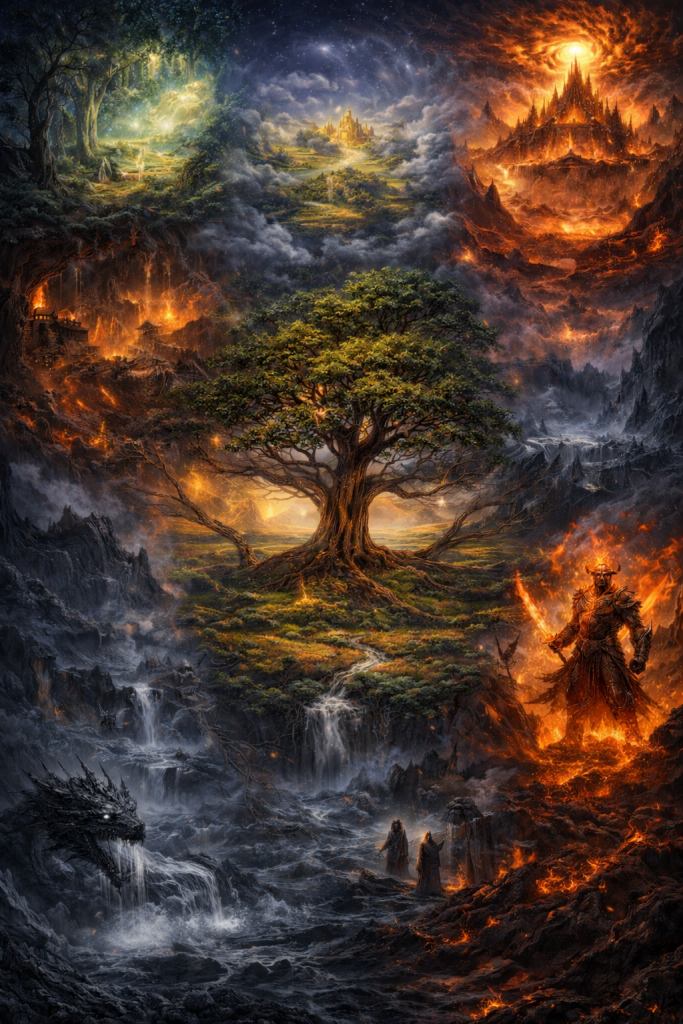
Yggdrasil is better understood as an axis — a living structure that connects realms without flattening them into coordinates. Its roots reach into different conditions of existence. Its branches shelter gods and worlds. Creatures move up and down it carrying messages, decay, and disruption.
It connects — it does not explain.
Overlapping Realms: when categories blur
Some of the biggest debates exist because the realms refuse to stay in neat boxes.
- Are Svartálfar and dwarves the same?
- Is Álfheimr a realm or a condition?
- Is Helheimr inside Niflheimr, or simply associated with it?
- Is Vanaheimr a place, a homeland, or a memory of older cults?
The sources answer: sometimes yes, sometimes no.
That doesn’t mean the system is broken. It means it reflects a worldview where function mattered more than classification.
Christian Influence and Later Systematisation
It’s impossible to ignore that much of what we have was written down in Christian-era Iceland.
Snorri Sturluson, in particular, shows a strong impulse to:
- organise,
- systematise,
- and explain.
That impulse is useful — but it can also smooth out older ambiguity. When Helheimr starts to look like Christian Hell, or when realms start behaving like fixed provinces, it’s worth asking whether we’re seeing older myth or later interpretation.
The Nine Realms likely existed as flexible concepts long before they were organised into a numbered set.
Why the Norse Never Gave Us a Map
The simplest explanation may be the best:
they didn’t need one.
The Norse worldview was not obsessed with cosmic schematics. It cared about:
- relationships,
- obligations,
- fate,
- and balance.
The Nine Realms function as a mythic language for talking about forces that shape life — land, death, fire, cold, craft, fertility, chaos, and order.
A precise map would miss the point.
So… What Are the Nine Realms?
They are:
- sometimes places,
- sometimes conditions,
- sometimes relationships,
- sometimes memories of older traditions,
- sometimes narrative tools.
They are consistent in function, not in form.
Trying to force them into a single model often says more about modern expectations than Norse belief.
The Nine Realms are not a diagram to be solved, but a mythic system meant to be lived with — flexible, overlapping, and shaped by story rather than cartography.
Sources and further reading
Primary sources:
- Poetic Edda, trans. Carolyne Larrington
- Prose Edda, trans. Anthony Faulkes
- Norse sagas, trans. Jackson Crawford
Scholarly context:
- Studies on Norse cosmology and mythic space
- Debates on Vanir, elves, and dwarves as categories
- Work on Christian-era influence on medieval Icelandic writing