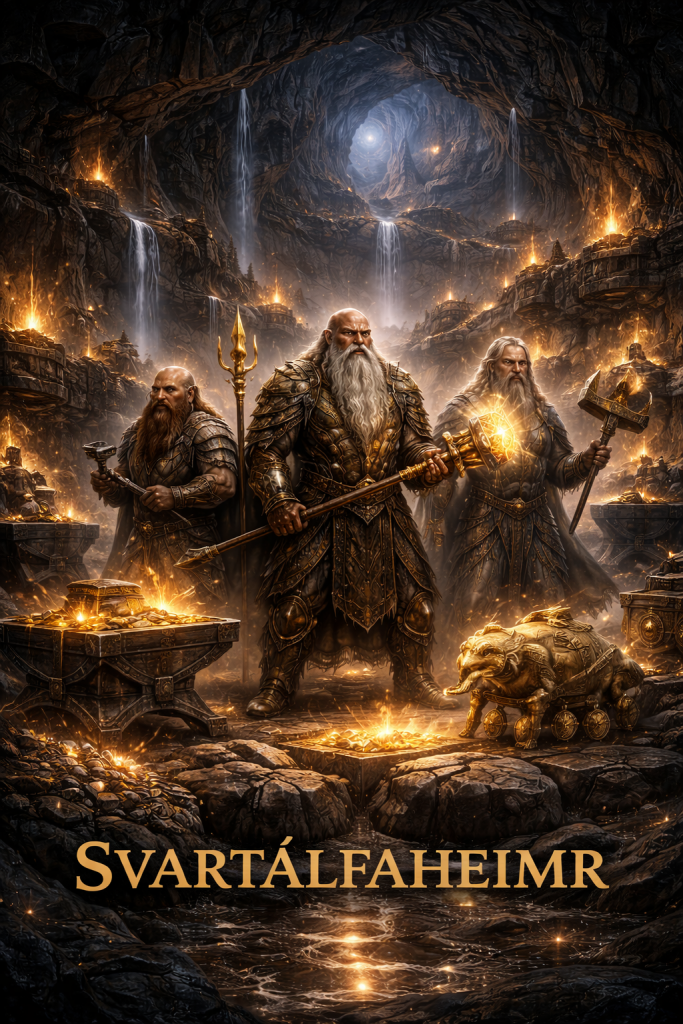
If Álfheimr is the luminous realm of growth and quiet blessing, then Svartálfaheimr — often overlapping in the sources with Niðavellir — is its shadowed counterpart: a realm beneath the surface, where transformation happens under pressure.
This is the world of dwarves — not cartoon miners, but beings of craft, cunning, memory, and consequence. In Norse myth, what is forged here does not stay neutral. Dwarven works shape the fate of gods and mortals alike, for good and for ill.
Svartálfaheimr is where power becomes material — and where desire, greed, and brilliance leave marks that can’t be undone.
Names and Identity: Svartálfar, Dwarves, and Niðavellir
One of the first things to be honest about is terminology.
The sources do not always keep “dark elves” (svartálfar) and dvergar (dwarves) neatly separate. In some passages, they appear interchangeable; in others, dwarves are clearly their own category. Niðavellir (“dark fields” or “fields below”) is explicitly named as the dwelling-place of dwarves.
Rather than forcing a clean modern taxonomy, the safer reading is this:
- Svartálfaheimr / Niðavellir refers to a subterranean, hidden realm
- Its inhabitants are beings of craft, transformation, and deep knowledge
- Whether called dwarves or dark elves, they are defined by what they make and what that making costs
This ambiguity is not a flaw. It reflects how the Norse imagined the deep world: layered, shadowed, and resistant to tidy labels.
The Dwarves: More Than Smiths
Dwarves are often introduced as master craftsmen — and they are — but the myths consistently give them three overlapping roles:
- Makers of divine treasures
- Keepers of ancient knowledge
- Warnings about obsession and greed
In Völuspá, the dwarves are said to come into being early in the ordering of the cosmos, shaped “from Brimir’s blood and Bláinn’s bones.” This places them inside creation itself, not as later add-ons. They are part of the world’s structure.
They don’t just make objects. They make systems — weapons, bindings, tools of fate.
The Treasures of the Gods: Creation Under Pressure
Some of the most important objects in Norse myth come from Svartálfaheimr / Niðavellir. These items don’t just empower the gods — they define them.
The Sons of Ivaldi
After Loki’s mischief costs Sif her hair, he turns to dwarven smiths to repair the damage. The Sons of Ivaldi produce three wonders:
- Sif’s golden hair, which grows like living hair once placed upon her head
- Skíðblaðnir, Freyr’s ship, which can fold like cloth yet always carries a fair wind
- Gungnir, Odin’s spear, which never misses its mark
These gifts establish a pattern that repeats throughout the myths: even wrongdoing can set creation in motion — but never without consequence.
Brokk and Eitri (Sindri)
In a later contest, two more dwarves are set against the Sons of Ivaldi. As they work the bellows, Loki interferes, transforming into a fly and biting Brokk repeatedly. Despite the sabotage, the dwarves complete their work:
- Mjölnir, Thor’s hammer — slightly flawed in its short handle, yet the most vital weapon of the gods
- Draupnir, Odin’s golden ring, from which new rings drip every ninth night
- Gullinbursti, Freyr’s shining boar, whose light pierces darkness
Mjölnir’s imperfection is important. It reminds us that even divine tools are shaped by struggle, distraction, and interference — and that usefulness matters more than flawlessness.
Knowledge Beneath the Stone: Alvíss and the Names of Things
In Alvíssmál, the dwarf Alvíss demonstrates knowledge of the secret names of nearly everything in the cosmos — sun, moon, earth, sea, clouds — as they are known among gods, giants, elves, and dwarves.
This poem reveals another layer of dwarven identity:
they are linguists of reality, knowing the many names that bind things into being.
Yet Alvíss is undone not by ignorance, but by time. Thor delays him until dawn, and the dwarf is turned to stone by the sunlight.
The message is sharp:
knowledge alone does not free you from fate.
Even wisdom has boundaries.
Andvari’s Hoard: When Making Turns to Ruin
One of the darkest threads tied to Svartálfaheimr is the story of Andvari.
In Reginsmál and Völsunga saga, Andvari is a dwarf who lives beneath the waters, able to take the shape of a pike. He hoards gold taken from the river, including a powerful ring. Loki forces him to surrender his treasure — and in doing so, Andvari curses it.
That curse unfolds catastrophically:
- Hreiðmarr is slain by his son Fáfnir for the gold
- Fáfnir becomes a dragon, physically transformed by greed
- Sigurðr slays the dragon, inherits the hoard, and is himself drawn into tragedy
Here, Svartálfaheimr’s gifts reveal their shadow:
what is forged or hoarded beneath the earth can reshape the soul of its bearer.
Fáfnir’s dragon-form is not random. He becomes what he clings to.
Dwarves, Runes, and Sacred Knowledge
Dwarves are not just makers of objects; they are tied to runic and cosmic knowledge.
In Hávamál, Odin’s acquisition of runes is linked to wisdom traditions associated with Dvalinn, a dwarf whose name appears in multiple contexts connected to learning and deep knowing.
This anchors dwarves as transmitters of sacred knowledge, not merely technicians.
They remember things the gods sometimes forget.
Svartálfaheimr in Ragnarök and Beyond
Svartálfaheimr does not dominate Ragnarök narratives the way Jötunheimr or Muspelheim do — and that absence is telling.
The dwarves’ work is already done.
Their creations — weapons, bindings, cursed treasures — are what carry the end of the world forward. They don’t need to march onto the battlefield. The consequences of their craft are already there.
Balance with Álfheimr: Light and Depth
Álfheimr and Svartálfaheimr are often treated as opposites — light and dark — but the myths suggest balance, not rivalry.
- Light Elves tend what grows above ground
- Dwarves shape what forms below it
Growth and crafting. Fertility and forging. Surface and depth.
Together, they maintain the world.
Svartálfaheimr Today: Why it Still Matters
For modern readers and practitioners, Svartálfaheimr speaks to themes that feel painfully current:
- creation under pressure
- the cost of obsession
- the ethics of making
- technology and unintended consequences
- wisdom without restraint
It reminds us that skill does not equal virtue, and that what we create will outlive our intentions.
Svartálfaheimr / Niðavellir is the deep realm where power is forged — a place of brilliance, wisdom, and danger, where creation and ruin are born from the same hands.
Sources and further reading
Primary sources:
- Poetic Edda, trans. Carolyne Larrington
- Völuspá (creation of dwarves)
- Alvíssmál (cosmic knowledge of dwarves)
- Hávamál (runic wisdom and Dvalinn)
- Prose Edda, trans. Anthony Faulkes
- Skáldskaparmál (the forging of the gods’ treasures)
- Völsunga saga, trans. Jackson Crawford
- Andvari’s hoard, Fáfnir, and the cursed gold