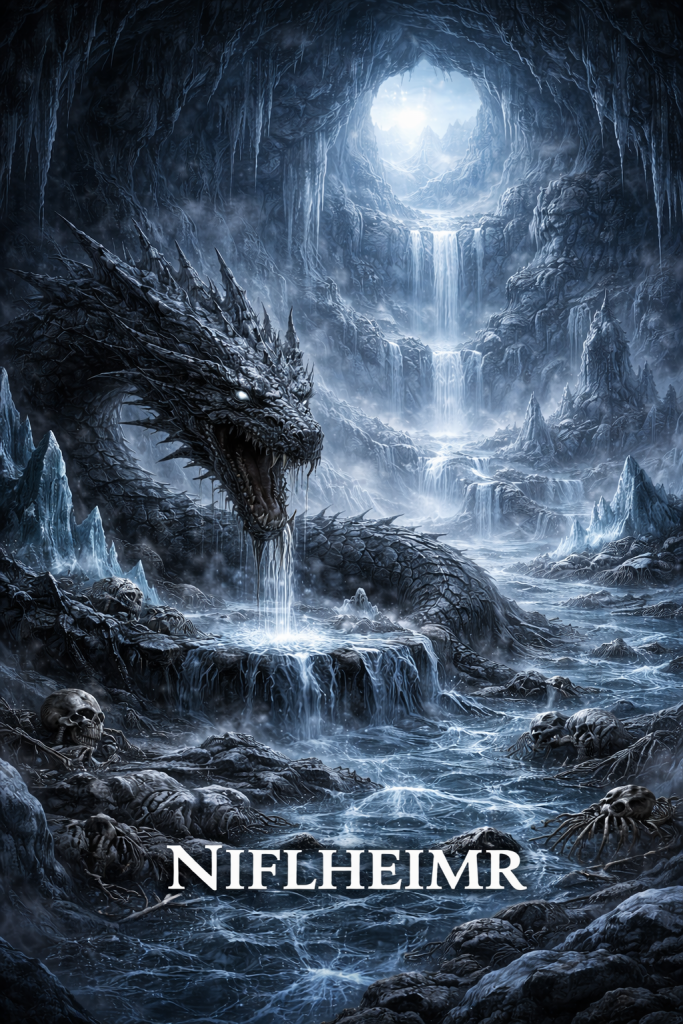
If Muspelheimr is the realm of raging heat and destruction, Niflheimr is its opposite and its equal: cold, mist, stillness, and depth. It is one of the oldest realms in Norse cosmology, present before gods, before humans, before the world itself had shape.
Niflheimr is not merely “a cold place.” It is a primal condition — the rime, frost, and silence from which form itself became possible.
Without Niflheimr, nothing solid could exist.
Niflheimr in the Beginning: Creation in Ice and Fire
Before the world was made, there was Ginnungagap, the vast yawning void. To one side lay Muspelheimr, blazing with sparks and flame. To the other lay Niflheimr, heavy with mist, ice, and frozen rivers.
When heat met cold, something unprecedented happened.
From the dripping rime where frost and fire touched, Ymir came into being — the first of the frost-giants. From that same melting ice came Auðhumla, the primeval cow, whose milk sustained Ymir and whose licking of salty ice revealed the god Búri, ancestor of the Æsir.
Creation in Norse myth is not gentle. It is chemical.
Ice gives substance. Fire gives motion.
Without Niflheimr’s frost, there would have been no flesh to shape when Odin and his brothers later slew Ymir and made the world from his body.
Land, sea, stone, and bone all depend on that first freezing.
The Frozen Foundation of the Cosmos
Niflheimr is not just part of the beginning — it remains structurally essential.
Beneath Yggdrasil, the World-Tree, one of its great roots stretches down into Niflheimr, drawing from the well Hvergelmir. This is no gentle spring. Hvergelmir is a roaring source from which many rivers flow, carrying cold, erosion, and force into the worlds above.
At this root gnaws Níðhöggr, the serpent or dragon whose endless biting represents decay, pressure, and time’s slow undoing.
Here is one of Norse cosmology’s most important truths:
destruction and preservation are not opposites — they coexist.
Niflheimr helps keep the world alive by slowly wearing it down.
Niflheimr and Hel: Distinction and Overlap
Niflheimr and Helheimr are closely linked, but they are not the same realm.
Key distinction
- Niflheimr is a primordial realm: ice, mist, cold, origin, erosion.
- Helheimr is an afterlife realm: governance, containment, the dead.
Hel herself is cast down into Niflheimr and given authority there, which is why the two are often merged in later retellings. But functionally, they serve different roles.
You can think of it this way:
- Niflheimr is the environment
- Helheimr is the administration within it
Hel rules the dead; Niflheimr simply is.
The Journey to Hel: Echoes of Niflheimr
When Baldr is slain, Hermóðr rides to Hel’s realm to plead for his return. His journey takes him through landscapes of darkness, cold, rivers, and gates — geography that strongly echoes Niflheimr’s terrain.
Baldr can be released, Hel says, if all things weep for him.
And all do — except one.
Loki, disguised as the giantess Þökk, refuses to shed tears. Because of that single act, Baldr remains in Hel’s keeping until Ragnarök.
This story reinforces an important theme:
Niflheimr and Helheimr are not cruel — but they are unyielding.
They respond to actions, not pleas.
Niflheimr at Ragnarök: Mist Unleashed
At the world’s end, Niflheimr does not remain quiet.
From Hel’s halls, the dead march forth. Loki breaks free. The ship Naglfar, built from the untrimmed nails of the dead, sails at last — long hidden in mist and cold.
And beneath the World-Tree, Níðhöggr rises.
In the final vision, he takes to the sky with corpses clinging to his wings, shaking death loose across the broken world. The frozen silence of Niflheimr becomes motion, flood, and force.
If Muspelheimr brings the fire that consumes,
Niflheimr releases the mist that unravels.
Creation began when ice and fire met.
It ends when both are loosed without restraint.
Rivers, Mist, and the Slow Power of Cold
Niflheimr is associated with ancient rivers — names that recur in the Eddas as sources of cold, venom, and grinding force. These rivers are not dramatic like fire. They work slowly.
Cold cracks stone.
Mist obscures boundaries.
Ice preserves — and destroys.
This is why Niflheimr often feels quieter than other realms. Its power is inevitable, not theatrical.
Niflheimr Today: Why it Still Matters
For modern readers and practitioners, Niflheimr speaks to forces that are easy to ignore until they’re unavoidable:
- entropy
- time
- grief
- decay
- the long winter after loss
It reminds us that not all endings come with fire and battle. Some come with silence, frost, and slow change — and those endings are no less sacred.
Niflheimr is the ancient realm of mist and ice — the cold foundation of creation itself, where decay, memory, and inevitability shape the world from below.
Sources and further reading
Poetic Edda (trans. Carolyne Larrington):
- Völuspá (creation, Níðhöggr, Ragnarök)
- Vafþrúðnismál (cosmic origins)
- Baldrs draumar (journey to Hel)
Prose Edda (trans. Anthony Faulkes):
- Gylfaginning (Ginnungagap, Ymir, Niflheimr, Hel)
Sagas (trans. Jackson Crawford):
- Contextual material on Hel, death, and cosmology