Miðgarðr isn’t “Earth” in the modern, science-textbook sense. In the Norse sources, it’s an inside-space — the human world defined by boundaries. It’s the place where daily life happens: hearths and farms, oaths and quarrels, winter hunger and summer work… and the constant knowledge that something vast and untamed presses at the edges.
If Ásgarðr is the realm of the gods-as-gods, and Jǫtunheimar is the realm of otherness and wild power, then Miðgarðr is the living middle: the human world held together by what keeps the outside out.
Where Miðgarðr Shows Up in the Sources
Miðgarðr appears across both Eddas. The Poetic Edda gives the older-feeling myth-poetry — sharp images and compressed truths — while Snorri’s Prose Edda (Gylfaginning) lays out the creation story in a more narrative, “here’s how it happened” way.
Both agree on the heart of it: Miðgarðr is an enclosure built for humans.
The Violent Creation of Miðgarðr
Norse creation begins with emptiness and extremes. Snorri describes Ginnungagap, a yawning gap between the freezing powers of Niflheimr and the burning forces of Múspellsheimr. When cold and heat meet in that middle-space, life doesn’t blossom sweetly — it congeals. From this collision comes Ymir, the primeval giant, and alongside him Auðhumla, the cow whose milk sustains him.
And then the story gets even stranger: as Auðhumla licks salty rime-stones, she uncovers Búri, the ancestor of the gods. Búri’s line continues through Borr, and from Borr come three figures who matter here more than almost anyone else: Óðinn, Vili, and Vé.
In Snorri’s telling, these brothers kill Ymir — and from that killing, they build the world.
The Prose Edda gives a full, brutal inventory of creation-by-corpse:
- Ymir’s flesh becomes the land
- his blood becomes the seas and waters
- his bones become mountains
- his teeth (and broken bone fragments) become stones
- his skull becomes the sky
- and his brains become clouds
The poetry echoes this same body-world logic. In Grímnismál, the world is explicitly formed out of Ymir’s body, with Miðgarðr made from his brows/eyelashes and clouds from his brain. Vafþrúðnismál also preserves the “earth from flesh / sea from blood / mountains from bones / sky from skull” pattern.
But the part that defines Miðgarðr isn’t just “the world was made.”
It’s what happens next.
Why Miðgarðr Exists: the fence against the jötnar
After the world is formed, the Prose Edda doesn’t say, “and humans lived happily ever after.”
It says the gods arrange the earth as a circle, the sea lies around it, and along the outer coasts land is allotted to the jötnar. Then, inland, the gods build a fortification against the hostility of the giants. The material for this fortification is taken from Ymir — in Snorri’s wording, his eyelashes — and this enclosure is named Miðgarðr.
That means Miðgarðr is not only “the middle.” It is “the middle” as a defended condition: a built boundary between the human world and what lies beyond.
Modern retellings sometimes label the outside simply as “Utgard,” but in the creation account the older point is broader and clearer: there is an inside and an outside, and the gods deliberately craft the inside for human life.
The Neighbours of Miðgarðr: Sea, Monsters, and Pressure at the Edge
Once you understand Miðgarðr as an enclosure, the famous border-figures make more sense.
Jǫrmungandr: the world-ring made alive
Snorri says the gods throw Loki’s serpent-child into the deep sea that lies around all lands. There it grows until it encircles the world and bites its own tail.
That image isn’t just monster-lore. It’s boundary-lore. The serpent becomes the living ring around the human world — a reminder that the edge isn’t empty. It’s occupied.
So when Thor clashes with the World Serpent in later myth-stories, it’s never only a heroic brawl. It’s the defender of the enclosure straining against what surrounds it.
The Creation of Humanity: Ask and Embla, and the gifts that make people “people”
After the world is shaped and bordered, the sources give us the arrival of humans.
Snorri describes Óðinn, Vili, and Vé walking along a shoreline and finding two trees (or pieces of wood). They shape them into the first humans: Askr and Embla. Then the gods give them what they lack — life and inner capacity.
Snorri’s version divides the gifts among the three in a neat way: one gives breath/life, another gives intelligence/movement, and the third gives form, speech, hearing, and sight. Once named and clothed, Ask and Embla are placed within the enclosure of Miðgarðr.
The Poetic Edda preserves a different triad. In Völuspá, it is Óðinn, Hœnir, and Lóðurr who find Ask and Embla “on land,” and the poem lists a set of gifts that translations render a little differently — but the pattern is consistent: the first humans begin as lacking, and the gods supply spirit/mind/blood or sense/colour/heat, depending on how you translate the Old Norse.
These aren’t contradictions so much as two versions of the same mythic move: human beings are not born fully “on.” They are awakened into personhood.
A lot of modern writers add an extra layer here — the idea that humans were created partly as future warriors for Valhǫll. That can be an interesting interpretation, but the creation passages themselves don’t spell it out as motive. What they do emphasise is simpler and sharper: humans were intentionally made, given specific powers, and placed inside a world that needs defending.
Miðgarðr at Ragnarök: When the Enclosure Breaks
Miðgarðr is built as a defended middle — a world held together by borders. Ragnarök is the mythic moment when those borders finally give way.
In the Ragnarök tradition, the catastrophe isn’t happening “somewhere else.” It happens to the human world directly:
The sea rises and the ring breaks
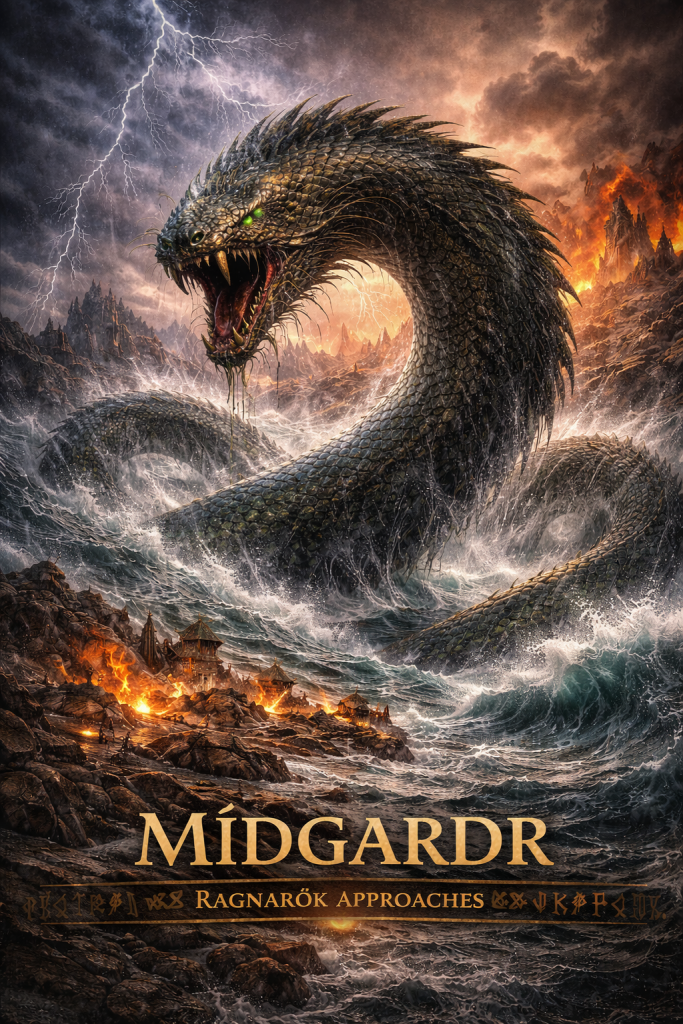
One of the most Midgarðr-specific images in Ragnarök is the uncoiling of Jǫrmungandr, the World Serpent. The same being that encircles the human world is part of what undoes it: when the serpent moves, the sea is no longer a quiet boundary. The waters surge, and the edges of the human enclosure become a flood.
If Miðgarðr is “the safe middle,” Ragnarök is the moment when the ocean-ring stops behaving like a wall and starts behaving like a weapon.
The sky and the ground don’t stay in place
Ragnarök isn’t framed as “a battle over there.” The cosmos shakes. The land trembles. The order that makes ordinary life possible collapses into storm, flame, and upheaval.
This matters because it keeps Midgarðr from being treated like an innocent backdrop. The myth is clear: the human world is part of the cosmic structure, and when that structure breaks, humans feel it first — in earth, sea, and sky.
Thor’s fight is also a Midgarðr story
Thor’s final battle with Jǫrmungandr is often told as a heroic climax, but it’s also deeply tied to Midgarðr as a concept. Thor is the defender of the enclosure — the god who pushes back the outer threats — and at Ragnarök he meets the boundary-beast itself.
Whatever version you’re reading, the emotional logic stays the same: the thing that has always circled the human world rises, and the defender meets it head-on. Even victory carries poison. Even protection has a price.
Fire reaches the middle
Ragnarök brings Surtr and the forces of Múspellsheimr into the story’s centre. Fire isn’t just “somewhere in Muspelheim.” It becomes a world-event. The human world is scorched, overrun, and remade.
The myth doesn’t portray Midgarðr as permanently secure. It portrays it as hard-won and temporary, like a fortification that holds—until it doesn’t.
After Ragnarök: the middle returns
And then comes the twist people forget: Ragnarök is not only an ending.
The sources describe a world that rises again — renewed, green, alive — and human life continuing. Two human survivors, Líf and Lífþrasir, endure through the catastrophe and become the seed of the world-to-come.
That’s the final Midgarðr message: the enclosure fails, the world breaks, and yet human life remains part of what returns.
Miðgarðr in Language and Stone: it isn’t just myth
Miðgarðr isn’t only a story-term. The concept shows up in the Viking Age world too. A runic memorial inscription (Sö 56, Fyrby) includes the phrase “á Miðgarði” — “in Midgard” — used as a real-world claim about reputation and skill.
So even if people argue about how to diagram the nine worlds, the word itself was meaningful enough to carve into stone.
Working with Miðgarðr as an archetype
The sources make Miðgarðr feel practical, not dreamy:
- Boundaries matter. Miðgarðr exists because something holds it.
- Safety is made, not given. The gods build defences; Thor fights; people keep living anyway.
- The outside is real. The myths don’t pretend chaos and danger aren’t there. They build the world with them in mind.
- Community is a kind of wall. Hearth, hall, kin, law, luck, reputation — these are Miðgarðr-technology.
Miðgarðr is the world where consequence sticks. You don’t get to be purely divine or purely monstrous. You live in the middle — and the middle shapes you.
A quick debate note: “nine realms” map, or one world with regions?
Modern arguments tend to go three ways:
- Separate “dimensions” or worlds.
- Regions of a single cosmological landscape.
- An inside/outside model: Miðgarðr as the enclosed human world, with dangerous or uncanny zones beyond it, and divine spaces set apart.
For Miðgarðr specifically, the inside/outside reading is hard to avoid, because the Prose Edda literally defines it as a fortification made to hold back giants.
So if someone insists there’s one “correct” realm-map, it’s fair to ask: correct according to which source?
Miðgarðr is the human world as the Norse sources frame it: an enclosure built against the outside — and a life lived with the border always in sight.
Sources and further reading
Primary sources:
- The Poetic Edda, trans. Carolyne Larrington — Völuspá (Ask and Embla), Grímnismál (Ymir-body creation + Midgard enclosure), Vafþrúðnismál (Ymir-body creation). (voluspa.org)
- Snorri Sturluson, Edda: Prologue and Gylfaginning, trans./ed. Anthony Faulkes — Ginnungagap, Ymir and Auðhumla, world made from Ymir, Midgard built as a fortification, Ask and Embla, Jǫrmungandr in the sea around the lands. (vsnrweb-publications.org.uk)
Runic attestation:
- Sö 56 (Fyrby) “á Miðgarði” wording in standard runic documentation.