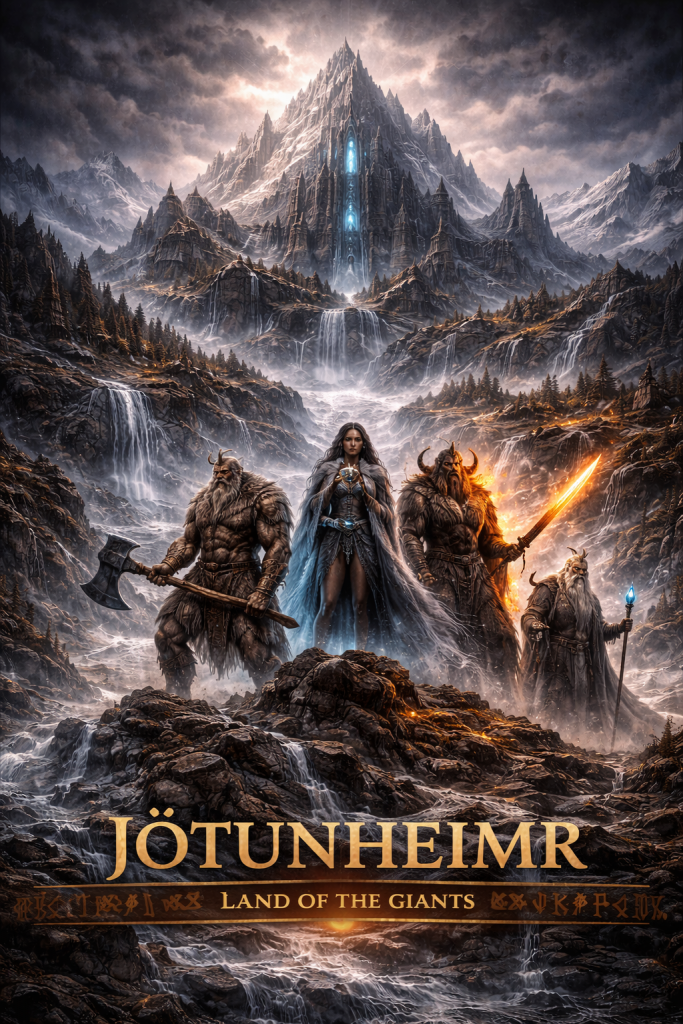
If Ásgarðr is the stronghold of the gods, and Miðgarðr is the protected middle enclosure of humankind, then Jötunheimr is the world outside the walls.
It’s the far country. The edge-realm. The place where the rules loosen, where glamour and danger walk together, and where the gods keep learning the hard way that power isn’t only measured in muscle.
Jötunheimr (often plural Jötunheimar, “giant-lands”) isn’t presented in the sources as one neat, mapped-out province. It’s a mythic outside — sometimes described like distant geography, sometimes like an uncanny otherworld you can travel into and still not fully understand.
And it matters because a huge number of Norse myth stories are basically this:
a god crosses the boundary into giant-lands… and comes back changed.
Where Jötunheimr Appears in the Sources
You’ll meet Jötunheimr and the jötnar throughout the two core Eddic streams:
- The Poetic Edda: key poems like Vafþrúðnismál, Þrymskviða, Hymiskviða, and Skírnismál all hinge on journeys into giant-space or negotiations with giant-folk.
- The Prose Edda (Anthony Faulkes): especially Gylfaginning and Skáldskaparmál, which preserve some of the most detailed narrative versions of these encounters.
Note: the medieval sources don’t hand us a single “canon map.” They hand us repeating story-patterns — borders, crossings, halls, tests, bargains, and consequences.
What is Jötunheimr?
In the Prose Edda’s creation-geography, the world is described as ringed by sea, and the giants are given the outer regions. The gods then build a fortification on the inner side of the world — Miðgarðr — specifically “against the hostility of giants.”
That framing tells you what Jötunheimr is meant to feel like:
- Beyond the enclosure
- Near the outer sea / edges
- Close to older forces, older dangers
- A place where the gods’ order doesn’t fully apply
So even when a story doesn’t say “and then they entered Jötunheimr,” if it’s about crossing out of the gods’ domain into a realm of giants, glamour, and peril… you’re in Jötunheimr territory.
The Jötnar: Going Beyond the Stereotypes
“Giant” is a clumsy English shortcut.
In the sources, the jötnar (singular jötunn) are far more complex than “big evil monsters.” They include rulers with halls, families with alliances, wisdom-keepers, witches, tricksters, terrifying predators, and bride-figures who become woven into the divine world through marriage.
A few grounded points that keep this honest:
Not one type, not one role
You’ll see different “flavours” of giant-kind in the tradition, such as:
- Hrímþursar (rime-giants / frost-giants): tied to cold, winter, and harshness.
- Mountain and wilderness jötnar: often associated with halls, stone, and remote strongholds.
- Shapeshifters and glamour-workers: where the threat is illusion, mind-games, and social traps — not just brute force.
- Kin of the gods: because the gods and giants are entangled through ancestry and marriage.
Some “god-world” figures are jötunn-born
This is one of the most important ways the myths refuse to simplify the jötnar. Giant-kind is not an alien species the gods can fully exclude. It’s part of the web.
- Skaði is jötunn-born and becomes bound into the gods’ world through negotiation and settlement.
- Gerðr is a giantess who becomes Freyr’s wife.
- The gods’ family lines cross into giant-lines again and again.
So the honest line is not “giants are good, actually.”
It’s: giants are part of the structure of the myth-world — threat, kin, teacher, rival, lover, and catastrophe all at once.
Borders, Landmarks, and “Giant-Space” Geography
Even though Jötunheimr isn’t a tidy map, the sources give strong boundary images.
The river Ífingr: a boundary that won’t freeze
In Vafþrúðnismál, a river called Ífingr is named as the divider between the gods’ realm and the giants’ realm — and it is described as a river on which ice never forms. That’s myth-logic for: this boundary is meant to be hard to cross.
Járnviðr (Ironwood): eastward, wolf-kin, and Ragnarök shadows
In Völuspá, we also get a bleak eastern image: an old giantess in Járnviðr (“Ironwood”) who fosters the kin of Fenrir — and one of that brood is tied to swallowing a heavenly light.
Snorri expands this in Gylfaginning with the Ironwood-women and wolves, leaning into the idea that some of the worst end-time forces are being raised “out there,” beyond the fence.
This matters because it links Jötunheimr-adjacent space to the long arc of Ragnarök: the outside doesn’t just threaten the world — it breeds the world’s ending.
Key Halls and Strongholds in Jötunheimr
Jötunheimr is often shown through its halls — because in Norse story-logic, the hall is where power is tested.
Here are the big ones you absolutely want in the article:
- Útgarðr and the hall of Útgarða-Loki (Prose Edda): the most famous “giant hall as illusion-machine” story.
- The hall of Vafþrúðnir (Poetic Edda): the “wisdom hall,” where a riddle contest can cost your life.
- Hymir’s hall (Poetic Edda / Prose Edda tradition): where kinship, tension, and world-serpent foreshadowing collide.
- Þrymheimr (Prose Edda): the home of Þjazi, tied to the kidnapping of Iðunn.
- Geirröðr’s court (Prose Edda): a hostile hall-trap built to break Thor.
- Gymir’s hall (Poetic Edda): where Skírnir negotiates — and threatens — to secure Gerðr for Freyr.
Major Stories Set in Jötunheimr (and what they reveal)
Óðinn and Vafþrúðnir: wisdom at knife-point (Vafþrúðnismál)
Óðinn travels to a giant’s hall to match wits in a deadly riddle contest. It’s one of the clearest examples that giant-lands are not simply “enemy territory.” They are also where cosmic knowledge lives, guarded by beings who do not play gentle games.
Thor and Útgarða-Loki: when the outside laughs (Gylfaginning)
This is the story that makes Jötunheimr feel uncanny. Thor is tested, belittled, and outplayed through illusion and scale — and when the truth is revealed, the stronghold itself is gone. It’s a mythic reminder that:
you can’t always punch the lesson.
Þrymr and the stolen hammer (Þrymskviða)
A jötunn steals Mjǫllnir, and the gods can’t brute-force their way out. Thor must infiltrate a giant-hall disguised as a bride. The humour is real, but the underlying point is sharp:
giant-world politics can trap even gods, and survival sometimes requires humiliation and cunning.
Hymir’s cauldron and the Midgard Serpent (Hymiskviða)
Thor and Týr travel into giant-space for a massive cauldron — and the story pivots into one of the great foreshadowings of Ragnarök: Thor’s confrontation with Jǫrmungandr. Jötunheimr journeys often do this: they start like errands and end like apocalypses.
Hrungnir’s duel (Skáldskaparmál)
Hrungnir is one of the most famous challenger-jötnar: pride, contest, violence, fallout. This story has that “strange respect and absolute enmity” flavour that so often marks god-giant relationships.
Geirröðr’s trap-hall (Skáldskaparmál)
Geirröðr’s court is “hostile hospitality” at its finest: the hall itself becomes a weapon, and Thor survives with help (and with the sense that giant-lands don’t just test strength — they test whether you can survive an environment designed to kill you).
Þjazi and Iðunn (Skáldskaparmál)
When Þjazi takes Iðunn (and the apples tied to divine vitality), it’s not a petty kidnapping. It’s a structural attack: the gods’ ability to endure is threatened. Jötunheimr isn’t only “where monsters live.” It’s also where the gods’ vulnerabilities get exploited.
The courtship of Gerðr (Skírnismál)
This one is messy — and it should be handled honestly. Freyr desires Gerðr, and Skírnir is sent to secure her. The poem includes pressure and threat as well as gifts and negotiation. Whether a reader frames it as mythic marriage diplomacy or coercion, it’s still one of the clearest “bridge between worlds” stories:
giant-kind can be joined to the gods’ world — but not without cost, and not without tension.
Skaði’s bargain (Gylfaginning)
Skaði comes to Ásgarðr demanding compensation for her father’s death. The outcome is negotiation, settlement, and a jötunn-born figure integrated into the gods’ world without being “tamed into sweetness.” It’s one of the best examples of:
the gods cannot simply erase the outside — sometimes they have to bargain with it.
Jötunheimr and Ragnarök: when the outside comes all the way in
Ragnarök is the final breakdown of the boundary system.
In the end-time traditions preserved in the Eddas:
- giants are among the major forces moving toward the final battlefield,
- the great boundary-beasts tied to jötunn lineage (Fenrir, Jǫrmungandr, Hel) step fully into their world-breaking roles,
- and the old theme reaches its climax: the outside breaches the enclosures.
Jötunheimr’s role, then, isn’t a random “villain faction.” It’s the endpoint of a cosmic tension that’s been present since the world was fenced.
Debate: Where is Jötunheimr, Really?
Readers often want to map the Nine Worlds like a diagram. Jötunheimr resists that.
Depending on the source and the story, Jötunheimr can read like:
- a distant geography (outer lands by the sea, beyond Midgarðr’s enclosure), and also
- an otherworld mode (illusionary halls, vanishing strongholds, tests that feel symbolic and literal at the same time)
A reasonable, source-respecting way to phrase it is:
Jötunheimr is “outside” both in place and in principle — the realm beyond the fence where older, wilder forces live, and where the gods repeatedly face what their own order cannot fully contain.
Jötunheimr is the mythic outside: sometimes enemy, sometimes teacher, sometimes kin — and, in the end, one of the great pressures that drives the world toward Ragnarök.
Sources and further reading
Primary sources:
- The Poetic Edda (trans. Carolyne Larrington) — Vafþrúðnismál, Þrymskviða, Hymiskviða, Skírnismál, plus Völuspá for Ironwood imagery.
- Edda / The Prose Edda (trans. Anthony Faulkes) — Gylfaginning and Skáldskaparmál for narrative versions of Útgarða-Loki, Skaði, Þjazi and Iðunn, Hrungnir, and Geirröðr.
- The sagas in Jackson Crawford’s translations where relevant to worldview and cultural framing.