The Younger Futhark runes are every bit as mysterious as they are ancient. These compelling symbols first emerged during the early Viking Age and were used throughout that powerful era of Norse history. Though fewer in number than their Elder Futhark predecessors, they’re rich in meaning and deeply rooted in Norse language, culture, and belief.
By around the 9th century, the Younger Futhark had become widely used, taking shape over a long transition period during the 7th and 8th centuries. While the Elder Futhark consists of 24 runes, the Younger Futhark streamlines the alphabet to just 16 symbols, adapted to suit the evolving Old Norse language of the Viking Age.
From Elder to Younger: A Transformative Shift
The transition from Elder to Younger Futhark wasn’t simply a matter of fewer runes. It reflected a broader cultural and linguistic evolution. Sounds shifted, meanings adjusted, and some runes disappeared entirely while others took on new phonetic values.
In the first ætt, the a rune’s sound changed to ą, and the old g and w runes fell out of use.
In what was once the second ætt, the æ and p runes vanished, while new forms like nauðr were introduced. The old j rune was lost, replaced by this new symbol, now used to represent the “a” sound.
The third ætt saw the greatest shift. Four runes were dropped (e, ŋ, o, and d), while others like t, b, and l remained largely intact, and the m rune took on a new visual form.
This transformation wasn’t arbitrary—it reflected how spoken Old Norse was evolving. Still, it’s curious that in a time of growing literacy and cultural complexity, the alphabet became simpler. Some believe this streamlining made the runes easier to carve and faster to use in everyday inscriptions.
Key Differences Between Elder and Younger Futhark
| Feature | Elder Futhark | Younger Futhark |
| Number of Runes | 24 | 16 |
| Time Period | 2nd–8th century CE | 8th–12th century CE |
| Language | Proto-Germanic | Old Norse |
| Use | Ritual & Magical | Practical inscriptions |
| Design | Angular and elaborate | Simplified and efficient |
The Younger Futhark Runes & Their Meanings
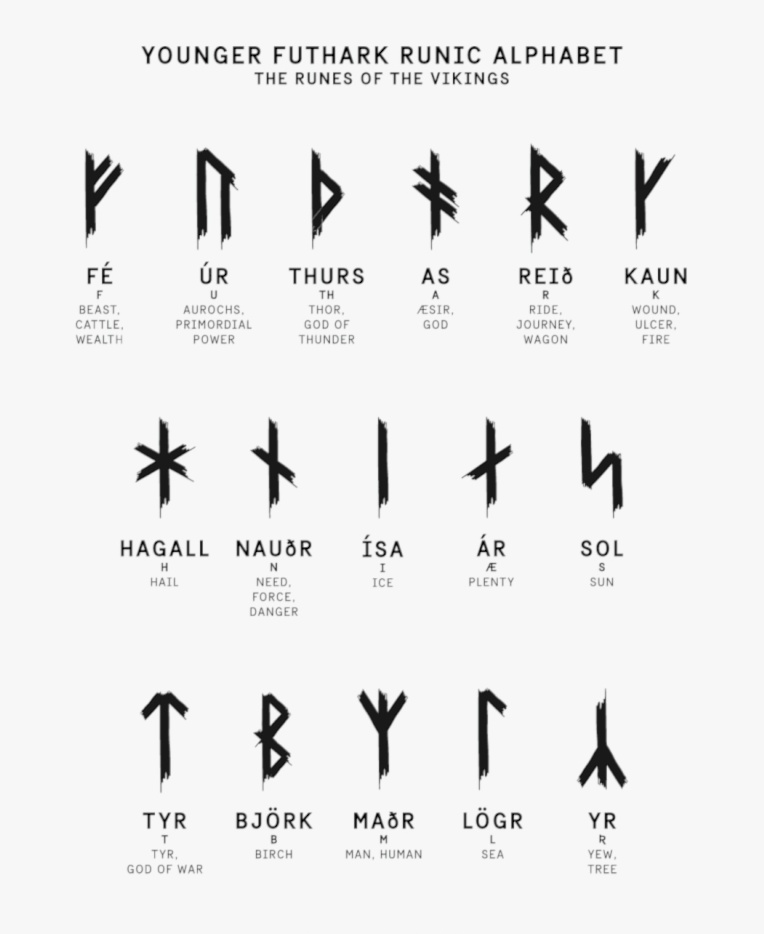
Here is a brief look at each of the 16 Younger Futhark runes and their deeper meanings:
ᚠ Fé (“wealth”) – The rune of money and possessions. It represents prosperity, abundance, and the often-complicated ties between people and wealth.
ᚢ Úr (“iron” or “rain”) – Symbol of strength, sudden change, and primal energy. It can signal either danger or blessing.
ᚦ Thurs (“giant”) – Associated with Thor and the chaotic forces of nature. This rune represents conflict, brute strength, and defense.
ᚬ As (“god”) – A rune of divine inspiration and justice, often associated with Odin and the sacred voice of truth.
ᚱ Reið (“ride”) – Symbolizing journeys, both physical and spiritual. This rune encourages movement, progress, and purposeful change.
ᚴ Kaun (“ulcer”) – Reflects wisdom gained through suffering. It also symbolizes creativity, inner fire, and the double-edged nature of knowledge.
ᚼ Hagall (“hail”) – The rune of disruption and necessary change. Like hail, it represents both destruction and transformation.
ᚾ Nauðr (“need”) – Speaks of hardship, resistance, and resilience. It brings a message of learning through struggle.
ᛁ Íss (“ice”) – A rune of stillness, patience, and clarity. It cautions against rushing forward and instead calls for inner control.
ᛅ Ár (“plenty”) – Signifies abundance, good harvest, and fruitful times. It also reflects life’s natural cycles and rewards.
ᛋ Sól (“sun”) – Named for the sun goddess Sól, this rune represents success, joy, wholeness, and the light of truth.
ᛏ Týr (“Tyr”) – A rune of justice, law, and courageous sacrifice. It invokes the spirit of fair leadership and moral strength.
ᛒ Bjarkan (“birch”) – Linked to the goddess and feminine energies, this rune is about renewal, fertility, and nurturing life.
ᛘ Maðr (“man”) – Represents human beings, family, and the shared experience of community. It also speaks to self-awareness and intellect.
ᛚ Lögr (“sea”) – A rune of water, intuition, and emotion. It reflects the depth of the subconscious and the flow of life’s currents.
ᛦ Ýr (“yew”) – The rune of death, endurance, and the mysteries of the underworld. It symbolizes transition, wisdom, and long life.
Even with their simplified forms, the Younger Futhark runes retain powerful spiritual and symbolic depth. They’re not just relics of the past—they continue to guide, teach, and inspire those who walk the Norse path today.