There are some figures in Norse mythology who stride into the stories with thunder in their hands and whole sagas wrapped around their names.
And then there is Óðr.
He is there, but only just. A shadow at the edge of the firelight. A husband remembered through absence. A name heavy with meaning, but a god almost completely hidden from view.
Óðr is best known as the husband of Freyja, one of the greatest goddesses of the Norse world. In Snorri Sturluson’s Prose Edda, Freyja is described as noble and powerful, and we are told that her husband is called Óðr. Together they have a daughter named Hnoss, whose name means something like “treasure” or “jewel.” She is so beautiful that anything especially precious may be called by her name. In Ynglinga saga, another daughter is also named: Gersemi, whose name also carries the meaning of treasure or precious thing. Because the two names are so similar in meaning, some scholars have wondered whether Hnoss and Gersemi may originally have been two names or versions of the same figure.
But Óðr himself? He is not given great speeches. We do not hear of his battles. We are not told what halls he keeps, what followers honour him, or what deeds made him worthy of Freyja.
Instead, we are told that he goes away.
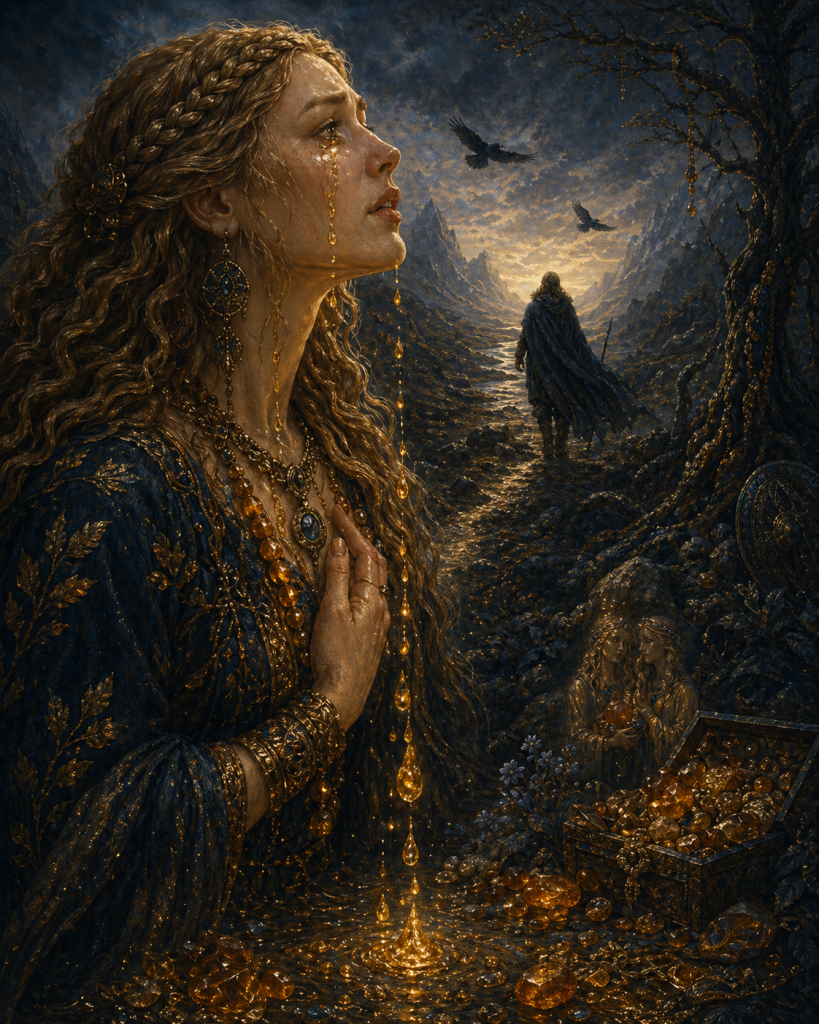
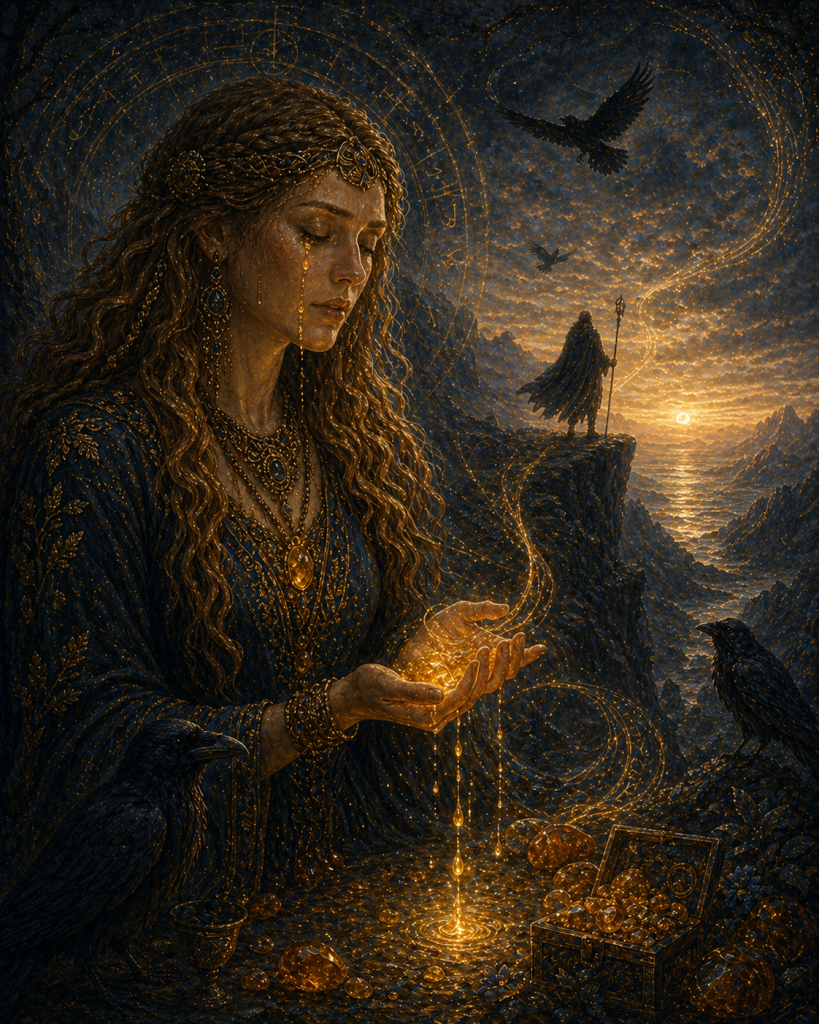
Snorri says that Óðr travels on long journeys, while Freyja goes out among strange peoples searching for him. As she searches, she weeps, and her tears become gold. This image became important enough that “Freyja’s tears” could be used as a poetic way of speaking about gold. In Skáldskaparmál, gold is directly connected with Freyja’s tears and with her daughter Hnoss.
It is one of the most beautiful and heartbreaking images in the lore: Freyja, mistress of magic, desire, beauty, and seiðr, searching the worlds for the one who has vanished. Her grief does not diminish her. It does not make her weak. She remains Freyja. Powerful. Sovereign. Golden. But she also mourns.
It’s an important point, because the gods in Norse myth are not distant marble statues. They love, rage, grieve, hunger, desire, lose, and seek. Freyja’s tears are not shameful. They are precious.
What Does the Name Óðr Mean?
The name Óðr is one of the keys to understanding why this quiet figure has fascinated people for so long.
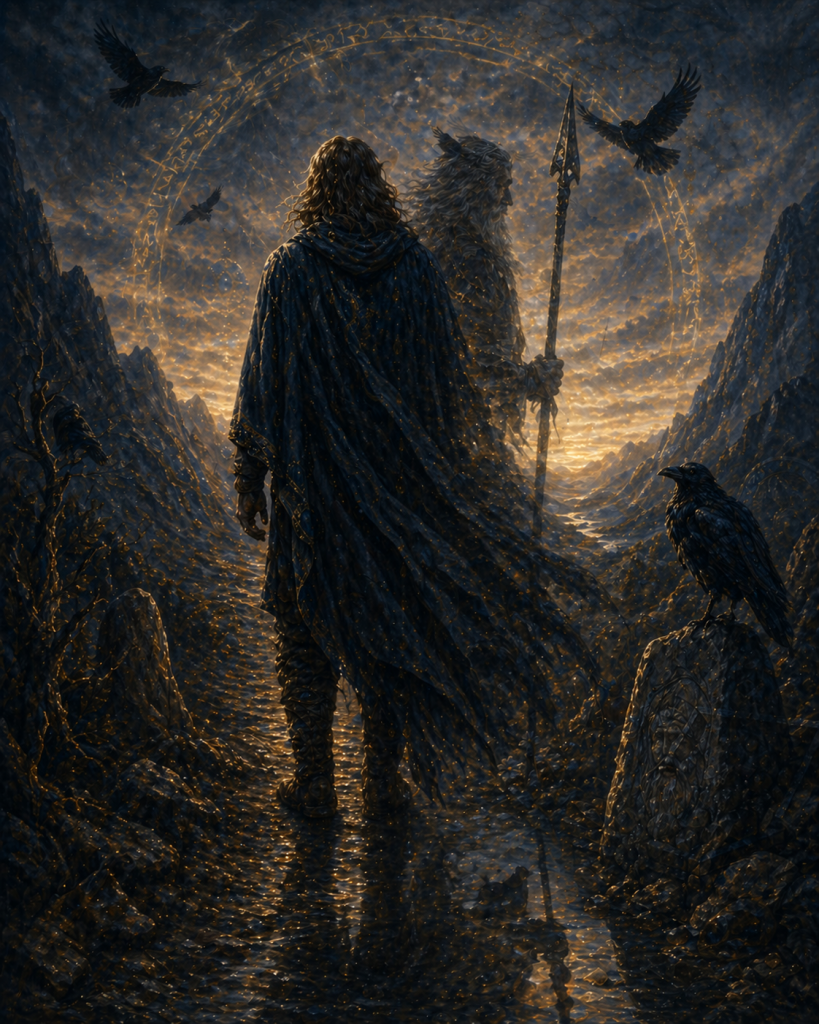
In Old Norse, óðr can mean mind, sense, soul, poetry, song, inspiration, frenzy, or ecstatic force. It is a word with heat in it. It does not describe calm, tidy thought. It is the mind when it is stirred. The soul, when it is moved. The voice when it becomes poetry. The spirit, when it is seized by vision, passion, or divine madness.
This also brings us to the obvious question: is Óðr connected to Óðinn?
The names are very close. Óðinn’s name comes from the same root connected with frenzy, inspiration, poetic force, and ecstatic states. Scholars such as Jan de Vries and John Lindow have discussed the possibility that Óðr and Óðinn were originally connected, perhaps even different forms or aspects of the same divine idea. Lindow notes the linguistic closeness, while also pointing out that Snorri keeps Óðr and Óðinn as separate figures in the stories we have.
This is where things become interesting.
Óðinn is the great seeker. He wanders the worlds for wisdom. He sacrifices himself upon Yggdrasil. He drinks from deep wells, questions the dead, speaks with seeresses, and crosses boundaries that most beings would fear to approach.
Óðr also wanders.
Óðinn leaves the familiar in pursuit of knowledge.
Óðr leaves, and Freyja searches.
So are they the same? Is Óðr a lost or older form of Óðinn? Is he a hypostasis — a particular aspect or expression — of Óðinn? Or is he his own shadowy god, preserved only in fragments?
The honest answer is: we do not know for certain.
And that uncertainty is part of his power.
Óðr and Freyja: Absence, Longing, and the Search
If we look at the myth on its own terms, Óðr is not remembered for what he does while present. He is remembered for the space he leaves behind.
Freyja’s search becomes the heart of the story.
She travels under many names. She seeks him among unknown peoples. She weeps gold. The myth gives us a goddess who is not passive in grief. She does not simply sit and wait. She searches. She moves. She follows the trail.
For a goddess associated with seiðr, this detail feels especially powerful.
Freyja is not only a goddess of beauty and love. She is also linked with magic, death, desire, wealth, and the deep arts of knowing. In Ynglinga saga, Snorri says that Freyja taught seiðr to the Æsir, which places her at the very heart of Norse magical practice.
So when Freyja searches for Óðr, we can read that on more than one level.
On the surface, it is the story of a wife searching for her absent husband.
But beneath that, it can also be read as the soul seeking inspiration. Magic seeking ecstasy. The heart searching for the lost divine spark.
And perhaps that is why the story lingers.
A Seiðr View: Óðr as the Far-Faring Spirit
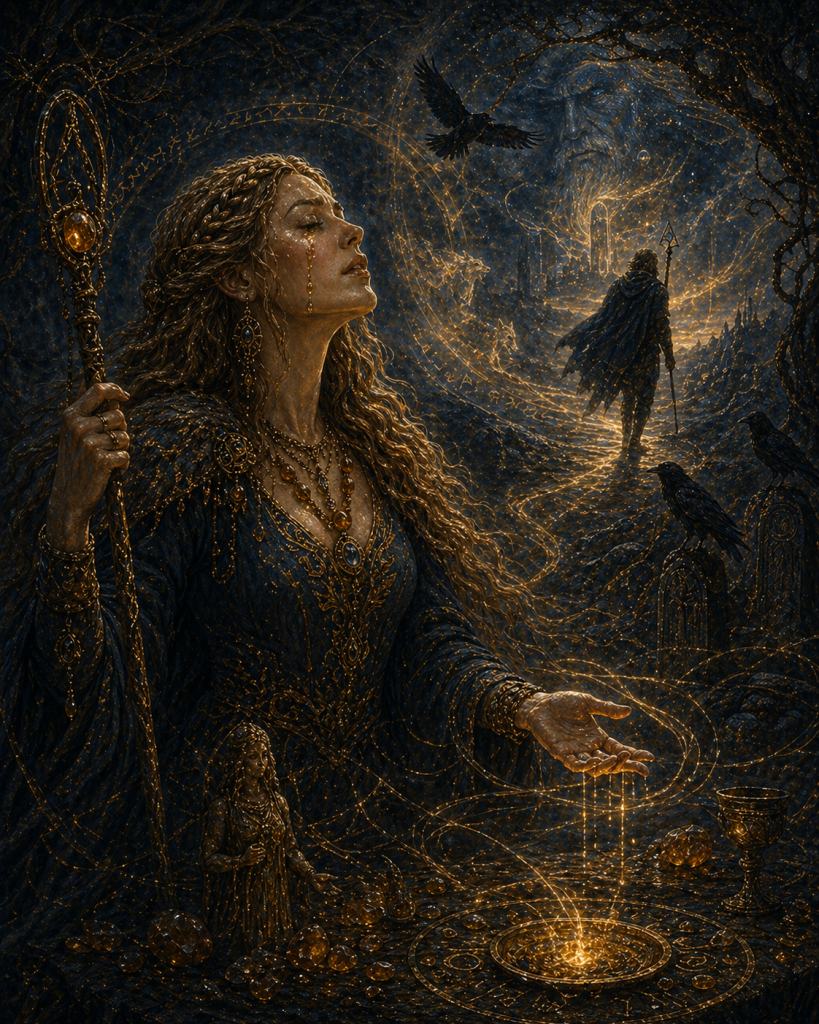
From a seiðr or shamanic perspective, Óðr’s long journeys can be understood as more than ordinary travel.
They may be read as far-faring: the movement of consciousness beyond the ordinary world. Not a holiday. Not wandering because he fancied a change of scenery. More like the mind or spirit leaving the known path to seek knowledge in places where ordinary sight cannot reach.
In Norse thought, the self was not always imagined as one neat, sealed thing. Ideas such as hugr, hamingja, fylgja, and related soul-concepts suggest a more layered understanding of being. The mind, luck, fetch, breath, and spiritual force could be spoken of in ways that feel far more fluid than the modern idea of a single fixed “self.”
Seen this way, Óðr may represent the part of us that leaves the safe hearth.
The part that journeys.
The part that cannot remain only in the familiar.
The part drawn toward the edge of the world because something out there is calling.
This also gives Freyja’s search a deeper meaning. As mistress of seiðr, she is not merely grieving. She is tracking. Seeking. Following the thread between worlds. Her golden tears become more than sorrow; they become insight, price, and offering.
In this reading, Óðr is the wandering ecstatic spirit, and Freyja is the magical force that knows how to find what has been lost.
The Psychological View: Inspiration That Will Not Stay Still
Psychologically, Óðr can be seen as the elusive nature of inspiration itself.
Anyone who writes, creates, divines, heals, sings, crafts, or works magic knows this feeling.
Sometimes the fire is there. The words pour through. The cards speak clearly. The herbs seem to whisper their uses. The hands know what they are doing before the mind catches up.
And sometimes?
Nothing.
The spark wanders off over the hill without so much as leaving a note.
Óðr, whose name is tied to inspiration, poetry, frenzy, and soul-force, becomes a powerful image for this inconstant muse. He comes and goes. He cannot be chained. He belongs to movement, not possession.
Freyja’s grief then becomes the ache we feel when the golden current disappears. The longing for the return of passion, creativity, connection, and vision.
But the myth also suggests that absence is not emptiness.
Gold comes from the tears.
Something precious is made in the longing.
That is an important teaching. We often want inspiration without the waiting, wisdom without the wandering, and magic without the ache. Óðr’s story does not offer that. It shows us that the search itself can create treasure.
The Seasonal and Natural View
Some modern Heathens and pagans also read Óðr through a seasonal lens.
In this interpretation, Óðr’s departure reflects the withdrawal of light and warmth, while Freyja’s golden tears echo the return of the sun’s radiance. His absence becomes winter, distance, and longing. His return, whether spoken or only implied, becomes the return of life, warmth, fertility, and brightness.
This is not stated directly in the medieval sources, so it should be treated as modern interpretation rather than ancient certainty. But it is not hard to see why the image appeals.
A golden goddess weeping for the absent one.
Gold scattered through the world.
Light returning after darkness.
For those whose pagan practice is rooted in the land and seasons, Óðr can become part of the yearly rhythm of loss and return.
Modern Pagan and Heathen Understandings of Óðr
In modern paganism, Óðr is often approached less as a fully described god with a fixed cult and more as a mystery.
Some may honour him as a distinct deity: a wanderer, a spirit of inspiration, a patron of ecstatic seeking, poetry, and spiritual travel.
Some see him as an aspect of Óðinn: younger, wilder, less enthroned, more purely tied to the raw current of óðr itself.
Some focus less on Óðr and more on Freyja’s response to him. For them, this myth becomes a sacred teaching about grief, longing, and sovereignty. Freyja weeps, but she is not broken. She searches, but she is not helpless. Her pain becomes gold.
For seiðr practitioners, Óðr may be approached as the far-faring mind, the ecstatic soul, or the divine spark that refuses to be domesticated.
He is not comfortable.
He is not tidy.
He is not easy to pin down.
But gods of the threshold rarely are.
So, Is Óðr a God Who Left?
Yes.
In the lore we have, Óðr is the one who goes away.
But he may also be more than that.
He may be the part of us that cannot stop seeking.
The restless mind.
The poet’s fire.
The soul in flight.
The ache for something beyond the visible road.
The divine madness that calls us out past the known fields and toward the edge of the world.
And Freyja?
Freyja is the one who knows the cost of loving such a force.
She teaches us that longing is not weakness. Grief is not failure. Searching is not foolish. Some things are worth following across strange lands, even when all we have to show for it at first are tears.
But when Freyja weeps, her tears become gold.
And perhaps that is the deepest mystery of Óðr: not simply that he leaves, but that his absence reveals what is most precious.
So what do you think?
Is Óðr a forgotten god, a face of Óðinn, a spirit of inspiration, or the part of the soul that must wander beyond the edge of the known world?
References / Further Reading
Primary sources to lean on:
- Snorri Sturluson, The Prose Edda, especially Gylfaginning and Skáldskaparmál. Anthony Faulkes’ translation is a good standard edition.
- Snorri Sturluson, Heimskringla, especially Ynglinga saga.
- The Poetic Edda, especially Völuspá. Carolyne Larrington’s translation is a good modern choice.
Helpful scholarly/reference works:
- John Lindow, Norse Mythology: A Guide to Gods, Heroes, Rituals, and Beliefs.
- Rudolf Simek, Dictionary of Northern Mythology.
- Margaret Clunies Ross, Prolonged Echoes: Old Norse Myths in Medieval Northern Society.
- Jan de Vries, Altgermanische Religionsgeschichte.