We’re coming up to Einmánuður, the last winter month in the Old Norse calendar. There’s something really powerful about this month — it carries that feeling of winter not being quite over, but the promise of spring finally beginning to stir. After the long, harsh months of cold, darkness, and endurance, Einmánuður marked a turning point: a time to prepare, to hold on a little longer, and to look ahead to the lighter half of the year. I’ve put together a post on the meaning of this month, its old traditions, and why it still speaks to us now.
Einmánuður is the sixth and final month of winter in the old Icelandic calendar. It begins on a Tuesday between 20 and 26 March, standing at that strange edge where winter is not quite finished, yet spring is beginning to stir. It is a threshold month — the last long breath of the dark half of the year before Harpa arrives and the summer months begin.
Of the twelve months in the old Icelandic calendar, Einmánuður is one of only four mentioned in more than one historical source, with the oldest reference going back to the 12th century. The other three are Gormánuður, Þorri, and Góa. Its name means “lone” or “single” month, and it is generally understood to carry that name because it stands alone as the last month of winter.
There is something fitting about that. Einmánuður has a solitary feel to it. By this point, winter has done its work. Stores have run low, bodies and spirits have felt the strain of the cold, and yet the promise of change is beginning to show itself. The light is returning, even if the weather is still not entirely trustworthy.
Folk Beliefs Connected to Einmánuður
Like the other old months, Einmánuður carried its own weather lore. One belief says that the weather on Lady Day, 25 March, foretells the weather for the next thirty days — or fourteen, depending on the source. If the skies are clear and the night is starry before sunrise, good weather is expected to follow.
There is also the old saying that if Einmánuður is wet, spring will be good. That feels very much in keeping with a farming culture that watched the land closely and knew that harshness and blessing often came hand in hand. What looks bleak in the moment may still be preparing the ground for growth.
Working the Land at the Edge of Spring
Einmánuður was not a month of idleness. Spring may have been approaching, but that only meant there was work to be done.
If the weather allowed, this was a good time to dam water and spread it over the fields, letting it lie there during the spring thaw. The silt left behind by the water was considered better than any fertiliser. It is such a practical image, but also a beautiful one — people working with the thaw, guiding it, trusting the land to receive what it needed.
This was also a time for quieter but necessary preparation. Dykes, channels, and turf banks would be repaired so meltwater could be directed where it was most useful. Fences, byres, and sheepfolds would be checked in readiness for lambing and spring grazing. Stones and winter debris would be cleared from the home-fields so that once the true thaw came, the land could be worked quickly.
Einmánuður was not really about dramatic action. It was about readiness. It was about paying attention, making repairs, and helping the land along as it woke. In that sense, it feels like a deeply honest month. Not flashy. Not easy. Just necessary.
The Final Stretch of Winter
By the time Einmánuður arrived, both people and animals would have felt the weight of winter.
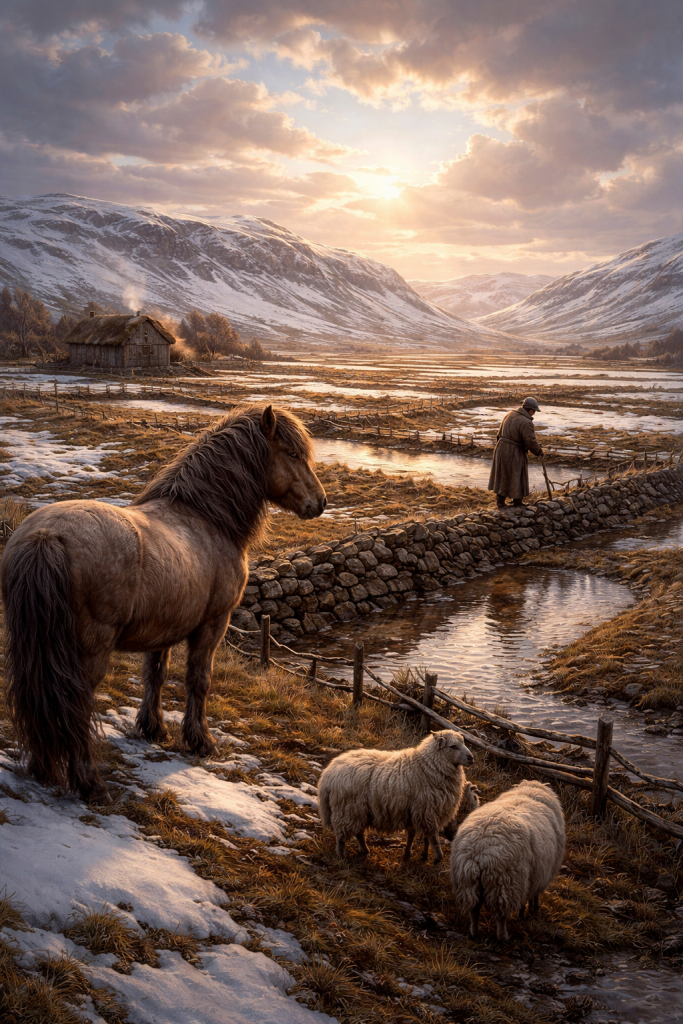
The Icelandic horse is one of the best-known symbols of this hardiness. Brought to Iceland by the first settlers from Norway, it grows a thick winter coat and is famed for its ability to survive the Icelandic cold. Many horses are kept outdoors all year, though they usually have some shelter when conditions turn especially bad. There is something admirable in that image — a sturdy creature standing through wind, frost, and sleet, already carrying the strength of spring inside its shaggy winter form.
But it was not just the horses. Sheep and cattle also tell the story of Einmánuður. Sheep survived on what grazing they could find when the snow allowed it, while cattle depended heavily on carefully rationed winter fodder. By the last winter month, every bit of hay and stored food mattered. The management of resources was not simply good planning; it was survival.
That is part of what gives Einmánuður its emotional weight. It is not only the end of winter in a poetic sense. It is the final stretch after a season that could be genuinely dangerous, exhausting, and unforgiving. No wonder the coming of Harpa and the summer half of the year was greeted with such relief.
The Meaning of Einmánuður Today
For those of us who look to the old Norse calendar in modern practice, Einmánuður still has something to teach.
This is a liminal month. A month for looking back over the winter and asking what carried us through. A month for noticing what feels worn out, what needs mending, and what no longer needs to be carried forward. It is also a month for beginning to think ahead — not rushing into full action yet, but preparing the ground.
The old farmers did not simply wait for spring to arrive. They cleared, repaired, guided, and prepared. There is wisdom in that. Before we rush to plant new things in Harpa, perhaps Einmánuður asks us to tend the channels first. Mend what is cracked. Clear what is cluttered. Make space for what we hope to grow.
To me, that is the spirit of this month. It is winter’s last lesson. A quiet reminder that endings are not empty things. They are thresholds.
Einmánuður stands between hardship and hope, with one foot still in the cold and the other turning toward the light. It is the lone month, yes — but not a lonely one. It is full of endurance, preparation, and the first quiet promise that summer will come again.
References
1. Literary and Scholarly Sources
- Prose Edda (Snorri Sturluson, 13th Century): Einmánuður is mentioned in the context of the old calendar structure. In some interpretations of Snorri’s work, this late winter period is also linked to the terms gaukmánuður (cuckoo month) or sáðtíð (sowing time), indicating the early start of spring farming tasks.
- Hœnsa-Þóris Saga (Chapter 5): Features a reference to the month name einmánuðr.
- Ljósvetninga Saga (Chapter 23): References the month as einmánuð.
- Vatnsdæla Saga (Chapter 42): References the month as einmánuði.
- Vápnfirðinga Saga (Chapter 14): References the month as einmánuð.
- Annals (Annálabrot): Early manuscripts, including Ann1005, show the spelling einmꜳnadi.
2. Historical Customs and Folklore
- Young Boys’ Day (Bóndadagur Connection): Similar to how the first day of Þorri is Bóndadagur (Husbands’ Day) and Góa is Konudagur (Women’s Day), the first day of Einmánuður was historically dedicated to the young boys of the household.
- Donation Day (North Iceland): In North Iceland, the first day of Einmánuður was traditionally a legal holiday called “Donation Day,” where people donated money to the poor, a custom that continued in various forms until the 18th-century.
- Weather Predictions: Folk belief held that if it rained on the first day of Einmánuður, it heralded a good spring.
- Spring Chores: It was considered a good time, weather permitting, to dam water to distribute it over fields, letting the sediment settle to fertilize the land, known as vökvun.