
Þrúðr is one of those Norse figures who carries a huge name and a small paper trail.
Her name literally means “Strength” (Old Norse: Þrúðr), and she is identified as the daughter of Thor and Sif. That alone gives her a striking place in the mythic family line: thunder on one side, golden-haired fertility/earth associations on the other, and a daughter whose very name sounds like a power-word.
And yet, like several fascinating figures in Norse myth, Þrúðr is mostly known through short references, kennings, and fragments, rather than one long surviving myth where she takes centre stage and explains herself.
So, who is she in the sources? A goddess? A valkyrie? A poetic personification of strength? All of the above, depending on which text (and which scholar) you ask?
Let’s walk through what survives — and what later readers have built from the gaps.
The daughter of Thor and Sif
The most secure starting point is simple: Þrúðr is named as the daughter of Thor and Sif.
Snorri preserves this in Skáldskaparmál, where he lists mythological names and kennings and notes that “Father of Þrúðr” is a valid poetic way to refer to Thor, while “Mother of Þrúðr” refers to Sif.
That may sound like a small detail, but in skaldic and eddic traditions, being used in kennings is not nothing. It means Þrúðr’s name had poetic currency and recognition. She mattered enough to function as part of the mythic vocabulary.
In other words, even when she is not starring in a surviving story, she is still embedded in the language poets use to speak about gods, giants, and warriors.
A goddess with a surprisingly small number of direct mentions
Despite her importance by name and lineage, Þrúðr is only mentioned directly in a handful of surviving sources.
That can feel frustrating at first (especially if you want a full “Thrud myth cycle” and the sources just smile mysteriously and hand you a kenning). But the surviving references are still rich, and they tell us a lot about how she was imagined.
She appears in prose and skaldic sources as Thor’s daughter, appears by name in a valkyrie list in Grímnismál, and is echoed in skaldic language tied to conflict, battle, and power. There is also the intriguing giant-related material hinting at a lost or variant myth involving her and Hrungnir.
So while she is not heavily narrated, she is not absent either. She is one of those figures whose importance survives in poetic infrastructure rather than in a single neat story.
The Alvíssmál marriage episode and the unnamed daughter
One of the best-known episodes usually connected to Þrúðr comes from Alvíssmál (The Lay of Alvíss).
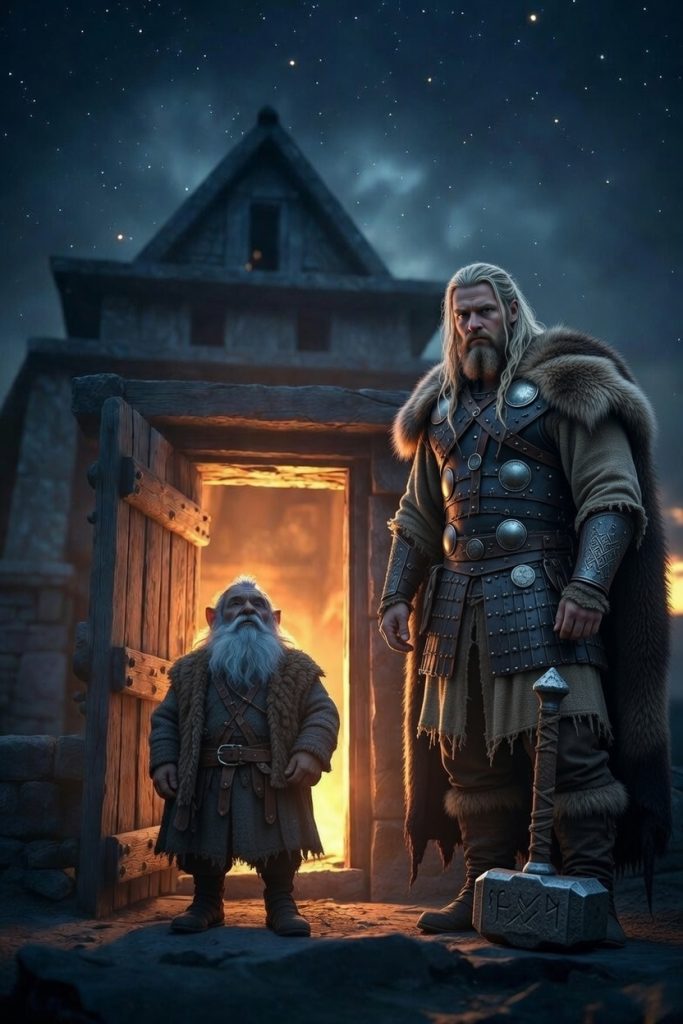
In the poem, the dwarf Alvíss arrives claiming he has been promised the hand of Thor’s daughter in marriage. The daughter is not named in the poem, but she is widely identified by scholars as Þrúðr.
Thor, less than thrilled by the situation, handles it in peak Thor fashion — not by calmly scheduling a family meeting, but by trapping Alvíss in a prolonged contest of knowledge until sunrise. Once daylight hits, the dwarf is turned to stone.
It is a brilliant poem, and it gives us a rare glimpse of Þrúðr as a figure whose marriage is significant enough to drive the narrative, even if she remains offstage. That absence matters too: she is the centre of the plot, but the poem’s primary focus is the wisdom contest itself.
So Þrúðr is present in Alvíssmál — but as the narrative spark, not the lecturer.
Why scholars still care about Alvíssmál even when Þrúðr stays in the background
It is worth saying clearly that Alvíssmál is often valued by scholars less for the marriage plot and more for its encyclopaedic poetic content — especially the lists of names for natural and cosmic things across different beings and realms (gods, humans, giants, etc.).
That means the poem’s historical and literary value is bigger than “Who was Thor’s daughter meant to marry?”
But for an article on Þrúðr, the important part is this: the poem preserves a tradition in which Thor’s daughter is a significant enough figure that a suitor’s claim to her becomes the setup for the whole exchange. Even unnamed, she matters.
And Thor’s reaction certainly suggests he takes the matter personally. Very personally.

Þrúðr in the valkyrie list
In Grímnismál, a figure named Þrúðr appears in the list of valkyries who bear ale to the einherjar in Valhalla.
This has led to one of the most persistent debates about her: is the Þrúðr in the valkyrie list the same Þrúðr who is Thor’s daughter?
There is no universal consensus.
Some scholars prefer to treat them as distinct figures who happen to share a powerful and meaningful name (“strength/power”). Others think the overlap may be intentional and that the daughter of Thor could indeed have a valkyrie dimension or function.
Both readings have something going for them. The name fits a valkyrie context perfectly. At the same time, “Þrúðr” is also a strong mythic noun that may have been used in more than one way.
So this is one of those places where the evidence gives us a real debate, not a tidy answer.
The “one Thrud or two?” debate
This question is worth slowing down for, because it shapes how people interpret almost everything else about her.
The single-figure reading
On this view, Þrúðr, the daughter of Thor and Þrúðr in the valkyrie list, are two aspects (or textual presentations) of the same mythological figure. In that case, her identity expands from “Thor’s daughter” into something closer to a battle-strength goddess with valkyrie associations.
This reading appeals to a lot of modern writers because it creates a coherent mythic profile: daughter of Thor, linked with strength by name, appearing among valkyries, and later read as a figure of enduring power.
The separate-figures reading
On the more cautious side, some scholars note that Þrúðr is also a common noun meaning strength/power, so the same word could easily appear as a personal name in multiple contexts without referring to one single, fully unified goddess.
That does not make the valkyrie Þrúðr unimportant — it just means we should be careful not to fuse every occurrence into one biography when the sources do not explicitly do that for us.
Honestly, both approaches are useful. One helps us explore mythic patterns; the other keeps us honest.
The lost myth hiding behind “Thief of Thrud”
If there is one fragment that makes everyone lean forward in their chair, it is the skaldic kenning describing the giant Hrungnir as the “thief of Þrúðr.”
That phrase appears in skaldic poetry and strongly suggests a story (or variant of a story) in which Hrungnir either abducted Þrúðr or was associated with an attempted abduction.
The frustrating part: the full myth does not survive.
What we do have is enough to see the outline of something potentially important. Hrungnir is already a major giant opponent of Thor in the mythic tradition. A kenning calling him “Thief of Þrúðr” hints that poets and audiences knew a context in which Þrúðr was central to his identity as an adversary.
That is not a random label. It looks like the surviving edge of a larger narrative.
And yes, it is one of those moments where the sources feel like they have torn out the best chapter and left us the footnote.
Kennings and why they matter so much for Þrúðr
Because Þrúðr lacks a long-surviving narrative, kennings are especially important for reconstructing her significance.
In skaldic poetry, a kenning is not just decorative language — it can preserve relationships, motifs, and mythic assumptions that otherwise vanish. Þrúðr appears in precisely this kind of poetic memory.
Her name is used to define:
- Thor (as her father)
- Sif (as her mother)
- Hrungnir (as her thief/adversary)
- Warriors/chieftains (through battle imagery linked with her name)
That is an impressive range for a figure often described as “poorly attested.” The poems may not give her speeches, but they make clear she carried real mythic weight.
Þrúðr in kennings for Thor
Thor is frequently identified through his relationship to Þrúðr, which tells us something about how well-known that relationship was.
The best-known pattern is simply “Father of Þrúðr”, but other skaldic forms also emphasise Thor’s fierce protective role. These kennings can carry a sense of paternal intensity — not just genealogy, but emotional and martial investment.
That fits very neatly with the Alvíssmál atmosphere too: if Þrúðr is involved, Thor is not exactly relaxed about it.
Þrúðr in kennings for giants and the Hrungnir connection
The giant kenning “Thief of Þrúðr” for Hrungnir is the most famous example, but it also appears in more complex, layered kennings, where that phrase is embedded inside a longer poetic structure.
These multi-step kennings matter because they show that the “Þrúðr theft” motif was not a one-off oddity. It was usable material in the shared poetic tradition.
That suggests an audience who recognised the reference — even if we, several centuries later, are left squinting at the surviving line and wishing someone had written the saga version down.
Þrúðr in warrior praise and the Karlevi Runestone
Þrúðr’s name also appears in runic/skaldic commemorative language tied to warrior praise, most famously on the Karlevi Runestone, where a chieftain is described with a kenning often translated along the lines of a “battle-tree of Þrúðr.”
This is exactly the kind of poetic usage that shows her name functioning beyond a narrow family reference. In skaldic diction, such constructions place a warrior in a mythic frame of battle and power, using Þrúðr as a meaningful determinant.
So even when the text is commemorating a human leader, Þrúðr’s name is doing symbolic work. Her name carries force.
Strength, battle, and what her name actually does
Þrúðr’s symbolism starts with the obvious and should stay there first: strength.
Not just because modern people like the sound of it (fair — it is a great name), but because the word itself is the foundation. Her name is a mythic noun. It names a quality and a person at once.
That makes her especially interesting, because she can be read in more than one layer:
- a named goddess in the mythic family of Thor and Sif
- a valkyrie-name in a battle-hall setting
- a poetic embodiment of force/power in skaldic diction
The sources do not hand us a tidy theological profile, but they do repeatedly point toward power, battle-strength, and significance in conflict imagery.
Chastity, marriage, and modern interpretation
Some modern interpretations suggest that if Þrúðr is identified with a valkyrie figure, she may have been imagined as bound by a vow of chastity, and that this might explain Thor’s hostility toward suitors like Alvíss.
This is an interesting interpretive idea, but it belongs firmly in the interpretive/modern reconstruction category rather than the “clearly stated in the sources” category.
What the sources do give us is:
- a disputed/unnamed marriage claim in Alvíssmál (widely linked to Þrúðr)
- Thor’s forceful intervention
- Þrúðr’s name in a valkyrie list
What they do not give us directly is a formal statement that Þrúðr herself had a vow of chastity. So it is best presented as a modern explanatory framework, not a settled fact.

Does Þrúðr survive Ragnarök?
This is another place where careful wording helps.
Þrúðr is often described in modern writing as a survivor of Ragnarök, especially when she is treated as a valkyrie figure or as part of the continuing divine line after the destruction of the old world.
In the surviving texts, Magni and Móði are explicitly named as inheritors of Mjölnir, while Þrúðr’s survival is more often inferred than directly and explicitly stated in the same way. Some readings treat her continuation as likely (especially under the valkyrie-identification model), while others are more cautious.
So the strongest phrasing is: she is often understood or interpreted as surviving into the renewed order, rather than presenting it as an undisputed textual statement.
That still leaves plenty of room for the thematic point: Þrúðr is repeatedly associated with enduring strength, and she fits beautifully into post-Ragnarök continuity readings.
Language, names, and the long afterlife of Þrúðr
One of the most fascinating things about Þrúðr is how her name lives on beyond mythology.
In Old Norse, Þrúðr is both a mythic name and a word tied to strength/power. Over time, as Scandinavian languages shifted away from the old thorn and eth sounds, the name moved into forms like Trud (and related name elements in compound names).
The “th” sound change is part of a broader linguistic evolution: Icelandic preserves the old letters and sounds, while mainland Scandinavian languages generally shifted them into hard T/D sounds.
So even when the goddess herself becomes shadowy in popular memory, the name element remains alive in naming traditions. That is a kind of mythic survival of its own.
Þrúðr as a naming element
The old þrúðr element (“strength/power”) also appears in a range of Germanic and Scandinavian names, especially older compound names built from martial or heroic roots.
This is one of the clearest examples of how mythic language moves into everyday naming culture. Even when people are not consciously invoking the goddess, they may still be carrying an old strength-root in a name form that has survived for centuries.
It is one more reminder that Norse myth does not only survive in stories. Sometimes it survives in the bones of language.
Modern neopagan interpretations and devotional symbolism
Modern Heathen and Ásatrú traditions often give Þrúðr a much fuller role than the surviving medieval texts do, and this is one of those areas where it helps to be clear and generous at the same time.
Historically, the sources give us fragments.
Modern practice gives her a lived devotional shape.
In contemporary neopagan interpretation, Þrúðr is often reimagined as:
- a goddess of inner resilience as well as physical strength
- a figure for coming-of-age and transition
- a symbol of female power outside wife/mother roles
- a patron for those cultivating discipline, courage, and service
None of that is “wrong” as modern devotion. It simply belongs to a different layer than medieval source-attestation.
And honestly, Þrúðr is exactly the kind of figure who invites this: strong name, strong lineage, sparse narrative, lots of room for meaningful reconstruction.
Þrúðr and rites of passage in modern practice
One especially compelling modern use of Þrúðr is as a symbol of adolescence and coming into one’s own strength.
This often draws on the contrast between:
- Þrúðr as the protected daughter in the Alvíssmál tradition
- Þrúðr as a valkyrie-name in Grímnismál
That creates a mythic arc modern practitioners resonate with: moving from being protected to becoming a source of strength in your own right.
Again, this is a modern devotional reading rather than a medieval doctrinal statement — but it is a thoughtful one, and it fits the surviving material surprisingly well.
Feminist and inclusive Heathen readings
In inclusive Heathen spaces, Þrúðr is often embraced as a symbol of female inheritance, autonomy, and power.
Some modern readers interpret Thor’s refusal to let Alvíss simply claim his daughter as an early mythic moment that can be read through the lens of bodily autonomy (with all the caution needed when applying modern language to old texts). Others focus on Þrúðr as a figure of succession and continuity: a daughter in a divine family line whose name is power itself.
These readings are modern, yes — but they are not arbitrary. They are built from genuine features of the old material: name, lineage, conflict, and enduring symbolic force.
Devotional acts and modern practice
Modern devotees who honour Þrúðr sometimes connect with her through acts that cultivate strength and service.
That can include physical training, martial discipline, community support, and devotional work centred on resilience. Some also link her to hardy, flexible natural symbolism (grass, willow, wetlands, stubborn-growing plants) as metaphors for strength that bends without breaking.
These nature associations are generally modern symbolic developments, not explicitly laid out in the surviving Old Norse texts — but they pair well with the broader theme many practitioners see in her: not just brute force, but endurance.
Why Þrúðr matters even without a long-surviving myth
Þrúðr is a perfect example of how Norse myth can preserve importance without preserving biography.
She appears in the poetic record as:
- Thor and Sif’s daughter
- a valkyrie-name in Grímnismál
- a key element in kennings for Thor, Sif, giants, shields, and warriors
- a figure linked to a likely lost abduction/conflict motif through Hrungnir
- a name whose semantic force (“strength”) continued into naming traditions
That is not a minor presence. It is a dispersed one.
She lives in relationships, in poetics, in naming, and in symbolic vocabulary — which may be exactly why she has remained so compelling. Þrúðr is not over-explained. She is concentrated.

The goddess of strength — and the strength of what survives
If Thor is the thunderclap, Þrúðr is the word that remains when the sound has passed.
She is one of those mythic figures who stands at the edge of the surviving record with just enough light on her to be unmistakable, and just enough shadow around her to keep scholars arguing (and writers happily busy) for years.
The sources do not give us a complete portrait. But they do give us something powerful:
A daughter of Thor and Sif.
A name among valkyries.
A force in skaldic poetry.
A clue to a lost myth.
A word that means strength — and keeps meaning it.
That is a remarkable legacy for a goddess who mostly survives in fragments.
References
Primary and source collections
- Prose Edda (Skáldskaparmál) — Snorri Sturluson (Þrúðr as Thor’s daughter; kennings including “Father of Þrúðr” / “Mother of Þrúðr”)
- Poetic Edda (Grímnismál) — valkyrie list including Þrúðr
- Poetic Edda (Alvíssmál) — unnamed daughter of Thor, widely identified with Þrúðr in scholarship
- Ragnarsdrápa (Bragi Boddason) — Hrungnir as “thief of Þrúðr” kenning
- Karlevi Runestone (Öland, Sweden) — skaldic commemorative verse using Þrúðr in warrior praise
References and links from your notes
- Internet Sacred Text Archive — The Poetic Edda index
- OAPEN Library — The Poetic Edda
- Open Book Publishers — The Poetic Edda (Introduction)
- ORA (Oxford University Research Archive) — material on commemoration in skaldic verse of the Viking Age
- Brepols Online — scholarship on eddic, skaldic, and runic texts; dating of the Poetic Edda
- The Open University — Classical Studies guide to referencing
- Skaldic Poetry of the Scandinavian Middle Ages — Snorra Edda and related skaldic materials
Modern scholarship/reference works (useful for article grounding)
- Rudolf Simek, Dictionary of Northern Mythology
- Margaret Clunies Ross (especially on skaldic verse and mythic naming/poetic function)