Hœnir is one of those figures in Norse myth who keeps turning up at major moments… and then politely declines to explain himself (relatable, honestly).
He appears at the creation of humankind, stands at the centre of the Æsir–Vanir hostage exchange, travels in famous triads with Óðinn and Loki, and is even named among the survivors of Ragnarök. And yet, compared to gods with dramatic speeches, thunderous entrances, or entire myth cycles built around them, Hœnir remains strangely shadowy.
So who is he, exactly? A creator-god? A failed leader? A ritual specialist? A half-preserved older deity whose original shape was gradually folded into later Odin-centred mythmaking?
Let’s walk through what the sources actually say — and where scholars start filling in the gaps.
Hœnir’s creation role and the gift of óðr
In Völuspá (in the Poetic Edda), a triad of gods finds the first humans, Ask and Embla, and brings them to life. Each gives a different gift, and Hœnir’s gift is óðr.
That word matters.
Óðr can carry meanings like mind, reason, awareness, inspiration, and even numinous or ecstatic spiritual insight (it is tied to the same root as Óðinn). So while Óðinn is often the god most associated with wisdom-seeking, poetic inspiration, and ecstatic knowledge, Hœnir is framed here as the one who gives humans the capacity for inspired consciousness in the first place.
A simple way to hold the triad is:
- Óðinn gives life-breath (önd)
- Hœnir gives mind/inspired awareness (óðr)
- Lóðurr gives warmth/colour/appearance (lá / litr góða)
That is not a minor background role. That is creation-myth important.
The hostage exchange and the “failed chieftain” problem
After the Æsir–Vanir war, peace is sealed by exchanging hostages. The Æsir send Hœnir and Mímir to the Vanir. Hœnir is described as impressive — tall, handsome, and very much leader-shaped. The Vanir make him a chieftain.
Then things go badly.
According to Ynglinga Saga, when Mímir is not present, Hœnir will not (or cannot) make decisions and falls back on responses like, essentially, “Let others decide.” The Vanir feel cheated — they expected wisdom with the package — and in anger, they kill Mímir and send his head back to the Æsir.
This is the episode that often gets Hœnir remembered as the “indecisive hostage” or “failed leader.”
But there are other ways to read it.
Maybe Hœnir is not “stupid” at all — just not a political decision-maker by nature.
Maybe his strengths are spiritual, ritual, or prophetic, and the Vanir tried to use him in the wrong role.
Or, on a broader interpretive level, maybe the story encodes a cultural mismatch after conflict: different expectations of leadership, wisdom, and authority meeting at exactly the wrong moment.
However, we read it, the episode is doing more than just mocking him.
And it is worth remembering this too: Hœnir is no disposable extra. He is an original Æsir, a creator figure, and a survivor of Ragnarök. That suggests a hidden durability in the mythic imagination, even if he is not the loudest god in the room.
The quiet companion in the travelling triads
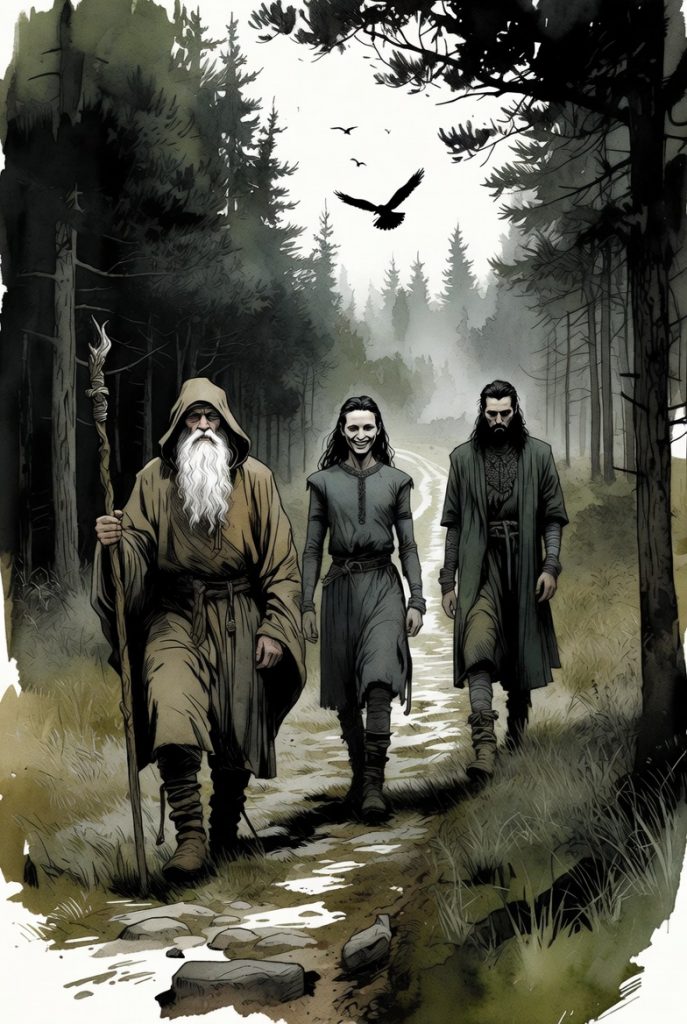
Hœnir also appears as the third member of well-known travelling triads with Óðinn and Loki — including stories connected with Þjazi and Iðunn, and the Andvari gold cycle.
He is present. He is named. He is just… rarely the one giving the speeches.
It is easy to read this as a purely narrative function (“we need a third figure here”), but triads in myth are often meaningful. Hœnir’s recurring place alongside Óðinn and Loki suggests he belongs among the core movers of mythic action, even if his role is quieter, less theatrical, or harder to classify.
In other words, he may not be delivering the monologue, but he is still on stage for a reason.
The survivor of Ragnarök and the priestly role in the new world
One of the most striking details about Hœnir is that he is named among the survivors of Ragnarök in Völuspá.
That alone is significant.
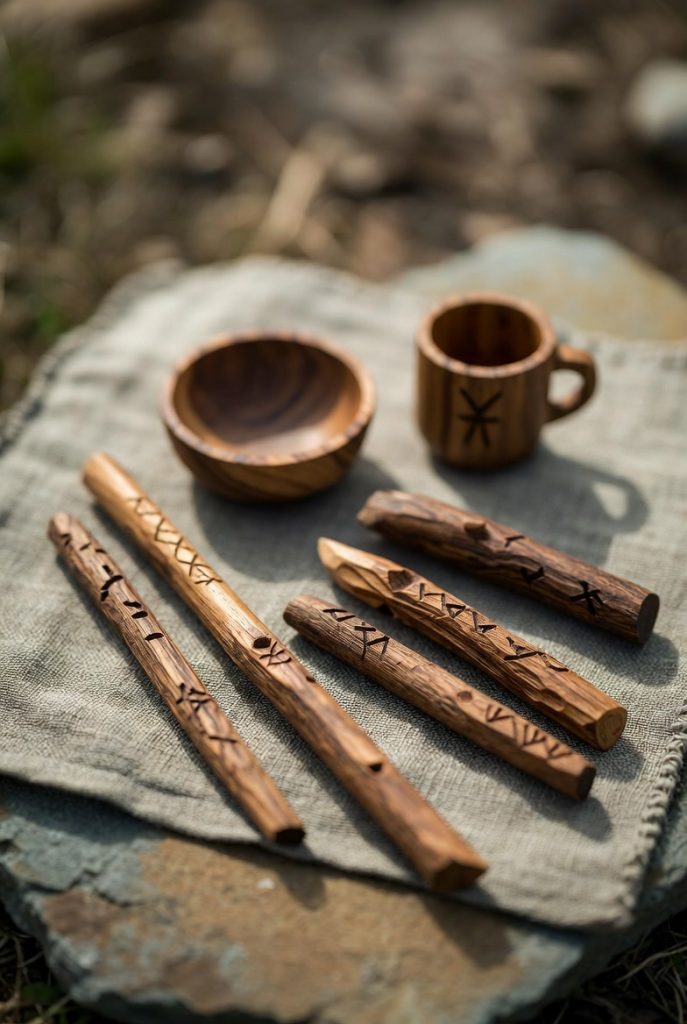
But the poem goes further: in the renewed world, Hœnir is associated with hlautviðr (lot-twigs / lot-wood), used in sacrificial and/or divinatory contexts. This points toward a priestly or prophetic function — not a war-leader, not a king, but someone involved in sacred choice, ritual interpretation, and the reading of fate.
Taken across the full mythic arc, it is a beautiful pattern:
- At the beginning of time, Hœnir gives óðr (mind/inspired awareness) to humanity.
- After the end of time, Hœnir handles hlautviðr (sacred lots) in the reborn world.
So even if the hostage episode makes him look passive or ill-fitted to politics, the cosmology frames him as something far more enduring: a keeper of mind, discernment, and sacred perception — precisely the qualities a renewed world would need.
Who was Hœnir, really? The main scholarly debates
Because Hœnir is clearly attested but thinly explained, scholars have long treated him as a kind of mythological detective case.
Hœnir as Vili
One of the most common harmonising theories is that Hœnir may correspond to Vili (Óðinn’s brother in Snorri’s creation account).
In Snorri’s Prose Edda, the creators of humanity are Óðinn, Vili, and Vé — not Óðinn, Hœnir, and Lóðurr. Since the functions overlap (especially around inner faculties, mind, and consciousness), some scholars argue that Snorri inherited variant triad traditions and systematised them into the more familiar Óðinn–Vili–Vé scheme.
That gives a neat comparative model:
- Poetic tradition: Óðinn + Hœnir + Lóðurr
- Prose systematisation: Óðinn + Vili + Vé
From there, one proposal is that Hœnir and Vili may reflect overlapping or substituted figures in different transmission lines.
It is a tidy solution — though, as with so much in Norse myth, not universally accepted.
The avian hypothesis: stork, heron, or swan imagery
This is one of the more unusual theories (and yes, that is part of the appeal).
Hœnir has epithets/kennings such as langifótr (“Long-foot”) and aurkonungr (“Mud-king”), along with associations like “swift god” in some discussions. These can evoke the imagery of long-legged marsh birds — storks, herons, or cranes — moving through wetlands.
Because Hœnir is also tied to the creation of humanity (through the gift of óðr), some older mythographers and linguists proposed that he may preserve traces of an older bird-linked life-bringer figure. The Faroese ballad Loka Táttur is often brought into this conversation too, since it includes Hœnir in a bird-related magical context involving swans.
Does this prove Hœnir “was a stork god”? No.
But it does suggest that some of his surviving bynames and later echoes may preserve fragments of imagery that the mainstream myth tradition no longer explains clearly.
A “both/and” possibility
A middle path is often the most useful one here.
Hœnir may preserve traces of an older spirit- or life-bestowing deity and have been absorbed into an increasingly Odin-centred myth complex over time. In that case, what survives are fragments: creation role, odd epithets, ritual significance, triadic appearances, and a major post-Ragnarök function — all pointing to a god who was once more sharply defined than the surviving texts now allow us to see.
Shadowy does not have to mean unimportant. Sometimes it just means the record is patchy.
Symbols and associations linked with Hœnir
This is the section where it helps to separate what is directly attested from what is interpretive or modern reconstruction, because Hœnir invites a lot of symbolic enthusiasm (understandably).
Strongest textual associations
Mind, awareness, and inspired consciousness
This is the clearest and most secure association, based on Völuspá. Hœnir gives óðr to Ask and Embla, which links him with mind, awareness, and inspired or spiritual consciousness.
If someone wants a core symbolic key for Hœnir, this is the one to start with.
Divination and sacred lot-casting
Also strongly rooted in Völuspá is Hœnir’s post-Ragnarök connection to hlautviðr (lot-wood / divinatory twigs). That supports associations with divination, sacred decision-making, ritual authority, and prophecy.
This fits especially well with a reading of Hœnir as a quiet priestly or prophetic figure rather than a warrior-leader.
Plausible symbolic associations from kennings and later material
Wading birds (stork/heron/crane-type imagery)
The epithets langifótr (“Long-foot”) and aurkonungr (“Mud-king”) are the main basis for bird associations, especially long-legged wetland birds. This is a scholarly and poetic inference drawn from the kennings, not a direct myth where Hœnir is plainly identified as a stork or heron.
So this is best presented as: possible imagery layer, not settled fact.
Swan associations
Swan links are more speculative but appear in some linguistic discussions and in later folklore material (especially Loka Táttur). Useful as part of the interpretive conversation, but again, not something to present as a firm historical cult symbol.
Creation imagery and modern symbolic use
Ask and Embla (ash and elm/driftwood)
Because Hœnir is one of the gods involved in the creation of the first humans, symbols connected to Ask and Embla — wood, driftwood, ash and elm, human shaping, the first awakening of consciousness — can be meaningful in modern devotional or symbolic work.
That said, it is best to frame this as mythic symbolism rather than direct archaeological evidence of Hœnir-specific cult objects.
What we do not have
This part is important and worth saying plainly: there is no securely identified archaeological symbol, statue, or runestone image that can be definitively assigned to Hœnir.
Most “symbols of Hœnir” lists are therefore built from:
- literary sources (especially Völuspá and Snorri)
- poetic epithets/kennings
- linguistic reconstruction
- later folklore echoes
- modern devotional interpretation
That does not make the symbolic work meaningless — it just means we should be honest about what is attested and what is inferred.
And with Hœnir, honesty about the gaps is half the scholarship.
Why the hostage story may matter more than it first appears
The Æsir–Vanir conflict attracts a lot of interpretation: social integration models, mythic “culture conflict” readings, migration-era frameworks, and Snorri’s euhemerising habit of treating gods as if they were once human rulers from “Asia.”
Whichever lens someone prefers, Hœnir’s place in the hostage exchange is telling.
He is important enough to be sent as part of a peace settlement. He is visually and socially legible enough to be chosen as chieftain material. But his apparent gift does not translate into the kind of leadership the Vanir expect.
That mismatch may be the point of the story.
It may not be telling us that Hœnir is worthless. It may be showing that different kinds of wisdom do not always travel well when people expect the wrong kind of authority.
Honestly, that feels mythically accurate in every century.
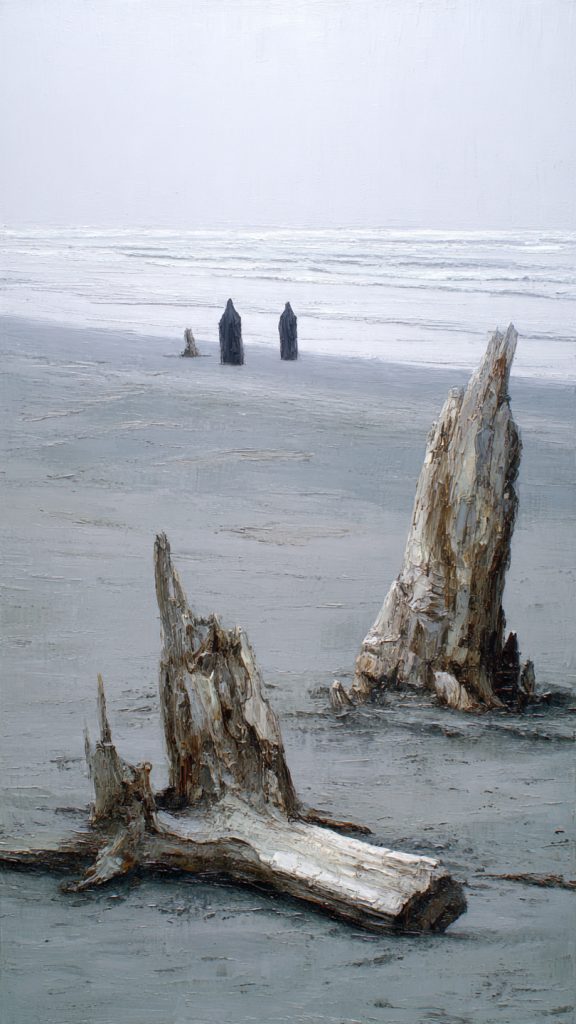
The god of mind who outlasts the world
Hœnir is easy to underestimate because he is rarely the loud one.
But the mythic scaffolding around him is remarkable:
- Creation: he gives humanity the inner spark of óðr
- Conflict and integration: he becomes a key figure in the Æsir–Vanir settlement
- Renewal after destruction: he survives Ragnarök and handles sacred lots in the reborn world
So if Óðinn is the god who seeks wisdom at terrible cost, Hœnir may represent something quieter but just as necessary: the enduring capacity for mind, inspiration, and spiritual discernment — the kind of wisdom that remains after the shouting stops.
That is a powerful role for a god so often treated as a footnote.
And maybe that is part of Hœnir’s mystery: he is not absent from the great myths at all. He is there at the beginning, there in the middle, and there at the end — still doing the work.
References (suggested list)
Primary sources
- Poetic Edda, Völuspá (creation stanzas; post-Ragnarök survival / hlautviðr passage)
- Prose Edda, Gylfaginning and Skáldskaparmál (triad narratives; kennings/epithets)
- Snorri Sturluson, Heimskringla, Ynglinga Saga ch. 4 (hostage exchange; “let others decide” motif)
Modern scholarship/reference works
- Rudolf Simek, Dictionary of Northern Mythology (entries on Hœnir; attestations and theories)