Norse cosmology doesn’t come with a map.
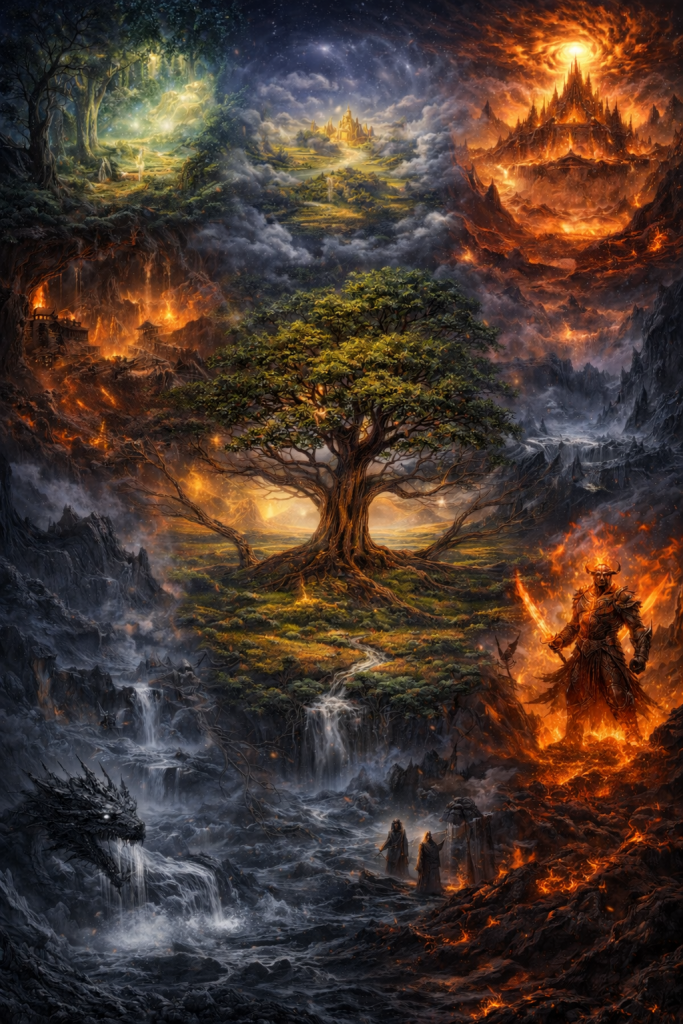
Instead, we get names, poems, journeys, boundaries, roots, fires, mists, halls, and endings. These are fragments that suggest a living worldview, not a fixed diagram. The Nine Realms are not clearly mapped in the surviving sources, and that uncertainty is part of the tradition, not a mistake.
This series looks at each of the Nine Realms and related cosmic structures as they appear in the Eddas and sagas. It sticks to what the sources actually say, but also leaves space for interpretation when the texts are unclear.
Instead of trying to fit the realms into one ‘correct’ layout, these articles treat them as places, conditions, mythic roles, and as layers of existence that overlap and interact.
Some realms are described in detail. Others are only hinted at, not fully explained. This unevenness comes from the sources themselves.
How to navigate this series
You don’t have to read these articles in order, but they do build on each other.
Each article can stand on its own, but together they show how Norse people may have understood the cosmos, life, death, and change.
When there are debates, they are mentioned. If later Christian influence affects the material, that is pointed out. If the sources are silent, speculation is avoided. There are a variety of translations of the Eddas and Sagas; however, for these articles, I use the following:
Translations referenced throughout the series:
- Poetic Edda: Carolyne Larrington
- Prose Edda: Anthony Faulkes
- Sagas: Jackson Crawford
The Realms and Cosmic Structures
The World-Tree
- Yggdrasil is the living axis that connects gods, worlds, the dead, and the forces that wear down the cosmos.
The Divine and Human Realms
- Ásgarðr is the world of the Æsir gods, featuring their grand halls and functioning as the center of divine power, governance, and mythic events involving the central deities of Norse tradition.
- Miðgarðr lies at the heart of the cosmos. It is the realm that is inhabited by humans, created from the body of the primordial being Ymir, with a protective circle made from his brows. Its circle of protection marks it as both a physical place and a shielded world.
The Otherworlds and Borderlands
- Jǫtunheimr is the land of the jötnar, beings linked to ancient wisdom, chaos, danger, hostility, and the needed opposition to the gods. It is both a place of exile and a source of challenge.
- Vanaheimr is the home of the Vanir gods, connected to fertility, wealth, prosperity, and peaceful negotiation. It exists in contrast yet in relation to Ásgarðr.
- Álfheimr is called the shining world of the Light Elves. It is connected to Freyr and stands for vitality, growth, and the energies that sustain life, but the sources leave its details mysterious.
- Svartálfaheimr, also known as Niðavellir, is the underground realm of dwarves. It is a place of crafting, hidden wisdom, and important consequences for the fate of gods and people.
The Realms of Death and Origin
- Helheimr is the underworld of Norse cosmology. It is where a majority of the dead live and is ruled by the goddess Hel. It is shown as a quiet, orderly place where the souls that were not chosen by battle gods go after death.
- Niflheimr is an ancient region of darkness, cold, mist, and ruin. It is a source of decay, tied to the deep origins of the cosmos through its ancient cold, standing in stark contrast to the fiery realm of Múspellsheimr.
- Múspellsheimr is the primordial realm of fire. It is described as a scorching, volcanic land of lava and flames. It’s home to the Fire Giants and ruled by the giant Surtr. It brings the spark of creation and the flames of destruction at Ragnarök, showing how fire shapes both beginnings and endings.
The Bridge Between Worlds
- Bifröst is the burning bridge between realms, fragile under the strain of the cosmos.
A note on the Nine Realms themselves
The Nine Realms are not shown as a strict system, since Norse sources do not support one clear model. Trying to force a single version often hides more than it explains.
The final article in this series looks directly at that question:
Are the Nine Realms places, layers, states of being, or something else entirely?
The answer, as with much in Norse myth, is both yes and no.
One final thought
These articles are not meant to close the discussion.
They are meant to give you a solid foundation, based on the sources, thoughtful, and open enough to let the myths breathe. The Nine Realms were never meant to be memorized like a chart. They were meant to be lived with, discussed, and revisited.
Are you ready to start your journey through the relams? Click on the link below!