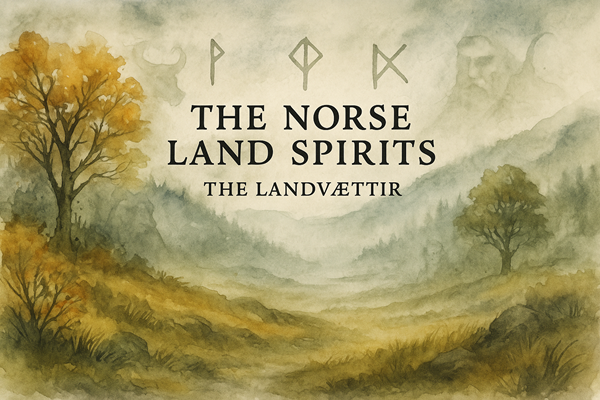
Landvættir, or “land wights,” are the unseen guardians of the natural world — the spirits that dwell in forests, mountains, rivers, and fields, each bound to a specific place within the living landscape. Revered since pre-Christian times, they were believed to hold great influence over the well-being of the land and those who lived upon it. Maintaining good relations with these spirits through respect and offerings was vital to a community’s prosperity.
“Land spirits (Old Norse landvættir) are, as the name implies, the spirits who dwell within particular places or features of the land. They wield considerable influence over the well-being of the land and all who depend on it.”
They could bless or curse those who dwelled or traveled through their domain — fierce protectors of their native ground, seldom tolerant of disrespect or neglect. The Landvættir were seen as passionate and potent beings, quick to defend the balance of nature itself. [1]
Even law and custom acknowledged their power. The first law code of Iceland (930 CE) declared that anyone arriving by sea must remove the dragon heads from their ships before nearing shore, “lest they frighten the land spirits.” [2] Such reverence speaks to the deep relationship between the Norse people and the living spirit of the land they inhabited.
The Nature and Forms of the Landvættir
The Landvættir are nature spirits in the truest sense — embodiments of the landscape itself. Each mountain, river, grove, and stone might house a wight who mirrors the spirit of that place. Their form was never fixed; they could appear as animals such as wolves, bears, or horses, or even as towering figures of mist and shadow. At times they seemed almost human, and at others, they were felt only as a stirring presence in the wind or the quiet hum of the forest.
They are the soul of the land made visible. When treated with reverence, they bring fertility, balance, and protection. When dishonored, they withdraw their favor — or worse, bring misfortune. Acts of carelessness such as overhunting, pollution, or desecration of sacred sites could rouse their anger, leading to failed crops, storms, or illness. Offerings of food, drink, or crafted gifts were given to soothe or honor them, often left at cairns or stones that marked their presence.
Landvættir in Norse Life and Lore
Respect for the land spirits was woven into the daily and spiritual life of the Norse. Offerings were made before planting or harvest, and travelers might ask permission before crossing new terrain. When settling new land, rituals were performed to greet and honor the local spirits, ensuring their blessing for the community’s success.
In saga literature, their presence is unmistakable. In the Heimskringla, within Óláfs saga Tryggvasonar, it is written:
“King Harald told a warlock to hie to Iceland in some altered shape, and to try what he could learn there to tell him: and he set out in the shape of a whale. And when he came near to the land he went to the west side of Iceland, north around the land, where he saw all the mountains and hills full of guardian-spirits, some great, some small.”
Such passages highlight the deep reverence the Norse held for the Landvættir — protectors fierce enough to turn away invading forces and guardians whose presence was visible to those who walked between the worlds.
The Landnámabók, or Book of Settlements, preserves the ancient Icelandic law prohibiting carved dragon heads on ship prows from approaching land. This tradition lives on symbolically in Iceland’s coat of arms, which bears the four Landvættir that guard the island — the bull, the eagle, the dragon, and the giant.
“It was the beginning of the preamble of the heathen laws that men should not take ships to sea with carved figure heads upon their sterns, but if they did, they should take them off before they came in sight of land and not sail to land with gaping heads or yawning snouts lest the guardian feys of the land should be scared thereat.”
Their Role and Influence
The Landvættir embody the living connection between humankind and the natural world. They are:
- Guardians of the Land: Fierce defenders of their territories — mountains, rivers, trees, and stones alike.
- Bringers of Fortune: They bless fertility and abundance when honored, and withdraw their favor when disrespected.
- Protective Spirits: Offerings ensured harmony and safety; neglect could invite calamity.
- Spiritual Intermediaries: Though not gods, they act as powerful go-betweens — a bridge between the human world and the greater forces of nature.
Throughout the Norse world, people left small cairns of stones or offerings of food and drink as tokens of goodwill. Even as Christianity took root in Scandinavia, these practices lingered quietly — a testament to the enduring reverence for the spirits who walked unseen beside the living.
The Wider Web of Spirits
In the Norse worldview, the boundaries between different types of beings were fluid. Landvættir often overlapped with elves (álfar), dwarves (dvergar), or even trolls — all seen as inhabitants of the natural world. Some scholars suggest that over time, their identities merged, giving rise to the later folklore of elves dwelling in hills and stones.
But whatever name they were given, their purpose remained the same: to remind humanity of its place within the greater web of existence. To live in harmony with the land was to live in harmony with the spirits themselves.
The Living Tradition
Even today, belief in the Landvættir endures in Iceland and among modern Heathens across the world. Offerings of milk, bread, or mead are still left at stones and trees in gratitude or greeting. Modern practitioners view them as guardians of both spirit and ecology — the heart of an ancient bond that connects people to the earth beneath their feet.
The old ways remind us that every mountain has a soul, every stream a voice, and every breeze carries the memory of the ancestors who once whispered to the Landvættir for blessings and protection. To honor them is to walk gently upon the world, with reverence for the living land that sustains us all.
References
[1] [2] Turville-Petre, E.O.G. 1964. Myth and Religion of the North: The Religion of Ancient Scandinavia. p. 234
Tags: Norse Land Spirits, Norse Mythology, Norse Pagan