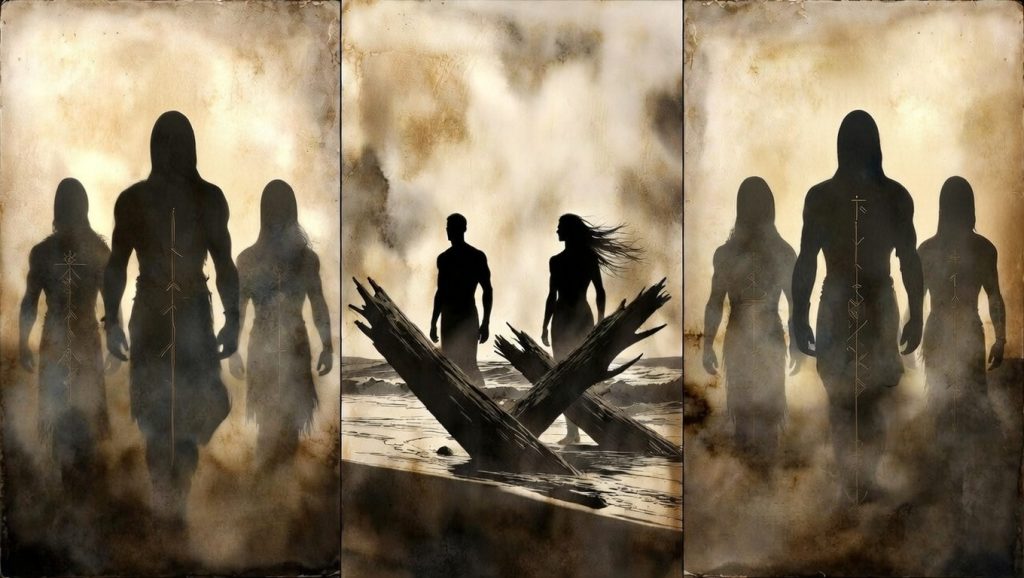
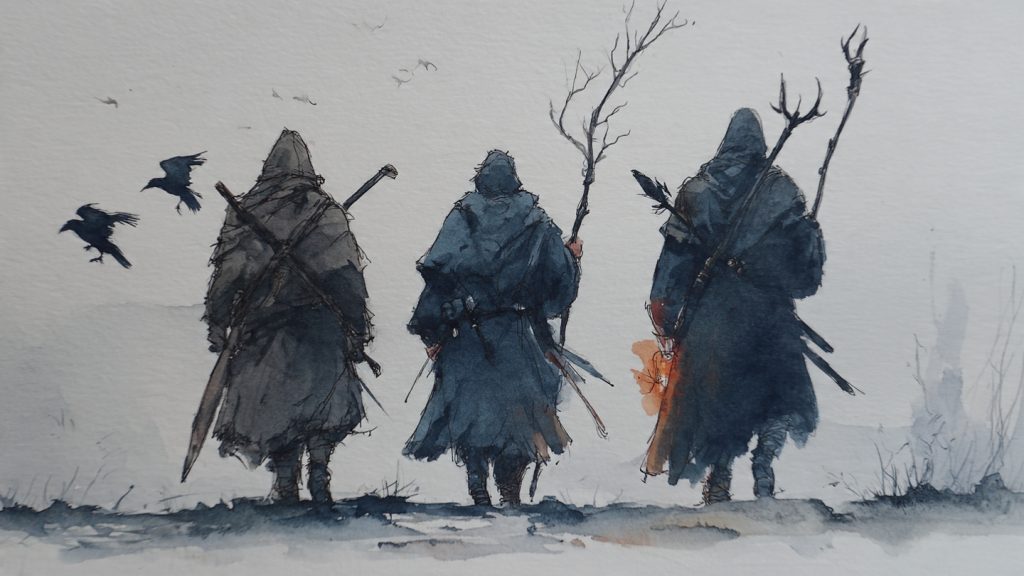
One of the most interesting “wait… hang on!” moments that we find in Old Norse myth is that we get two different trios involved in humanity’s creation — depending on whether you’re reading the Poetic Edda or Snorri’s Prose Edda.
- Poetic Edda (Völuspá): Óðinn, Hœnir, Lóðurr
- Prose Edda (Gylfaginning): Óðinn, Vili, Vé
Same scene, same first humans (Askr and Embla), same “we found two pieces of wood and made people” vibe… but different supporting cast. So what gives?
This isn’t just trivia. Which triad you lean towards changes the whole feel of the myth: are humans made “civilised” by mind, speech, senses and social order — or brought to life through breath, ecstasy/inspiration, and blood-warm vitality?
Let’s dig in!
The Two Triads At A Glance
Both sources agree on the core idea: a threefold divine act brings humans into being. But they frame it differently.
Snorri’s triad: Óðinn, Vili, Vé (Prose Edda)
Snorri gives us a tidy, structured trio — explicitly brothers, sons of Borr and Bestla — who appear in the broader “world-ordering” cycle (including Ymir and the shaping of the cosmos).
And their names are strikingly conceptual:
- Vili = “Will”
- Vé = “Sacred space / sanctuary / holiness”
That already sounds like a neat theological package: Breath + Will + Sacred Order.
Völuspá’s triad: Óðinn, Hœnir, Lóðurr (Poetic Edda)
Völuspá is older in voice and often feels more cryptic. Here, the trio are described more loosely as powerful gods (not as clearly defined “brothers”), and the focus narrows right in on the animation of the human.
And instead of “Will” and “Sacredness,” we get:
- Hœnir — mysterious, significant, but oddly under-explained
- Lóðurr — almost a ghost in the sources, barely named elsewhere
This triad feels less like a theological diagram and more like an old myth fragment where the meaning is carried by the gifts rather than the résumés of the gods.
The Gifts to Askr and Embla: “civilised humans” vs “living humans”
This is where the two versions really show their personality.
In the Prose Edda
Snorri’s gifts come across as social and cognitive — the things that make humans recognisably human in a community: mind, speech, senses, and appearance.
In Völuspá
The gifts are rawer and more primal:
- önd — breath/spirit
- óðr — mind, inspiration, ecstatic “poetic” consciousness (hard to translate cleanly)
- lá and litu góða — vitality/heat/blood and “good colour/complexion,” i.e., the visible signs of life in the body
So if Snorri gives us “what makes humans civilised,” Völuspá gives us “what makes humans alive.”
And honestly? That difference alone explains why people get so hooked on this topic.
The Big Debate: Are These Six Different Gods… Or The Same Gods Under Different Names?
Scholars have argued for ages over the “identity overlap” question: did the tradition change, did Snorri change it, or are we looking at multiple names/facets for similar roles? It’s something we see often in the stories. Look at how many names Óðinn has!
Theory 1: Lóðurr is Loki (the “identity crisis” theory)
This seems to be the favourite debate topic, and it’s not pulled out of thin air.
Why people connect Lóðurr with Loki
Across other myths, we repeatedly see a travelling trio of:
Óðinn + Hœnir + Loki — not Óðinn + Vili + Vé.
Here are some examples:
- Haustlöng (Odin/Hœnir/Loki encounter Þjazi)
- Reginsmál (Andvari’s gold)
- Loka Táttur (later tradition with the same trio)
There’s also kenning evidence: references to “Lóðurr’s friend” for Óðinn that parallel Óðinn being called “Loptr’s friend” (Loptr being Loki).
And later Icelandic poetic tradition (rímur) sometimes treats “Lóður/Lóðurr” as a Loki-name — suggesting the overlap stayed alive in oral memory long after conversion.
The big objection: “But Lóðurr sounds benevolent”
Völuspá frames the trio as “mighty and loving/benevolent,” and Lóðurr’s gift is life-giving — “good colour,” warmth, vitality. That clashes with the popular later image of Loki as pure menace.
But here’s the tension that makes the argument interesting: Loki isn’t “the devil” in the older material. He’s a boundary-breaker, a catalyst, a companion in adventures — until things curdle.
So one way to hold the Loki=Lóðurr theory without forcing it is:
- early Loki = necessary spark / disruptive life-force / fire-in-the-blood
- later Loki = destabiliser, oath-breaker, doom-bringer
That doesn’t prove the identification, but it makes it less “no way, impossible.”
Theory 2: Hœnir is older than Snorri’s Vili
Hœnir is weird, and that’s exactly why people think he may preserve something old.
In Völuspá, he gives óðr, a word linked to inspiration, mental activity, and ecstatic states — and it’s the root sitting right inside Óðinn’s name.
But in later narratives (like the hostage exchange), Hœnir can look indecisive or “silent,” relying on Mímir.
So one interpretation is:
- Hœnir may once have carried a ritual/divinatory role (or a mythic “presence” that made sense in cultic or poetic context)
- Snorri, writing later, may have found that role too obscure or too hard to narrate cleanly — so he swaps in Vili (“Will”), a concept that’s immediately understandable and easier to systematise
This fits a broader pattern: Snorri is often an organiser. Sometimes that’s brilliant. Sometimes it’s… a little too tidy.
Theory 3: Snorri “streamlined” an older triad into abstractions
This theory doesn’t require Lóðurr to equal Loki, or Hœnir to equal Vili. It simply argues:
- Völuspá preserves a more archaic, myth-poetic triad (breath + inspiration + embodied vitality)
- Snorri reframes the triad into something that reads like a structured theological model for his audience (breath + will + sacred order)
I’ve noted two spicy “why Snorri might do that” angles:
1) Alliterative/poetic shaping
Vili and Vé create a pleasing alliterative cluster (words starting with the same sound) in the Germanic style, especially with Óðinn/Wōden in mind, which could reflect mnemonic tradition (using catchy sounds to make information easier to remember) or deliberate crafting.
2) Christian-era framing
Snorri’s Prose Edda was written in Christian Iceland. Even when he’s preserving myth, he’s doing it through a worldview that values system, structure, and sometimes a “safe” distance from raw pagan sacredness.
That doesn’t mean “Snorri ruined it.” It means his version is a version shaped for explanation and teaching.
Theory 4: the “Triune Óðinn” Idea (Facets, Not Separate Gods)
Some people (scholars and modern Heathens alike) have explored the possibility that:
- Vili and Vé aren’t independent characters in an active myth
- they function more like aspects of sovereignty — what a king-god is (breath/spirit, will/intent, sacred authority)
That would explain why Vili and Vé mostly vanish after creation: they were never meant to be “plot characters” the way Thor or Freyr are. They’re mythic scaffolding.
Meanwhile, Hœnir remains present in the myth-cycle and even survives Ragnarök in some traditions — which supports the idea that Hœnir is “a real figure” in story logic, not just a conceptual label.
So… Which Triad Is Right?
The most honest answer is that both are real within the tradition, but they’re doing different work.
If you want a creation story that emphasises:
- the ordering of society
- speech, senses, human “culture”
- divine legitimacy and sacred boundaries
…Snorri’s triad fits beautifully.
If you want a creation story that emphasises:
- the mystery of what animates matter
- inspiration/ecstasy/óðr as a holy spark
- blood-warm vitality and the embodied soul
…Völuspá hits harder.
And it’s completely reasonable (especially in a Heathen context) to treat this as a feature, not a bug: multiple strands of myth preserved side by side, each revealing a different layer of what it meant to be human.
What This Argument Changes For Us, Spiritually
If, as a modern Heathen, you’re reading this with one eyebrow raised, here’s the real punchline:
- In one version, humanity is made through sacred order.
- In the other, humanity is made through breath + inspiration + living heat.
That means the myth isn’t only asking “who created us?”
It’s asking what we were made for?
Are we here to uphold frith, structure, and right relationship — or are we also here to carry the wild, inspired, risky spark that makes poetry, prophecy, art, and transformation possible?
And if the answer is “both,” congratulations — you’ve just described being human!
References used in this discussion
- Snorri Sturluson, The Prose Edda (trans. Anthony Faulkes)
- The Poetic Edda, especially Völuspá (trans. Carolyne Larrington)
- E.O.G. Turville-Petre, Myth and Religion of the North
- Ursula Dronke, The Poetic Edda: Volume II (commentary on Völuspá)
- Rudolf Simek, Dictionary of Northern Mythology