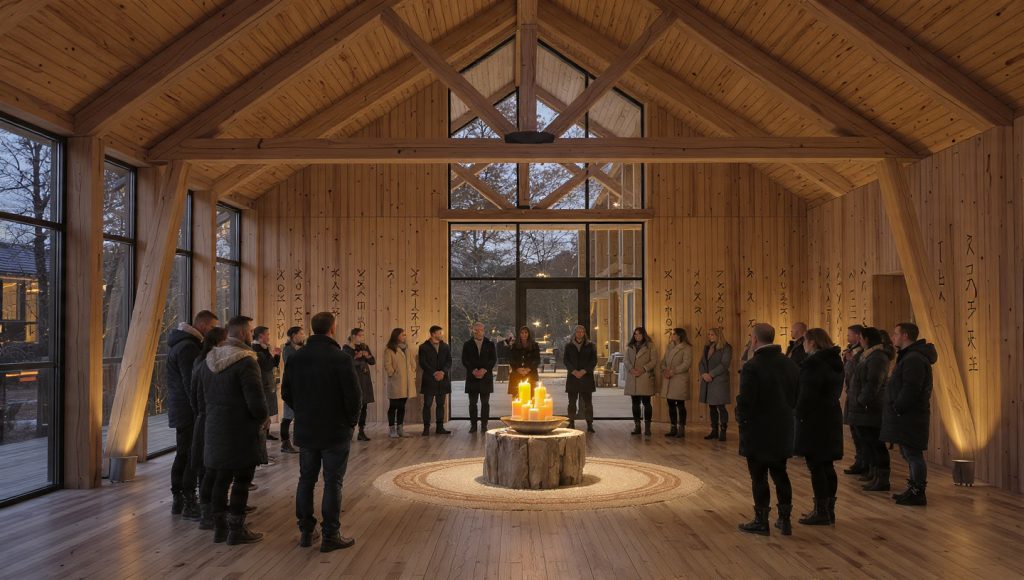
Let’s try a bit of alternate history, but keep it respectful.
Not the Marvel version, and not the “Vikings rule the world forever” fantasy either. I mean the kind of thought experiment you can actually sink your teeth into.
If Scandinavia hadn’t converted when it did, and Christianity hadn’t swept in to take the reins, where might Norse paganism have wandered?
Here’s the thing: Forn siðr—the old custom—wasn’t a single, tidy religion with a holy book and a checklist of beliefs. It was a living, breathing tradition: local rites, regional flavors, oath-culture, feasts that marked the seasons, sacred places tucked into the land, and a web of relationships that tied together gods, ancestors, spirits, kin, and community. And it varied. Wildly.
Place-name research and cult-landscape studies shout about regional patterns: some gods and cult words pop up everywhere in one valley, then vanish in the next. That doesn’t look like a single, unified religion. It looks like a patchwork of local traditions that just happen to be cousins.
So if Christianity hadn’t barged in, Norse paganism wouldn’t have stayed frozen in a Viking Age snapshot. Living traditions don’t sit still. They grow, shift, and surprise you.
The biggest question is how. And the most likely answer is this:
Norse paganism would probably have picked up more structure—not because it had a secret craving for bureaucracy, but because kings and states are hungry for order. The moment a realm starts acting like a realm, it wants its religion to act like scaffolding.
From local feast to royal religion
As Scandinavian monarchies grew up, they needed glue: something to hold people together, steady the law, and make rule over big territories feel real. Religion is handy for that. Not in a mustache-twirling villain way, but in the very human sense of “we need shared rituals and stories to make this work.”
This is where the alternate history gets juicy, because Norse religion already tangled cult and power together. Elite halls weren’t just for feasting—they were for rites, for showing off generosity, for weaving law and sacred obligation into one thick rope. There wasn’t a neat line between politics and religion. It was all one knot.
But as monarchies flexed their muscles, things would start to shift:
- Major cult centres become state-sponsored (and politically loaded).
- Some rites get pulled upward into “official” royal ceremonies.
- Public religion steps onto the stage of governance. Kings show off their luck, their protection, their fertility, and their claim to the gods’ favor.divine favour.
And here’s the key pivot: conversion to Christianity often offered rulers a ready-made partnership between kings and clerics, plus literacy and administrative reach. Winroth’s work is frequently cited for arguing that conversion was driven heavily by political, economic, and cultural self-interest, not simply forced belief.
So in a world where the Christian package doesn’t arrive (or doesn’t take), Norse paganism has two options:
- Stay decentralised and let kings struggle to unify rule without a shared religious bureaucracy, or
- Develop its own institutional “spine” — enough to support administration and legitimacy.
Most roads lead to option two winning out over time.
The “Roman model”: religion as civic duty (aka the spiritual tax)
This is where it helps to borrow a lens from elsewhere, just to make the mechanics visible. In the Roman world, the state didn’t particularly care whether you felt devotion to Jupiter. What mattered was whether you performed the rites that kept the civic order and cosmic order in balance. Participation was part of being a citizen.
In an alternate pagan Scandinavia, you could plausibly get something similar: a shift away from “personal belief” and toward civic religion. Not “believe this or else,” but “show up, take part, and be counted.”
The King’s luck as political proof
Old Norse concepts of luck/fortune (often discussed through terms like hamingja and gæfa) sit very neatly inside sacral kingship. In a centralised state, the “luck of the king” becomes the public evidence that the gods back his rule — and if crops fail or defeats pile up, that’s not just bad leadership, it’s spiritual failure.
Civic ritual as membership
Attending seasonal rites at the royal hall signals: I belong here. I am part of this realm. This shift turns a living tradition into state ideology—not by inventing new gods, but by changing the meaning of participation.
A priesthood… but probably not a “Norse church.”
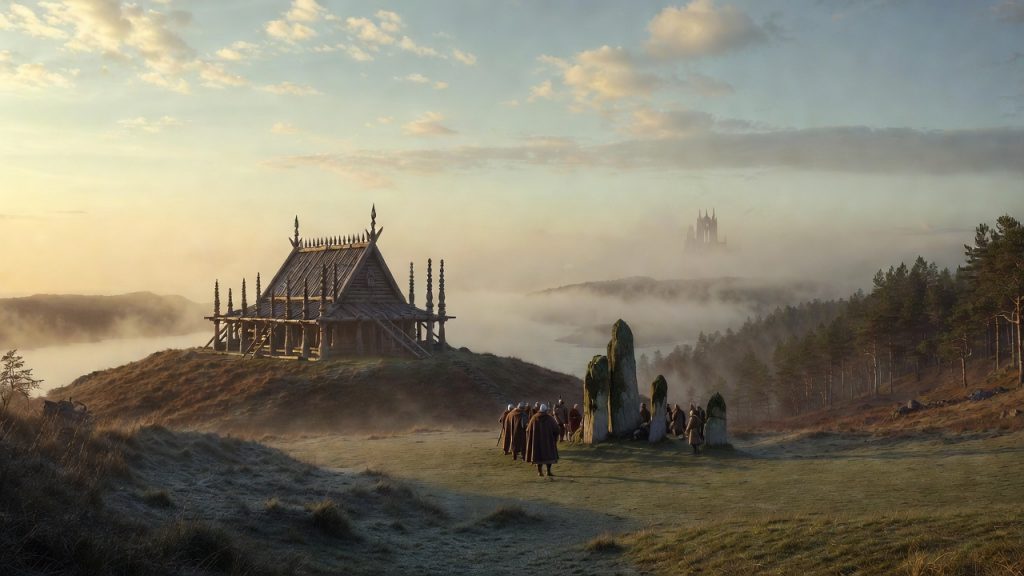
This is where people start picturing a pagan Pope of Uppsala. It’s a fun image, but probably not how things would play out.
What’s more likely? Something subtler:
- Specialised ritual leaders attached to royal and regional centres.
- Law-speakers and administrators who are increasingly trained in writing
- A defined class whose job includes ritual expertise, record-keeping, diplomacy, and education
Not necessarily celibate priests. Not a single, towering hierarchy. More like a growing class of professionals, because states run on people who know their stuff.
And this isn’t pulled out of thin air. Scholarship on the goði role (particularly in Icelandic contexts, where it’s best documented) shows a fusion of religious and legal-social function: cult, community leadership, assembly life, and ritual authority overlapping.
So: less church, more web of state cults.
Sacred architecture expands (and gets political)
There’s a stubborn myth that Norse worship only happened outdoors. Yes, sacred groves, wells, stones, and wild places mattered. But dig into the research, and you find cult buildings, ceremonial halls, and ritual houses woven right into the strategies of the elite.
If paganism remained dominant while kingdoms centralised, it’s very plausible that:
- Royal cult halls and sanctuaries become more monumental.
- Major festivals are staged at recognised ritual centres.
- Architecture grows up to support feasting, oath-making, assemblies, offerings, and all the public show that comes with power.
And if you want a perfect “this is why the Uppsala stuff is complicated” example: the famous written description (Adam of Bremen) is late and agenda-shaped, and the archaeology is heavily debated. Modern survey work at Gamla Uppsala strongly cautions against treating the “golden temple” as a straightforward, literal building you can simply point to on a map.
In other words: even in our own timeline, Uppsala is where cult, hall, and politics all blur into one big, complicated tangle.
“Holy texts” and the move from oral myth to written tradition
This is one of the juiciest “what ifs” in the whole thought experiment.
Because the myths we have were recorded in a Christianised context centuries after conversion, and that shapes what survives and how it’s framed.
In a world without Christian conversion, the Norse don’t suddenly invent a Bible. The real shift is this:
Writing becomes central to power, and power prefers records—whether ink or runes.
We know runes weren’t only for grave markers and solemn phrases. The Bryggen finds in Bergen include hundreds of medieval runic inscriptions — everything from owner labels and business notes to personal messages — showing everyday runic literacy in a living urban world.
And we have clear evidence of long-form manuscript writing in runes too: Codex Runicus (AM 28 8vo), a runic manuscript from around 1300 containing the Scanian Law, among other texts.
So in a timeline where pagan elites get serious about institutions, you’d expect to see written materials like:
- ritual calendars and festival frameworks
- legal-religious texts (because law and oath are sacred territory)
- genealogies linking rulers to gods/legendary ancestors
- myth cycles recorded as “official versions” attached to specific cult centres
- charms, oaths, blessing forms, boundary rites, ancestor rites
Would this iron out all the differences? Not a chance. Regional quirks are stubborn. But you’d probably get a court-approved version of myth and ritual that spreads through administration, education, and sheer prestige.
Ritual evolution: not “civilised vs barbaric,” but “state control vs local power”
Finally, let’s examine how rituals themselves might have evolved in this alternate timeline—not just in form, but in who holds the power.
As states settle down, they like to keep a tight grip on violence and public spectacle. That changes the shape of ritual.
Human sacrifice is the hottest example. The written sources are biased and complicated — but there’s serious archaeological discussion in Denmark that human sacrifice occurred in some contexts, framed as an extreme, costly gift.
In a pagan state getting more centralised, you’d see one—or both—of these pressures:
- Ritual is regularised: high-stakes rites get restricted to approved contexts under royal oversight.
- Ritual is symbolised: offerings shift toward votives, animals, feasting, public oaths, and wealth/tribute-as-offering
Not because the religion gets softer, but because wild, uncontrolled ritual power is a headache for anyone trying to run a kingdom.
7) The moralising-god debate: honour vs sin (and why “monitoring” might be enough)
As we close in on the big-picture changes, let’s consider the moral dimension: did a centralised Norse religion need “moralising gods”—or was public honor enough?
One of the biggest hurdles for a growing state is how to encourage cooperation when nobody’s watching. A big argument in the study of religions is that “moralising high gods” (all-seeing, punishing sin) can support large-scale cooperation.
But Raffield and colleagues argue you don’t necessarily need moralising gods if you have supernatural monitoring more broadly — gods, spirits, ancestors as witnesses, and consequences that are social, legal, and spiritual all at once.
Norse religion already leans hard into honor and shame, oath-culture, reputation, and the kind of action everyone can see.
So in a centralised pagan state, you don’t get a list of sins. You get a Code of Honour, formalised and public, where:
- Breaking contracts and betraying kin is not only criminal but spiritually contaminating.
- being branded with níð becomes a kind of social death — exile from community, luck, and protection
And yes, the language around níð is harsh for a reason. Social order was the whole point.
The politics of “favourite gods.”
If pagan Scandinavia starts dancing to the tune of the state, some gods step into the spotlight.
A royal cult might elevate:
- Odin for kingship, victory, elite identity, poetry, sacral authority
- Thor for protection, order, boundary-keeping, the everyday sacred
- Freyr/Freyja for prosperity, fertility, peace, abundance
But place-name evidence says the old religion was anything but uniform. Only a handful of gods show up everywhere, and even then, they gather in tight local clusters.
So you’d end up with a mix that looks something like this: official pantheon + local spirits + regional loyalties + household rites. In other words: delightfully messy, because humans never do tidy religion.
Syncretism: the North Sea becomes a pagan cultural sphere
Here’s where Norse paganism has a genuine advantage: polytheistic systems are adaptable.
In borderlands and along trade routes, gods blend, swap attributes, or get adopted by new neighbours. Instead of conversion, you get a swirl of merging, layering, and creative remixing.
So it’s plausible a dominant pagan North could have continued absorbing or blending with:
- Sámi and Uralic traditions at the edges of Scandinavia
- Baltic and Slavic influences across trade and settlement zones
- local land spirits and regional cults that never fully disappear
Instead of flattening belief into one “correct” way, expansion would likely spin out a wider pagan world—shared motifs, but strong local dialects of practice.
The institutionalised völva: a gendered power shift
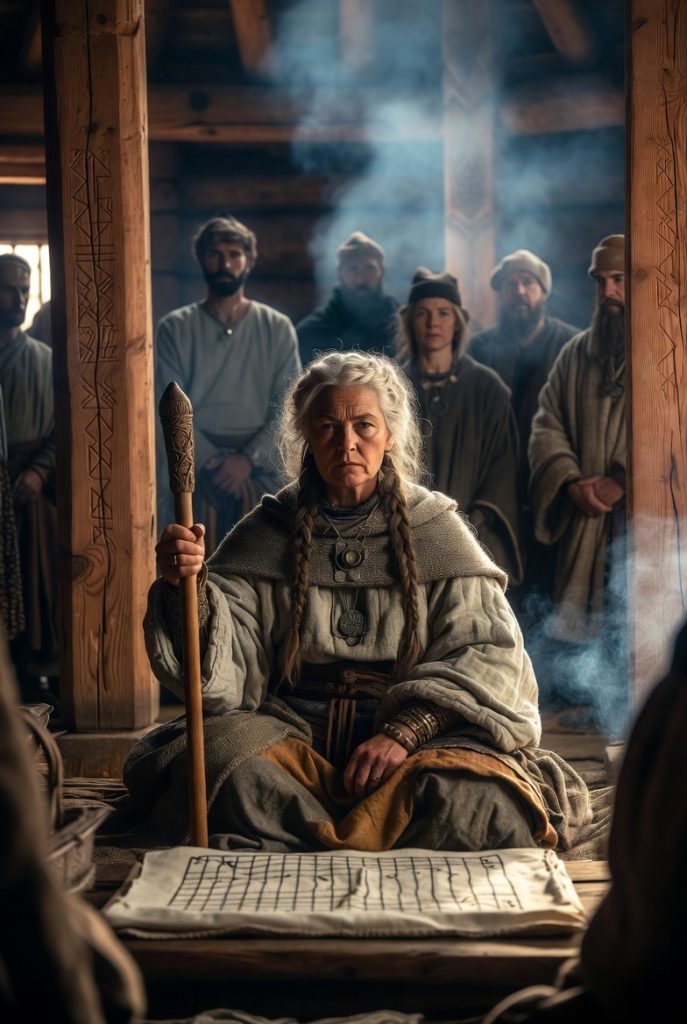
Norse sources and scholarship both point to a world where magic, religion, and gender roles get tangled fast. Seiðr is often painted as women’s power, with plenty of thorns for any man who tries it. Neil Price, especially, digs into how sorcery, gender, and social identity all knot together in the evidence.
In a centralised pagan state, the völva’s role probably has to go one of two ways:
1) Professionalisation: the oracle model
The völva becomes an institutional office—an official seer consulted before wars, law changes, successions, and major public decisions. Not “witch in the woods,” but “state-recognised interpreter of fate.”
2) Suppression: the control model
Kings and law-speakers try to clamp down on seiðr because it’s wild, unpredictable, and refuses to be tamed by the state.
Either path is believable. The real question is what it does to power.
The Uppsala Oracle (speculative, but tasty)
In this alternate history, Old Uppsala isn’t just a ritual site. It’s the seat of a High Seeress—a Húsfreyja-Völva with real institutional clout. She doesn’t rule the king, but she acts as a check. If the land spirits aren’t consulted, if oaths aren’t ritually sound, the army’s luck falls apart.
That sets up a very Norse kind of balance: public power in the hands of men, shaped and limited by the ritual authority of women.
(And yes, I can already hear someone muttering, “that would never happen,” while history quietly coughs and points at Delphi.)
When Hávamál becomes the spine of the realm (a thought experiment)
This is the moment when lived tradition puts on a crown and becomes state ideology.
If a centralised Norse state made it to the late medieval period without Christian scripture, it’s easy to imagine Hávamál—proverbial wisdom from the Poetic Edda—getting promoted to the role of ethical and legal backbone. Not a list of commandments, but a text of wisdom and order.
Unlike the Ten Commandments, which come down from on high with a “thou shalt not,” a pagan code would probably be all about guidance for keeping:
- frith (social peace)
- luck (hamingja/gæfa)
- reputation, obligation, reciprocity
- visible action over private thought
The “Lögmál Óðins” (speculative mock table of contents)
If you want a bit of help visualising it, here’s what a 14th-century manuscript might look like:
| Section | Title | Legal & spiritual focus |
|---|---|---|
| I | The Rights of the Hearth | Hospitality laws; guest-right; boundaries and sacredness of home |
| II | The Oath-Binding | Ritual procedure for contracts; spiritual consequences of oath-breaking |
| III | The Wergild Scales | Structured compensation to settle feuds and protect frith |
| IV | The King’s Luck | Ritual duties of the monarch tied to fertility and victory |
| V | The Seeress’s Decree | Regulation of seiðr; distinction between sanctioned prophecy and harmful sorcery |
| VI | The Kin-Debt | Obligations to ancestors; burial mound maintenance; inheritance as sacred duty |
Honour vs sin, in plain language
A Christian code cares about what’s in your heart—don’t covet, don’t even think about it. A Norse-flavored code? It’s all about what you do. No rules against wanting. Plenty of rules against stealing, breaking oaths, or wrecking frith.
A religion that lives in the visible world.
Updated structural comparison (for those of you who like a quick map)
| Feature | Historical (post-conversion trajectory) | Alternate (centralised paganism trajectory) |
|---|---|---|
| Authority | Bishop / king partnership | King as sacral ruler + cult network (goðar / ritual officials) |
| Law model | Sin / penance frameworks + canon influence | Honour / oath frameworks + customary law |
| Literacy | Latin manuscript culture | Runes + Latin-style writing culture (runes adapted for manuscripts) |
| Sacred space | Parish church network | Royal hall / monumental hof / cult centres |
| Spiritual goal | Salvation / afterlife emphasis | Orlog/legacy, communal luck, frith-in-the-world |
| Fate/future | Scripture-shaped prophecy | Institutionalised divination (völva office) + omen/lot traditions |
(That “literacy” line is a big deal: Codex Runicus shows runes can absolutely function in long-form manuscript writing, even inside medieval manuscript culture as we know it.)
The modern ripple: Odin and Thor as sacred figures
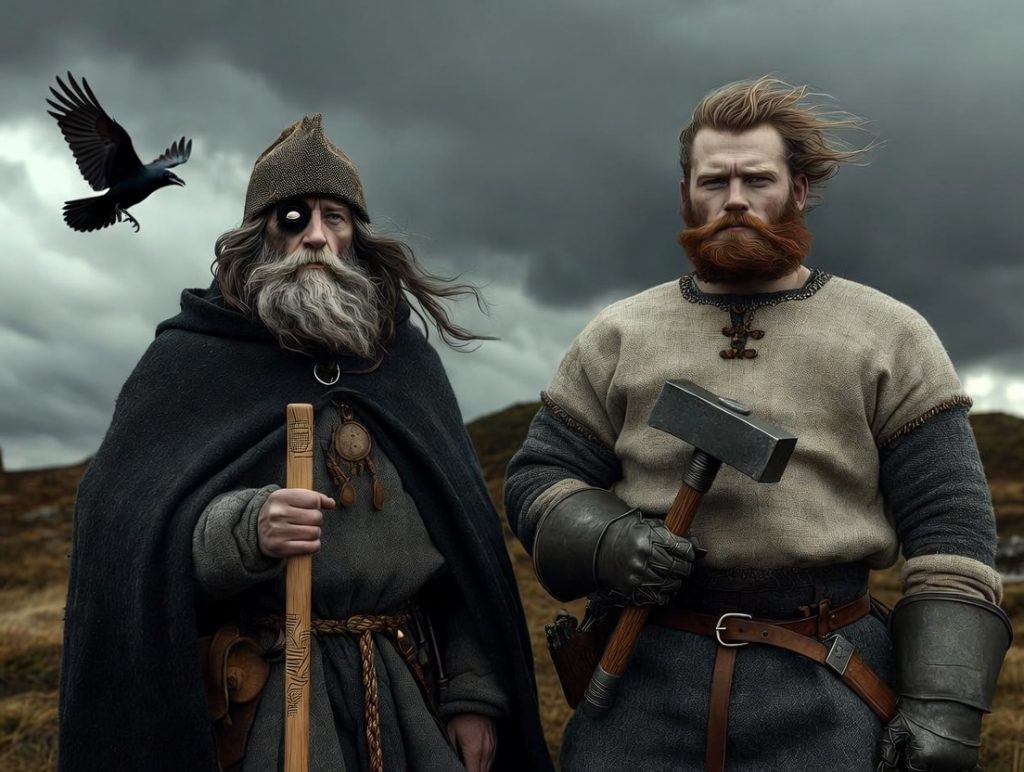
If Norse religion had stayed on top, modern Western culture would feel very different—not just in art and symbols, but in the deep-down assumptions about what counts as normal.
Plausible shifts:
- Sacred images: you’d probably see taboos about how gods can be shown. Not because pagans are extra strict, but because any big religion draws lines around the sacred.
- Values: more weight on reciprocity, honor, oaths, ancestry, frith, and right relationship. Less on sin and salvation.
- Cosmology: Ragnarok as a cultural instinct could make “collapse and renewal” feel like a cycle, not a one-time apocalypse.
None of this is set in stone. But it’s a reasonable shape for a thought experiment.
The thread we’re actually holding today
We’re living in a version of this evolution right now.
Modern Heathenry and Forn Siðr are, in many ways, picking up the thread where the Viking snapshot left off. We’re all trying to figure out how ancient values—frith, oaths, reciprocity, honor, relationship with land and ancestors—work in a world of technology, globalism, and mixed communities.
We’re not recreating the past. We’re doing what living traditions always do: adapting, testing, rebuilding, and—of course—arguing in the comments section. Some things really are eternal.
Conclusion: The North That Might Have Been
If Christianity hadn’t stepped in, the Norse world wouldn’t have stayed frozen in a tableau of longships and leather armor. It would have grown up—trading its Viking adolescence for a sophisticated pagan adulthood.
We’d likely see a Northern Europe shaped not by cathedrals, but by monumental halls. The legal backbone of the state would be forged from the sacredness of the oath, not the fear of sin. Literacy would live in runic manuscripts and other scripts. Prophecy would be part of the system, not pushed to the margins. And religion? Less about private salvation, more about public commitment to the luck of the folk.
In the end, the Old Ways survived because they knew how to adapt. If they’d been allowed to grow on their own terms, we wouldn’t just have different myths. We’d have a different sense of what it means to be a citizen, a kinsman, a human being standing before the turning of fate.
Norse paganism didn’t need to be “saved” to become complex; it was already on its way to building a world where the gods didn’t demand your soul.
They just expected you to keep your word.
As always, I’ve included a list of the references and suggested reading for anyone who wants to take their own deep dive into this topic 😉
References and suggested reading.
Aðalsteinsson, J.H. (1985) ‘Blót and Þing: The Function of the Tenth Century Goði’, Temenos: Nordic Journal for the Study of Religion, 21, pp. 23–38. doi:10.33356/temenos.6197.
Alkarp, M. and Price, N. (2005) ‘Tempel av guld eller kyrka av trä? Markradarundersökningar vid Gamla Uppsala kyrka’ [‘Temple of gold or church of wood? Ground-penetrating radar surveys at Gamla Uppsala church, Fornvännen, 100(4), pp. 261–272. Available at: http://kulturarvsdata.se/raa/fornvannen/html/2005_261 (Accessed: 25 January 2026).
Brink, S. (2014) ‘Reading Cult and Mythology in Society and Landscape: The Toponymic Evidence’, in Tangherlini, T.R. (ed.) Nordic Mythologies: Interpretations, Intersections, and Institutions. Berkeley, CA: North Pinehurst Press, pp. 157–172.
Brink, S. (2013) ‘Myth and Ritual in Pre-Christian Scandinavian Landscape’, in Sacred Sites and Holy Places, pp. 33–51. Turnhout: Brepols. doi:10.1484/M.SEM.1.101565.
Bryggens Museum (Bergen City Museum) (n.d.) ‘Bryggens Museum – Main exhibition: Below Ground’. Available at: https://bymuseet.no/museum/bryggens-museum/?lang=en (Accessed: 25 January 2026).
Clunies Ross, M. (1994). Prolonged Echoes: Old Norse Myths in Medieval Northern Society. Volume I: The Myths. Odense: Odense University Press.
Clunies Ross, M. (1998). Prolonged Echoes: Old Norse Myths in Medieval Northern Society. Volume II: The Reception of Norse Myths in Medieval Iceland. Odense: Odense University Press.
Hallberg, P. (1973) ‘The Concept of gipta–gæfa–hamingja in Old Norse Literature’, in Foote, P., Pálsson, H. and Slay, D. (eds.) Proceedings of the First International Saga Conference, University of Edinburgh, 1971. Edinburgh: University of Edinburgh, pp. 143–183. Available at: https://sagaconference.org/SC01/SC01_Hallberg.pdf (Accessed: 25 January 2026).
Larrington, C. (trans.) (2014) The Poetic Edda. 2nd edn. Oxford: Oxford University Press (Oxford World’s Classics).
National Museum of Denmark (n.d.) ‘Human sacrifices?’. Available at: https://en.natmus.dk/historical-knowledge/denmark/prehistoric-period-until-1050-ad/the-viking-age/religion-magic-death-and-rituals/human-sacrifices/ (Accessed: 25 January 2026).
National Museum of Denmark (n.d.) ‘The Viking blót sacrifices’. Available at: https://en.natmus.dk/historical-knowledge/denmark/prehistoric-period-until-1050-ad/the-viking-age/religion-magic-death-and-rituals/the-viking-blot-sacrifices/ (Accessed: 25 January 2026).
Peratello, P. (2020) ‘Codex Runicus (AM 28 8vo): A pilot project for encoding a runic manuscript’, Umanistica Digitale, 4(9), pp. 155–169. doi:10.6092/issn.2532-8816/10579.
Price, N. (2019). The Viking Way: Magic and Mind in Late Iron Age Scandinavia. 2nd edn. Oxford: Oxbow Books.
Price, N. (2020). The Children of Ash and Elm: A History of the Vikings. London: Allen Lane.
Raffield, B., Price, N. and Collard, M. (2019) ‘Religious belief and cooperation: a view from Viking-Age Scandinavia’, Religion, Brain & Behavior, 9(1), pp. 2–22. doi:10.1080/2153599X.2017.1395764.
Ström, F. (1974) Níð, Ergi and Old Norse Moral Attitudes. London: Viking Society for Northern Research (Dorothea Coke Memorial Lecture in Northern Studies, 1973). Available at: https://vsnr.org/dcmlectures/nid-ergi-and-old-norse-moral-attitudes/ (Accessed: 25 January 2026).
Sundqvist, O. (2016). An Arena for Higher Powers: Ceremonial Buildings and Religious Strategies for Rulership in Late Iron Age Scandinavia. Leiden: Brill. doi:10.1163/9789004307483.
Winroth, A. (2014). The Conversion of Scandinavia: Vikings, Merchants, and Missionaries in the Remaking of Northern Europe. New Haven, CT, and London: Yale University Press.
Gardeła, L. (2021). Women and Weapons in the Viking World: Amazons of the North. Oxford: Oxbow Books.