The Winter Solstice is the turning point — the longest night behind us, and the first small promise of returning light ahead. In my Yule cycle, this is the second day of Yule, and it’s a night that carries a very particular kind of magic: Aasgaardsreiden — the Wild Hunt.
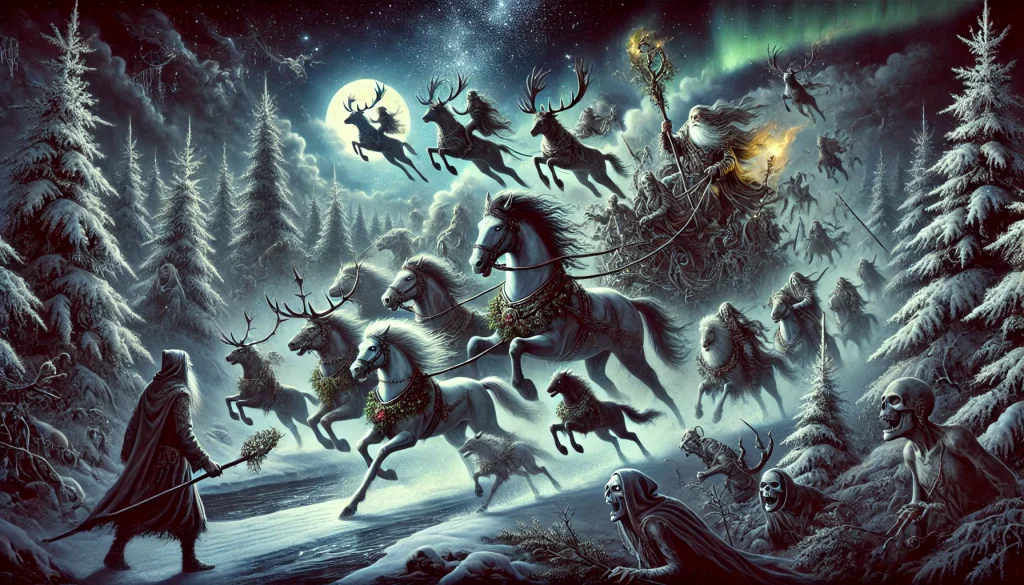
Across the old stories, the Wild Hunt tears through the winter skies like a living storm. Odin rides at the head of it, often astride Sleipnir, his eight-legged horse, with a host of riders and hounds behind him — a supernatural procession that feels half-myth, half-weather itself. The howling winds become voices. The snap of branches becomes hoofbeats. And the dark feels… crowded.
Boots by the hearth, gifts in return
There’s a charming folk custom tied to this night: children leaving boots near the fire with treats for Sleipnir, and receiving gifts in return. You can absolutely see how these older threads might echo into later winter traditions — stockings by the hearth, leaving snacks, magical gift-givers, even the idea of an otherworldly rider crossing the night sky. Not “proof,” not a straight line, but the same kind of ancestral storytelling rhythm.
Not just a cozy tale
The Wild Hunt isn’t only a whimsical winter story. In wider European (especially Germanic) folklore, it can be a spectral host of the dead, moving through the twelve nights — sometimes as a warning, sometimes as a reminder, sometimes as a force that sweeps up what’s out of place.
And Odin embodies that contradiction perfectly: he’s a god of wisdom and sovereignty, but also a god deeply tied to death, spirits, and the unseen roads. In the Hunt he becomes both harvester and guide — the one who rides between worlds, gathering, guarding, and sometimes terrifying the living into remembering what’s sacred.
Odin, Jólnir, and the spirit of Yule
One of Odin’s many names is Jólnir — often understood as “Master of Yule.” That alone tells you how closely he’s woven into this season.
Yule has always carried two truths at once:
It’s a midwinter feast, a defiant act of life in the dark, and it’s a time for the dead, when the veil feels thinner and the ancestors feel near.
The midwinter offerings aren’t just “celebration.” They’re a real spiritual wager: we give what we have now, trusting that the gods, the land, and the turning wheel will restore what’s needed later. The Hunt, in that sense, becomes part of the cosmic machinery — the movement of life, death, and rebirth.
Some traditions call the riders “the furious army,” which fits Odin’s own epithet as “the Furious One.” And Sleipnir, the eight-legged traveler, isn’t just a cool mythic detail — he’s a symbol of Odin’s shamanic power: movement through both physical and spiritual realms, without permission from ordinary limits.
The living, the dead, and boundaries
Ancient people didn’t romanticize winter. Long nights and harsh weather brought danger — and the unseen felt closer. Ancestors could be protectors, yes… but not every wandering spirit was welcome.
So the Wild Hunt carries a boundary lesson:
- honor the dead
- feed what must be fed
- don’t wander into the dark careless and unshielded
Offerings of food and drink weren’t only devotion — they were protection and reciprocity. A way of saying: “We respect the roads you travel. Bless this home. Pass us by.” Some folk customs even speak of leaving offerings out in liminal places — the treeline, the edge of the forest, sometimes set in small boats — a symbolic “sending” into the otherworld.
Remembering the dead, welcoming the light
This is one of the reasons Yule hits so deeply: it makes space for grief and hope in the same breath. We remember who we’ve lost, and we also celebrate the return of the light — not because everything is fixed, but because the wheel keeps turning.
So if you leave something out tonight — do it with intention. Under the tree, by the hearth, outside at the doorstep. Not just “for Santa”… but as a nod to Odin Jólnir, and to Sleipnir, and to the older winter roads that still hum beneath our modern holidays.
And yes — if you want to leave cookies out, I won’t stop you. Just don’t forget the eight-legged horse.
Poem: The Wild Hunt
When the winter winds howl and Yule fires blaze bright,
Best to stay indoors, safe from the night.
For those who wander the dark Yule-tide paths
May hear the rustle of branches’ wrath.
Is it the wind through the trees, or more?
A spectral host on the hunt’s great chore?
The barking of hounds, the hooves of dark mares,
Fire flashing as the furious army tears.
– Kveldulf Gundarsson, “Mountain Thunder,” 1992
May your home be warm, your hearth be bright, and your thresholds be strong.
May Odin Jólnir ride the high roads of the sky and pass you by in blessing, not in burden.
May the restless winds carry away what doesn’t belong,
and may the returning light find you steady, protected, and unafraid.
Hail the Hunt — and hail the turning of the wheel.