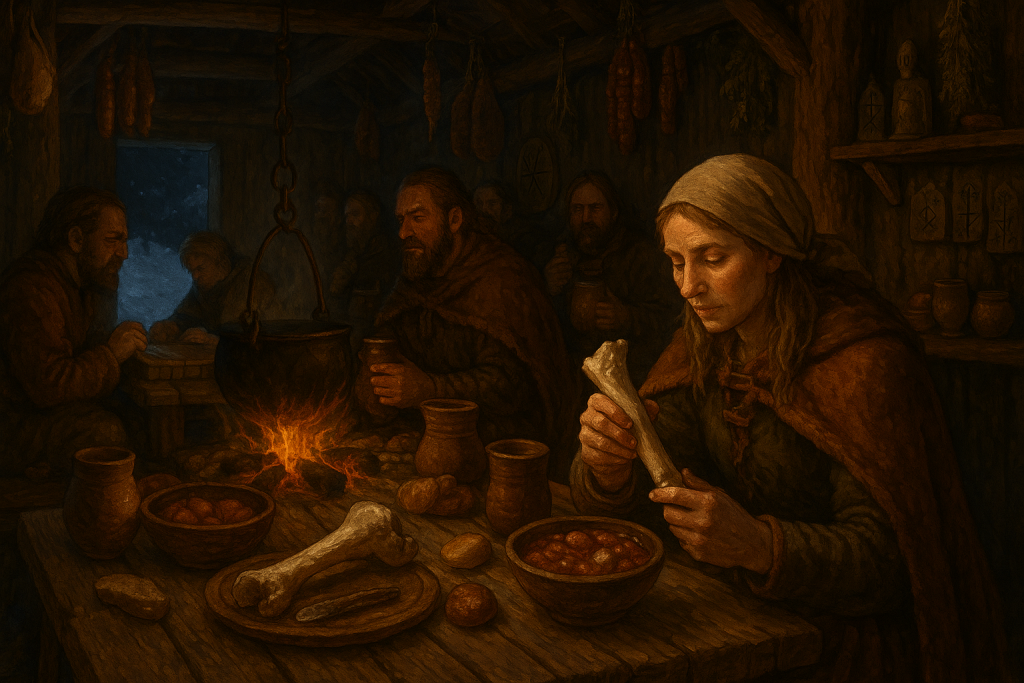
The bones are cracked, the kettles simmer, fat gleams in the firelight. In Mörsugur, we honour what sustains us when the world is cold and lean.
In the old Icelandic calendar, Mörsugur was one of the toughest and most important winter months. Its name, often translated as “fat-sucker” or “bone-sucking month,” refers to a time when people relied on every bit of stored food, especially animal fat and marrow, to survive.
Mörsugur falls in midwinter, roughly mid-December to mid-January in our modern calendar. It is the third winter month of the Old Norse/Icelandic year, following Gormánuður (Slaughter Month) and Ýlir, and overlapping with the deep Yule tide. It usually begins on Odinsdagr (Wednesday) on the 9th week of the Norse winter period, which is usually between the 20th and the 27th of December.
Names and Meanings: Fat, Yule, and Rams
The Old Norse name Mörsugur (or mörsugr) is generally understood as:
mǫrr / mör – fat, suet, marrow
sugur / sugr – sucker, one who sucks
Together, these words mean “fat-sucker,” likely referring to the fatty foods consumed during Yule and winter, when marrow, suet, and preserved meat were essential for survival.
In different sources, the month is also called:
Jólmánuðr / Jólmánuður – “Yule Month”
Hrútmánuðr / Hrútmánuður – “Ram Month”, since sheep are in heat at this time.
These other names each point to a different part of the season:
Jólmánuðr underlines its close association with Jól/Yule, the great midwinter festival.
Hrútmánuðr refers to the sheep breeding season, reminding us that even in the coldest time, the next generation is already on its way.
Some modern writers call Mörsugur the “second Yule month”—Ýlir leads up to Yule, while Mörsugur continues the celebrations deeper into midwinter.
Life in the Bone-Sucking Month
By Mörsugur, autumn’s fresh harvests are long gone. Fields lie frozen or sodden, and no new crops are coming in. Whatever people eat now has been salted, smoked, or dried earlier in the year, stored as grain, root vegetables, and preserved foods, and drawn from animals – meat, fat, marrow, dairy, and eggs when available.
In this setting, the name “fat-sucker” really fits. Animal fat and marrow provided high-calorie nutrition when the cold burned through energy, and few other rich foods were available. Cracking bones and eating the marrow was practical, and in many cultures, it was also seen as a treat. It was a way to make sure nothing was wasted.
Some modern heathen writers talk about “bone-sucking ceremonies” or marrow-feasts as symbols of luck and renewal during this season. These ideas fit the themes of the time, even if the rituals are mostly modern creations rather than direct traditions from medieval sources.
Feasting, Games, and Winter Pastimes
Even though the season was harsh, Mörsugur was not just a gloomy time. It kept many of the social and festive traditions of Yule going:
Feasting and drinking around the hearth and the high table
Sharing preserved meats, sausages, cheeses, legumes, and stored vegetables
Mead, ale, or later glögg-type spiced drinks warming cold bellies
Long, dark nights encouraged indoor entertainment, including:
Dice and board games, including early forms of hnefatafl (Viking “chess”)
Storytelling and song, with sagas, family tales, and heroic poems passed down by lamplight
Music, dancing, and friendly contests, both inside and outdoors, when the weather allowed
In northern areas, people also enjoyed winter sports when there was enough snow and ice. They went skiing, sledding, played in the snow, and found ways to have fun with the winter instead of fighting against it.
The Religious and Magical Side of Mörsugur
Spiritually, Mörsugur sits at a potent crossroads: The longest night has passed, but winter is still deep and dangerous. The sun has turned, but its strength is only just beginning to return. Food and fuel stores are being tested, and people are acutely aware of fate, luck, and divine favour.
Many modern practitioners associate Mörsugur with:
Odin, as the leader of the Wild Hunt and the god of winter journeys, wisdom, and death.
Thor, for protection from storms and the threats of the season.
Freyja and Freyr, as Vanir deities of fertility, survival, and the quiet promise of returning growth.
The dísir and ancestors, whose guidance and protection are sought in dangerous months.
Some modern accounts mention runes carved on branches for luck in the new year, the lighting of sacred fires at midwinter. Offerings of food, drink, or symbolic gifts to the gods, wights, and ancestral spirits.
Whether these practices are old or newly created, they all share the same feeling: people look for blessings, protection, and good luck when life is at its hardest.
Mörsugur Today: Carrying the Old Themes Forward
Most of us don’t need bone marrow and suet to get through January anymore, but the spirit of Mörsugur still fits well with modern life.
You might honour this month by:
Cooking hearty winter foods that use the whole animal or plant, like stews, broths, roasted root vegetables, rich plant-based meals, and traditional winter sausages or puddings.
Practicing mindful meat-eating: if you eat meat, choose ethical, well-raised sources, use as much of the animal as you can, and take a moment to honour the life that provided your food.
Celebrating time together indoors with game nights, storytelling, reading sagas out loud, or hosting cozy gatherings by candlelight or fire.
Making offerings: a bowl of stew by an outdoor stone, a splash of mead on the earth, candles and bread on an ancestor altar.
Practicing midwinter magic or divination, like working with runes, tarot, or dream interpretation, to focus on getting through the rest of winter and looking forward to spring.
In many Nordic countries, echoes of this time survive in:
Seasonal dishes like blood sausages or rich winter stews
Hot drinks such as glögg (gløgg) are served from Yule through the darkest months.
Ongoing customs of lighting candles against the deep dark, sharing food, and gathering in close circles indoors.
The Lesson of the Bone-Sucking Month
Mörsugur reminds us that survival comes with a cost, and it’s important to remember this—not to scare us, but to help us feel grateful. When resources are precious, like food, energy, or time, nothing should be wasted. Even in the depths of winter, life goes on quietly. Rams are breeding, seeds wait in the frozen ground, and the sun, though still weak, is slowly returning.
Honouring Mörsugur means giving thanks for your food, recognizing the lives and work behind every meal, and finding joy in warmth, togetherness, and shared stories while winter rages outside.
Mörsugur Ritual – Bone, Fat, and Midwinter Strength
This is a Norse-inspired rite for honouring what sustains us in the deep cold that you can use.
This ritual is meant for Mörsugur, the Bone-Sucking Month – roughly mid-December to mid-January, or any time you feel the deep weight of winter, the need to honour what keeps you alive (food, warmth, kin, spirit), or a pull toward ancestor, animal, and survival themes. It’s especially suited to an evening when you’re cooking a hearty winter meal, or working with bones, broth, rich foods, or their vegetarian equivalents.
What You’ll Need
Adjust this for your own diet and practice. The ritual can be meaningful without being graphic.
1 candle in a deep colour (dark blue, black, brown, or deep red)
A small bowl of something rich and sustaining, for example, bone broth, stew, or a small piece of meat with bone. OR for a veg option: thick bean stew, mushrooms, nuts, or a very rich root-veg dish.
Offerings:
A clean bone (soup bone, chicken bone, antler) or a carved/symbolic “bone” talisman
A piece of bread or flatbread
A cup of drink – mead, ale, cider, or warm herbal tea
Symbols of Odin, Thor, Freyja, Freyr, or your winter gods
Runes like Uruz (ᚢ) for primal strength, Algiz (ᛉ) for protection, Jera (ᛃ) for the year’s turning
Create a small altar on a table or near your cooking space.
- Opening the Bone-Sucking Month
Place your candle in the centre and light it.
Take three slow, steady breaths. Notice the depth of winter in your body: the stillness and the cold outside your walls.
Say:
“This is Mörsugur, bone-sucking month, midwinter of the North. When the fields are bare and the nights are long, we live on what was stored, on fat, marrow, and memory.
I kindle this light to honour the food that sustains me, the lives that were given, and the strength that carries me through the dark.”
- Hallowing the Stead
If you use the hammer sign, trace a small T-shape in the air above the altar.
“By hammer’s ward and holy will, may this place be hallowed. Between hunger and plenty, between life and death, let this stead be safe and sacred.”
Pause and let the space “click” into ritual mode.
- Honouring the Animals and the Cost of Survival
If you have a bone or bone-symbol, hold it gently in both hands. If not, place your hands over the bowl of rich food.
“To the animals whose bodies feed us, to cattle, sheep, goats, pigs, birds, and fish,
to all whose lives become our strength: I see you. I honour you. I thank you.”
If you’re vegetarian/vegan, you might add:
“Even when I do not eat your flesh, I honour you as kin and companions, sharing this world, shaping its stories and my own.”
Take a quiet moment to truly appreciate all the lives and efforts behind your food: animals, plants, soil, farmers, workers, transporters, and cooks.
“May I eat and live in a way that honours the cost of my survival, and wastes as little as I can.”
- Blessing the Marrow of Winter
Now focus on the rich food in front of you, whether it’s stew, broth, mushrooms, beans, or whatever you have chosen.
“This is my marrow in Mörsugur – the dense strength that keeps me going
when the world outside is cold and lean. In this month of fat and bone, I bless all that sustains me.”
Name, aloud or silently, the “marrow” of your winter:
Actual food and drink
Warmth (heating, blankets, safe roof)
People who support you
Income, skills, or resources
Spiritual practices, deities, and spirits who keep you going
As you name each one, picture a thin thread of candlelight moving from the flame into your bowl of food, filling it with gratitude.
“May these supports hold. May they be enough. May they be used wisely. May I remember I am not alone in this winter.”
- Gods, Wights, and Ancestors of Midwinter
Call in the powers you feel around Mörsugur. For example:
“Odin, Allfather, winter wanderer, rider through storm and snow, be welcome at my hearth. May your hard-won wisdom guide me through the deep cold.”
“Thor, friend of farmers, defender of Midgard, shield this home from storm, frost,
and all that would harm us this season.”
“Freyja and Freyr, Vanir of life, love, and quiet growth beneath the earth, be honoured in this dark time when the next year’s life stirs unseen.”
“Dísir and ancestors, who knew hunger, cold, and long winters, sit with me now. Teach me courage, frith, and gratitude.”
Set aside an offering of the food and drink as offerings on the altar.
- The Bone-Sucking Act (Symbolic or Literal)
If you’re comfortable and it fits your practice, take a small bone with a bit of meat or marrow, or a chunk of your hearty food if you’re not using bones. Hold it up and say:
“In Mörsugur, they cracked the bone and sucked out the marrow, wasting nothing,
honouring the life that fed them. I do this now in memory of them, and in honour of what sustains me.”
Take a slow, mindful bite, or sip of broth, or mouthful of your chosen food. As you eat, imagine you are drawing in strength, endurance, and the will to keep going through the rest of winter.
If you prefer to stay purely symbolic, you can simply touch the bone/food to your lips and then place it back as an offering, speaking the same words.
- A Quiet Oath to Yourself
Mörsugur is also a reminder not to waste what you have, whether it’s food, energy, or time. Take a moment to make a small, realistic vow for the rest of winter, such as:
“I will waste less food.”
“I will treat my body more kindly.”
“I will rest when I’m exhausted instead of pushing to collapse.”
“I will reach out when I feel alone.”
Place your hand over your heart and say:
“In this bone-sucking month I make this small oath to myself: [state your vow]. May I keep it as best I can, for my own well-being and for those who share this world with me.”
- Closing the Rite
When you feel complete, thank those you’ve called:
“Odin, Thor, Freyja, Freyr, and all holy powers of winter – thank you. Landvættir and house-wights – thank you for your watch in the dark. Dísir, ancestors, and beloved dead – Thank you for your strength and example. Go if you must, stay if you will,
In peace and good friendship between us.”
Blow out the candle, saying:
“The rite of Mörsugur is ended; The strength of Mörsugur remains. May I be fed in body and in spirit until the light grows stronger again.”
Later, take the small portion of food and drink you set aside and offer them outside – at a tree, stone, or crossroads – with a final quiet:
“For gods, wights, and kin. Thank you.”
References:
Andreas Nordberg – Jul, disting och förkyrklig tideräkning: Kalendrar och kalendariska riter i det förkristna Norden (Yule, Disting and pre-Christian time-reckoning: Calendars and calendric rituals in pre-Christian Scandinavia)
Terry Gunnell – Old Norse Religion in Long-Term Perspectives: Origins, Changes, and Interactions
Reverend Björn Halldórsson – Atli
Snorri Sturluson – The Prose Edda
Tags: #OldNorseCalendar #VikingTraditions #NorseFestivals #Heathenry #NorseMythology #Yule #Midsummer #WinterNights #PaganHeritage #LunarCalendar #NorsePaganism #EarthSpiritTarot