When the veil grows thin this Samhain, soft whispers coil through the shadowed barrows of the North.
The restless dead are said to stride once more, the draugar of Norse legend.
Not quite ghost and not quite demon, these old revenants claw up from their graves, dragging the echo of unfinished lives and the cold of the otherworld.
Their tales warn that the line between life and death is slimmer than we dare assume…
Though the old Norse never marked Samhain, they surely venerated the departed and the forebears. Settle in while I weave a story of the Norse Draugr.
The Draugr: Undead Guardians in Norse Lore
Within the dim corridors of Norse myth, few beings stir more unease and more fascination than the Draugr, the undead of the Viking Age.
Not ghost and not zombie, these revenants are something far more tangled: wardens of funeral mounds, holders of old grudges, and uneasy souls refused rest.
Their stories ring through Icelandic sagas and broader Scandinavian lore, baring firm beliefs about death, honor, and the frail veil that parts the living world from the realm of the dead.
What Is a Draugr?
The term draugr (Old Norse), at times spelled draugur in Icelandic or dreygur in Faroese, is believed to signify “one who walks again” or “rider after death.”
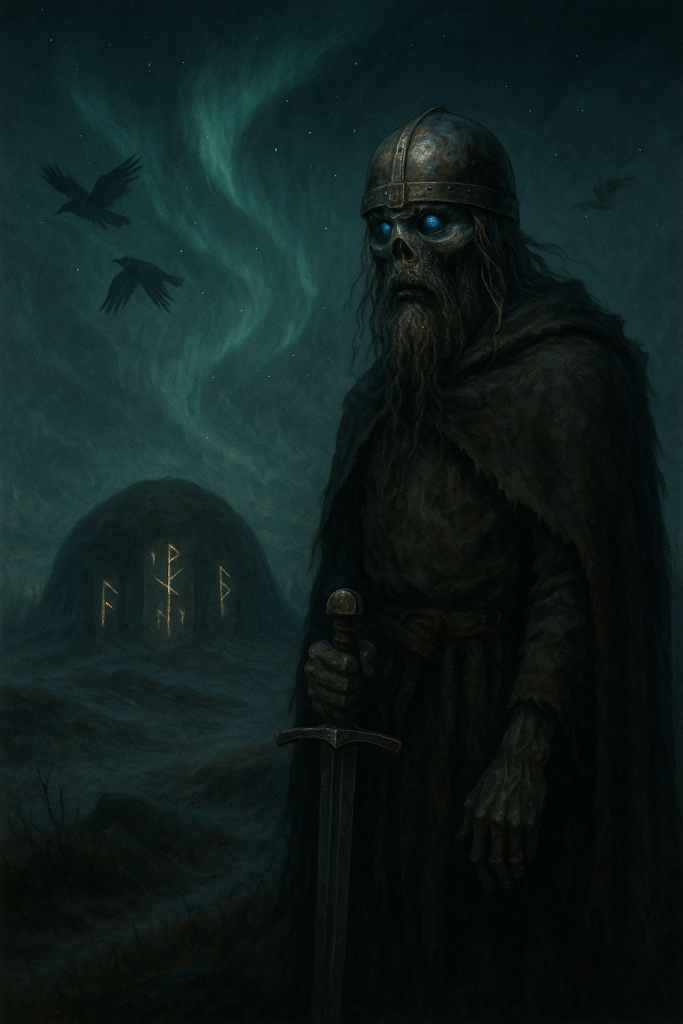
Unlike airy spirits, draugar hold a solid form along with uncanny powers. They climb from the tombs bloated and black, at times described as large as an ox or even a skinned bull, foul decay and fierce might blended as one.
Draugar were called “the dead without status”, those who had missed proper rites, lost life by violence, or carried souls heavy with spite, greed, or work unfinished. With peace denied, they lingered near their barrows, guarding hoards and punishing any who dared disturb them.
In pre Christian Norse belief, that idea tied closely to ancestor veneration: the thought that the dead stayed potent and might bless or curse the living depending on how they were treated.
Origins: How One Becomes a Draugr
Becoming a draugr unfolded as a spiritual shift as surely as a bodily one.
Many roads could open to this uneasy destiny:
Unfinished Business or Curses: Souls who perished clutching rage, envy, or wrongs were thought to step back into the world.
Improper Burial Rites: When the needed rites were absent, a spirit might fail to pass quietly into the next realm.
Contagion of the Undead: Certain stories claim that meeting a draugr or even touching its mound could “infect” the living, chaining them to the same doom.
The word aptrgangr, literally “one who walks after death”, sums up the chill idea. It shows the Norse view that death was not always final, it was a doorway that might, under some terms, open once more.
Form and Nature of the Draugr
Tales paint draugar as foul and fearsome, their corpses black, bloated, and stinking of rot. Yet they are no witless brutes. They carry sharp minds, clear memories, and a keen sense of the lives they once lived.
Their raw strength lets them crush warriors or cattle with ease, and their magic is potent. In many sagas, draugar are said to wield the following arts:
Shapeshifting: taking on shapes human or bestial to unnerve trespassers.
Weather Control: calling forth fog, storm, or sudden night.
Prophecy and Second Sight: reading the destinies of those they meet.
Supernatural Strength: bending iron or flinging men as if they were straw.
Some legends say the draugar wander far from their barrows, trailing sickness or frenzy across the land until a rite drives them back or a new death fells them again.
Burial Rites and Protection Against the Undead
To the Vikings, burial stood as a holy duty that guarded both the peace of the dead and the safety of the living. A bad burial risked stirring a draugr, so many safeguards sprang up:
Binding the Toes or Legs: a cord or cloth tied feet tight so the body stayed still.
Iron Objects: items like scissors, nails, or blades set in the grave to ward off bleak powers.
Grave Orientation: the corpse might be laid facing north, the quarter of death, thus it could not find the road back home.
Mound Guardianship: treasure went into the earth with the fallen, yet raiding a mound was fraught. Any who broke the soil risked the fury of the undead warden.
All these measures show how closely Norse faith and down to earth dread of death and the after place were braided together.
Tales from the Sagas
Medieval Icelandic texts keep chilling records of draugar and of souls brave, perhaps foolish, enough to meet them.
Grettis Saga
Among the most famed stories is that of Grettir the Strong, who clashes with the draugr Glámr. Cursed, Glámr stalks the countryside, spreading blight and fear. The encounter is fierce and fateful, and though Grettir prevails, the draugr’s final curse trails him for the rest of his days.
Eyrbyggja Saga
Elsewhere, a whole settlement suffers waves of revenant unrest. Corpses climb from graves until a priest performs the right rite to settle them. The tale stands as a sharp warning about proper burial and reverence for the departed.
Across such stories the draugar appear not only as terrors but as moral mirrors, holding greed, violence, or shame in place long past the grave until someone dares face it.
Are Draugar Truly Evil?
Today we might rush to label draugar as evil, yet Norse myth seldom works in simple black and white.
Their acts, from haunting the living to guarding a mound or chasing vengeance, often grow from duty, fury, or clinging ties rather than pure spite.
For Vikings morality shifted. A draugr could be a monster to be sure, yet at times a warning or even a guardian, all depending on the moment. Their presence smudges the border between curse and consequence, echoing the Norse sense that each deed in life echoes after death.
The Symbolism of the Draugr
Beneath the horror the draugar point to deep truths at the heart of the Viking outlook:
The Power of Legacy: the deceased stay linked to the living, for good or ill.
The Importance of Ritual: correct honor and memory keep the realms in balance.
The Cycle of Life and Death: even as flesh decays life’s spark persists, a lesson heard in both the old faith and the later Christian lore.
In this light the draugr stand not merely as undead beings but as keepers of outcome, proof that death closes no tale yet instead extends the thread we spin while alive.
Shadows Beyond the Barrow
As autumn sinks and the veil grows thin the draugr tales ring louder. They teach that the dead never stray far from the living, and that memory, honor, and regard for the past shield our walk through gloom.
The Vikings trembled at the draugr’s might, yet they caught its meaning:
live with honor, meet death in peace, salute those who walked before, or risk joining the restless who watch from the soil.
And perhaps, when wind howls across the mound lit fields this night, it is not only the storm you hear… but the whisper of a draugr standing guard.
Bibliography
Chadwick, N. K. (1946). “Norse ghosts: A study in the Draugr and the Haugbúi”. Folklore.
“Ritual and Hierarchy in Old Norse Mythology”, (John Lindow, 2022, p. 51).
Glámr in the Grettis saga
Bennett, Lisa (2014). “Burial Practices as Sites of Cultural Memory in the Íslendingasögur”. Viking and Medieval Scandinavia
Ellis, H. R., Davidson, H. R. E. (2013). The Road to Hel: A Study of the Conception of the Dead in Old Norse Literature. United Kingdom: Cambridge University Press.
Tags: Draugr, Norse Mythology, Norse Pagan, Viking Lore